Lushlife at Johnny Brenda’s on Friday.
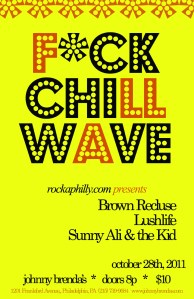
 This week, Philadelphia hip-hop artist Lushlife released his latest mixtape entitled No More Golden Days. He will perform at Johnny Brenda’s this Friday, October 28th with Brown Recluse, and Sunny Ali and the Kid. Our Ashley Hall caught up with him to talk about everything from his new release to why he’ll never leave Philly.
 How did the name Lushlife come about?
I grew up playing a lot of jazz. I was in jazz band in middle school and high school. The early hip-hop that I was into was pretty jazzish, A Tribe Called Quest, Black Moon and stuff. And Lushlife is actually a reference to Duke Ellington Song and it’s fitting I think about stuff I rap about. I feel like there’s a sense of romance in a lot of the stuff that I rap about. It’s like really lush kind of ideas that I like to weave together. So I just thought it was fitting in a metaphorical way.
What inspired you to become a hip-hop artist?
I’ve been playing an instrument for any portion of my life I can remember. I started playing piano when I was five or six and it’s kind of always what I felt I would do. Even at the youngest age I was so obsessed with music and I just never even thought of doing anything else. There just wasn’t really any question in it. So I was going to school for music for a little while and get the opportunity to release a record in London and I left school and started making records for the last 10 years.
What are your thoughts on Philadelphia as a music scene? Why stay here?
Its really become a huge part of me, even growing up I was a huge fan of The Roots, of course, and Black Thought is definitely one of my top three MCs. Even at the youngest age I totally looked up to him. I just think he fucking kills. Also, like the Philly’s soul sound from the 70’s is something that really informs my production. Just being here its like the perfect life for me. I love the music scene. I love the city. As much as I like New York, I’m in New York a lot for playing and stuff. A piece of life in Philly just suits me so well, and that’s why I’ve been here for going on more than half a decade.
How would you say Golden Days is different from Cassette City?
When I started making records I was making really classic sounding hip-hop. The last album, Cassette City, was a departure from that where I was exploring indie soundscapes but really keeping the core hip hop element alive. But No More Golden Days I’m sort of stepping even further away and I’m doing a lot of stuff with lo-fi recording techniques. Everything was recorded to tape and I don’t think you’ll see that in many hip-hop releases these days. And I worked with dudes from Titus Adronicus and Brown Recluse who are a Philly band and in the future Das Racist, which are on the hip-hop side. I think hip hop artists kind of step into indie territory, but it begins and ends at sampling MGMT. Growing up I was listening The Pixes and The Smiths, so it’s very natural for me to meld the worlds of indie music and hip hop in a way that I think isn’t just like indie music with touches of hip hop, or hip hop with touches of indie music. I like to think I achieved that with No More Golden Days.
Did you feel making a mixtape gave you more freedom?
I was always hesitant to working in a mixtape format. I wasn’t ever going to just make a record and just throw it out there. It was going to be a real commitment of time. So with a mixtape, you’re going to spend a ton of time making it, why not make just make a real full-on record release? But as I started to explore the mixtape format, I realized that there was actually more creatively open to me. Whereas making an album there all these restraints about sampling rights and copyrights and all sorts of bullshit. But just having the freedom beyond even sampling to be like, “Oh I love this Drake beat,” and to write some rhymes to it and put it on the mixtape, that’s freedom that you wouldn’t have with an album. So I got to use lots of other people’s beats, rap over it, stuff that I could never get sample clearance for in that context. So it’s been great. And it’s good to put something like that out there. That’s why I was to able to make something so robust. Like a 17 track piece for me, if it were all 100% original production, would’ve taken my ages. Like my last album took me two years.
Going off that, how do you take different bits of songs from vastly different artists and make them flow together so well?
Sometimes these things come to me really quickly, but sometimes it’s a little bit arduous. For example, I did this track where I have Frank Ocean’s, “Beats For Novocain” playing and I sing a refrain from a Fleet Foxes song over it. That was sort of belabored. I knew I wanted to use that Frank Oceans instrumental, I thought it was incredible and it fit the vibe of my mixtape very well. And I knew I wanted to do something different with it and I’m a big Fleet Foxes fan. It didn’t quite occur to me for a while and when I started singing Mykonos over it, it totally fit. So sometimes it works really quickly and sometime it takes forever to find something that works.
I saw this mixtape had a ton of collaborations, who was your favorite to work with?
Oh man, there were so many dudes that were incredible. Dice Raw from The Roots crew. He’s definitely an artist I admired as a kid. As a thirteen-year-old I had his records memorized, so to be able to work with him is pretty surreal. Heems from Das Racist of course is like killing it right now and a track we did, just premiered on Spin today and I really love that joint. On the indie side, Brown Recluse, you know, Philly bands. I’m actually playing with them Friday for the Rockaphilly event. They live around the corner from me and they are just incredible musicians in their own right. Tim the lead singer did some incredible production on the record so it’s a good sort of grab bag of incredible artists that I just personally love.
What did you want to convey to the listener through No More Golden Days?
I think a lot of dudes especially in the framework of hip-hop, they are going for a 90’s kind of sound. They’ll just like use the same sonics that artists did in the golden era of hip-hop. I don’t like to just be brought back to something by something that sounds exactly like that older sort of stuff. And what I wanted to do was kind of recreate a sense of nostalgia, like give people the chills, but not because they were feeling nostalgic about something. So I guess in essence what I wanted to do was try to create records that give you the chills. And I don’t know if I’ve at all achieved that with anybody, but if I have pushed even a few people, that’s exactly what I am going for.
Do you feel hip-hop is changing as a genre? How so?
Hip-hop is always evolving and changing and I personally go through periods of loving it and not listening to it as much. I think what’s great about the internet is basically whatever is going on the pop side, what’s being played on power 99, may not be the best shit, but I really think that the internet allows so many artists to flourish. You don’t have to dig too far and you’ll find incredible, incredible musicians. So I think hip-hop is alive and well and just like every other art form it’s going through growing pains, changing, and it’ll swing back around. And I think the title No More Golden Days is kind of a reference to the idea that people look back on 90’s as a period that’s never gonna come back again and I don’t think it necessarily should come back again. Like who cares? Its over, it’s been done. It was incredible. It informed my sound in a huge way, but there’s no need to rehash it. So move forward and keep that as part of the culture.
Lushlife’s mixtape is available FOR FREE on his bandcamp as a digital download, and also as a limited edition cassette.
Comments are closed.


 JUMP: The Philly Music Project
Read this, immediately downloaded. “Free album” was the kicker.