METZ with Bully and So Pitted @ The Church.
 Text by Bryce Woodcock. Images by Rick Kauffman.
Toronto’s METZ unleashed sonic apocalypse from the pits of the First Unitarian Church basement at a routinely teeming, sweaty and deafening show last week.
The appearance was part of their tour with Nashville’s post-grunge power-pop outfit Bully and incipient labelmates and Seattle natives, So Pitted.
So Pitted opened the show exhibiting their distinctive approach to a sound that every Seattle native absorbs through osmosis. It’s something dark and noisy and brooding — call it “Pacific Northwest Noir” — that would be misleading to designate “grunge,” as the term is used today. The first song of their set, “The Sickness,” started at an impossibly slow pace with Jeannine Koewler’s chest-compressing guitar played through a bass amp outlining a progression and lead singer Nathan Rodriguez slurring words over the top. It then abruptly surged into an anti-melodic, nearly atonal but structured noise assault that’s energy carried through almost the entire performance.
Mid-set, drummer Liam Downey swapped his sticks for lead guitar and vocals, churning out a couple of his detached and monotone portraits of the void as told by rhythmic drum blasts, pulsing low-end fuzz and squealing feedback.


Bully, fronted by Alicia Bognanno, whose sound was reminiscence of the 90s alt-rock that put glam rock in the grave for good, played second. A grunge-tinged four-piece with power anthems accented by Bognanno, whose crooning clashed with heart-felt squeals, Bully was full of punch-you-in-the-face emotion. Hailing from Nashville, TN, which remains a musical hotbed of cross-genre creative influence, Bully was a perfect match with road-mates in So Pitted and METZ.
METZ creates a sound far greater than the sum of their parts — guitarist Alex Edkins, drummer Hayden Menzies and bassist Chris Slorach. The trio unleashed a hard-hitting set spanning their full discography. Their chug-loving brand of noise rock was an unrelenting barrage that would have made Sub Pop forerunners Nirvana proud. They were raw and at times viscous and unforgiving. Edkins thrashed his Fender Jazzmaster in a fashion its creator may have not intended but was certainly designed to withstand.
METZ ended their tour with Bully and So Pitted on Saturday in Chicago, but they’ll pick back up in Singapore when the Toronto trio takes on New Zealand and Australia in February.


Rittenhouse Soundworks: Arts in Progress.
 Text by Brendan Menapace. Images by Jason Melcher.
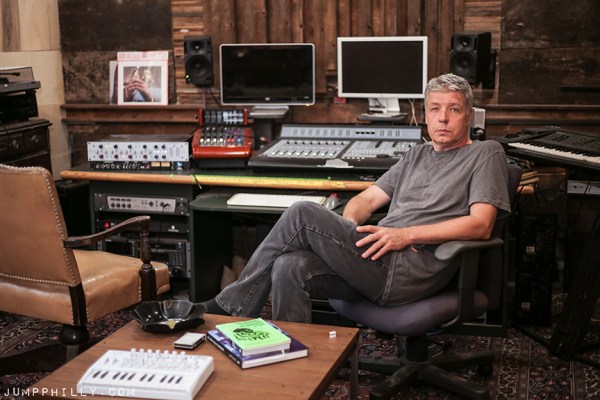
Jim Hamilton appreciates the creative process. He sees the value in creating music organically in a room with other people. The beauty in music is hearing the time, effort and collaboration within. His studio in Germantown, a work in progress in itself, reflects that.
Hamilton, 57, of Germantown, explains the history of his new studio space on Rittenhouse Street—the aptly named Rittenhouse Soundworks—as he opens the door to reveal a large empty garage.
“This building was built by Chrysler in the turn of the last century,” Hamilton says, gesturing to the expansive room. “So, where it once was a symbol of the industrial revolution, now it’s a symbol of manufacturing art.”
Hamilton speaks very softly, as if he’s trying not to wake someone up. His eyes widen and he begins to speak with passion when he gets onto a topic that interests him. He says he can go on for hours about things like percussionists and the evolution of musical styles across the world. Every now and then, when he references an old piece of music, he’ll mimic a saxophone melody or pat out a drum rhythm on his knees.
Hamilton grew up around the arts. While coming of age in Kensington, his father was a professional tap dancer, so Hamilton grew up in a dance studio and got his own start in music tap dancing.
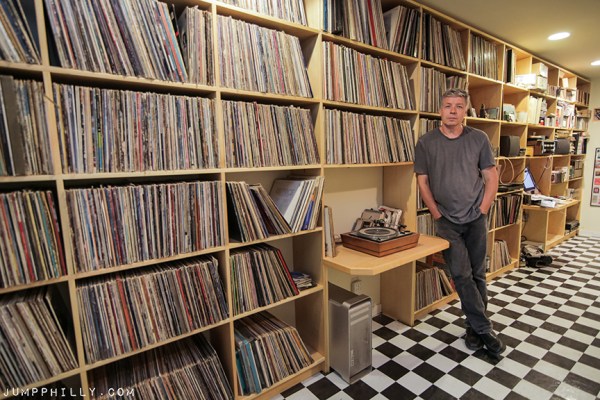 The library in his studio, filled wall-to-wall with records, is where interns will eventually be working on radio broadcasts out of the studio. Hamilton says the room is a recreation of the environment he grew up in. His father sold turntables and taught tap, with renowned dancers from all over the world coming into his family’s studio to teach.
Hamilton has a wealth of musical history knowledge. He knows about how Appalachian dance meshed with a Cherokee flat foot dance and evolved into tap, and how tap is the reason the drum set exists in America. He knows about how old Irish rhythms made their way to the rest of the world and created new styles. He rattles off countless musicians many have never heard of. And he says if you want to learn about history, you follow the music.
“You don’t really learn about it in school, because they don’t really teach culture,” he adds. “Information isn’t knowledge. It’s how you connect that gives you the awareness.”
With so much creativity and encouragement in his family, Hamilton says that the arts became a way of learning about himself.
“My parents instilled in [my siblings and I] this mentality with talent, you can go anywhere,” he says. “So it was kind of expected that you would find out who you were as an individual and then do that. So it wasn’t said, but it was implied, that you were going to find your place through this improvisation.”
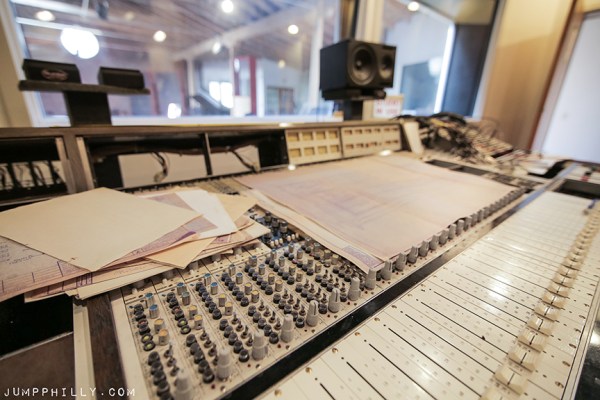
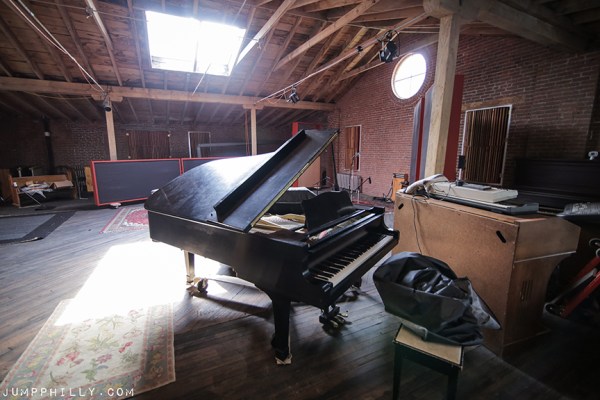 The main recording studio at Rittenhouse Soundworks is one of the largest rooms in Philadelphia, in terms of open floor plan—approximately 5,000 square feet. Behind the studio, the control room has a mixing board that was used for the last three Sly and the Family Stone records. Thanks to detailed schematics, Hamilton and fellow Rittenhouse producer and engineer Brian Boland were able to fix the console themselves.
Though Rittenhouse Soundworks is still in the works, the studio is already drumming up business. Hamilton and Boland just finished recording a classical ensemble of seven musicians for a production of “Peter Rabbit Tales” at the Enchantment Theater Company, composed by Charlie Gilbert, who is the composer in residence for the company. The sound of French horn and trumpet bleeds into the room from the mixing room downstairs. It’s one of the more complete areas of the studio.
“It’s been great to be a part of the whole experience [of working at the studio,]” Boland says. “Jim and I always used to talk about it, and then he pulled the trigger and got the building and kind of lured me back from Los Angeles.”
Boland had been in Los Angeles for 10 years before moving back last October to work with Hamilton. He’s playing back takes from the Peter Rabbit project to Gilbert, who’s sitting with stacks of sheet music in front of him.
“I was excited to work here, first of all because I was completely captivated by Jim and his vision of the place when I came here,” Gilbert says. “I was really jazzed and wanted to be a part of it. And it offered us a big room where we could have seven musicians. I was looking for a big room with a good acoustic sound, and this really fit the bill.”
Hamilton smiles when he hears this. It’s clear that the studio is truly a labor of love to him. He does it to be a part of the creative process and make something special.
Going forward, the studio will be used to broadcast three online radio shows under the name Tension Rod Radio, named for Hamilton’s record label. The first release on his label was a percussion duo out of Rio de Janeiro.
Hamilton devoted his space and his time to something he believes in. He wants to use his facility to teach younger generations how to create something organic through art.
“You got empty chairs in the studio? There should be kids there, learning, so they can understand that this is how you be a producer,” he says. “We’re creating an environment here that supports learning. We learn from each other because everybody trusts and nurtures each other. And people come here to be a better them. You’re here because, whatever it is that you do, you’re here to give that away.”
Heritage: A New Home for Jazz.
 Text by Hannah Kubik. Images by Mina Lee.
Sitting on a black leather chair surrounded by red cedar walls, Terrance Leach, part owner of the restaurant and live jazz bar Heritage, begins to tell his story – one that starts 13 years ago after Leach moved from Newport, Rhode Island to South Philadelphia.
Leach met business partner Jason Evenchik while working as a waiter and bartender. Evenchik asked him to be the general manager of Time, a whiskey bar, restaurant and live music venue he was opening in Center City. That was more than seven years ago, before Time had lines out the door on weekends and Center City was in its nascent stages of the booming nightlife scene. The struggle to find talent was daunting.
“I really had to go out looking for dudes,” Leach says. “There weren’t a lot of places to hear live music like there is now.”
However, as Center City evolved, Time went from having bands play three to four times a week to seven days a week. Currently they have two bands per day, every day.
“Now I can build a band if I want to,” says Leach.
 Having pieced together the right blend of music, food and drinks at Time, Leach (above) and Evenchik applied this model to Heritage, located in Northern Liberties, which they opened this past April.
“People are drawn to the diversity,” says Maddy La Voe, who has been going to both Time and Heritage since their openings. “Because they combine many ideas in one building, there is something for everyone. Plus, there aren’t many places to hear live jazz anymore.”
For Evenchik, offering live music as opposed to using an iPod or records was never in question.
“There’s no comparison,” he says. “I listen to music constantly but nothing is as moving as a live performance. There are shows that bring people to tears and that is something you cannot get, typically, from a recording.”
For alcohol enthusiasts, Heritage offers nearly 100 types of whiskey and 36 draft beers. For foodies, the dishes utilize local, fresh, seasonal ingredients with a menu that changes weekly. For those seeking a venue with sound quality, the Heritage owners built a wooden clamshell shaped stage surrounded by cedar walls and sprayed the ceiling with K-13 sound-proofing, allowing each note to travel the entire length of the room.
“We don’t want people to come just for the music,” Leach says. “That would defeat the purpose of having a huge dining room. We want people to come for dinner and drinks, have a conversation, turn their chairs around if they want to and enjoy the music.”
What Leach and Evenchik create are not just music venues, but atmospheres. To fulfill their vision, they needed music that was neither loud and bustling nor sleep inducing. They found their answer in jazz, funk and soul.
“Jazz allows for the opportunity to turn it up and really get moving with organs, horns and vocals,” says Evenchik. “It’s a music that approaches funk and what we call the Philly sound.”
The “Philly sound” Evenchik refers to continuously echoes within the walls of Heritage and Time. It is produced by the local bands Leach booked years ago that still perform at the clubs today.
“I get calls from people all around the world asking to play because they heard the words ‘music venue,’” says Leach. “But if I were to bring in a bunch of new people in one month, all the people who have been loyal to me for years, all the local musicians, it’s like I’d be firing them. They wouldn’t get their gigs.”
This loyalty paired with family-style treatment is what Leach says separates their restaurants from other music joints in Philadelphia. He admits that while he may not pay the bands as much as other places, he covers their bar tabs and everyone is viewed as a family member. In addition to family treatment, the bands are given stylistic freedom.
“I don’t micromanage the musicians because I’m not a musician,” Leach says. “I understand music and I love it, but I hire them because they know what they’re doing. They’re the talent – you have to let them do their thing.”
Another significant factor that keeps bands returning is an appreciation for sound quality.
“We’re always getting compliments on the way our rooms sound,” says Leach. One saxophone musician, Tom Moon, who plays for them at both places but got his start at Time, continuously says how he loves the room.
“So eventually we named his band Tom Moon’s Love Room,” says Leach.
Looking back seven years, Leach never thought he would be recognized for his live music offerings. His goal at the time was to work with Evenchik to create an establishment filling a void.
“Years ago you couldn’t find a whiskey bar, restaurant and live music venue all wrapped up in one,” Leach says.
Today, Leach has a phone full of contact information for local jazz musicians like Luke O’ Reilly, Ernest Stuart, Tom Moon and Lucas Brown. Though there was no master plan or personal ties to jazz, this music genre has become an important pillar in the pair’s success. Symbolizing this is the chandelier that hangs in Heritage. It is constructed of old brass instruments Leach and Evenchik collected from various pawnshops and bids off eBay.
“I want to continue expanding it by ceremonially adding things to it, like on our one year anniversary, add a trombone, kind of like a Christmas tree,” says Leach with a laugh. “Who knows how big it will get.”
Archawah: Illinois Frontman’s Drops a Solo Album.
Nearly a decade after local pop/folk band Illinois dropped their first album, frontman Chris Archibald is releasing his debut solo project.
Performing under the moniker Archawah, Archibald will drop the album on January 18 and celebrate with a show at Bourbon & Branch on the 23rd.
Illinois will continue as well. They headline The Fire on Saturday, January 30.
The Holy Mess: Sitting on the Cusp of the Trash Age.
 Text by Vince Bellino. Images by Jessica Flynn.
Jeff Riddle is on the steps leading to his South Philly home when the other members of The Holy Mess – SteveO and Keith Yosco – show up.
In the basket of his bike, SteveO has a forty and a Smirnoff Ice, which he hands to Riddle.
Riddle has been “iced.”
It’s a well-known tradition— upon being presented with the drink, the receiver has to chug it. Riddle, the band’s guitarist and one of its vocalists, complains he wanted to sip the drink and enjoy it with a cigarette, but he will have no such luck. Dutifully, he gets down on one knee and chugs it.
“Tastes like Sprite,” he says, laughing.
The Holy Mess has made a reputation for the shenanigans its members like to be a part of, but the trio has also worked hard to build the respect they now hold both in the local punk community and in national and international circles.
The band formed in 2006 and has seen several different amalgamations in its almost 10-year history. Bassist and vocalist SteveO and drummer Yosco, the remaining original members, became friends as teenagers and have been playing music together since. With the addition of Riddle in 2012, the current lineup became solidified.
This past summer, the band headed to Brooklyn’s Converse Rubber Tracks Studio to record the follow up to their 2014 full-length, Comfort In the Discord. The new EP, Trash Age, deals with the dismal outlook for the world and its future.
“There was the Renaissance, the bronze age, the ice age,” says SteveO. “The next one coming is the trash age. We’re sitting at the cusp of the trash age. If you just look around, not only is it actual, physical trash in the ocean – like there is an island of trash in the Pacific Ocean – but it’s the things being said, the things being touted, the things you see on television, the things you hear on the radio. It’s all really trash. There isn’t a lot of substance anymore, in the way we feel. …We’re pretty much referencing this faux culture we live in.”
The Holy Mess will be self-releasing Trash Age, just as they did with their last full-length.
“It just boils down to what makes the band work the best,” Yosco says. “We can take what we earn as a band and recycle it back into the various projects we’re involved in.”
“We do our mail ordering ourselves, we book our own shows and release our own records,” says SteveO. “We do everything ourselves. After being around for as long as we have, we’ve learned a lot of what not to do. By doing things ourselves, it’s just way more direct.”
 The members of The Holy Mess have been playing music for decades between the three of them.
Having had the opportunity to play many places in the U.S., a European tour with The Menzingers and recently Groezrock Festival in Belgium, The Holy Mess takes all of their opportunities in stride.
“We’re afforded a lot of cool fucking opportunities, for sure,” Yosco says, adding that many of the places he’s been able to go in the world were because of music. “We don’t take anything for granted. We appreciate everything this band has allowed us to do, see and feel.”
The Cats: Make Music. Drink Beer.
 Text and images by Michael Bucher.
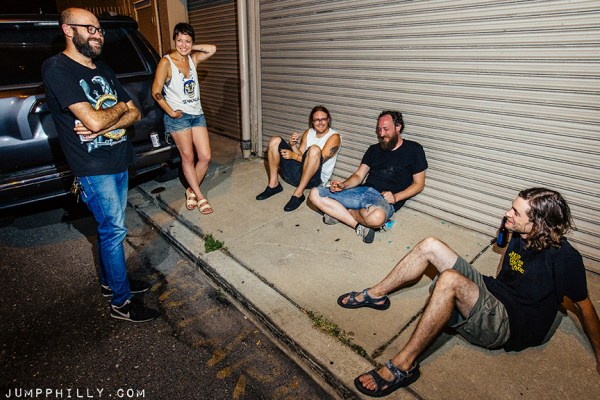
Sitting outside Titan House in the glow of a South Philly sunset, The Cats are drinking together before their set later tonight. There’s a case of Miller Lite retro cans and blue and orange bottles of MD 20/20, something the company calls a fortified wine. Drinking, The Cats agree, is consistently a part of their writing, recording and performing, and it works. When asked what they wanted from the band, Brett Green put it simply – “a good time.”
“I think the beer drinking has intensified since Brett – particularly Brett – and I joined the band,” says Greg Fowler.
The Cats are a group of friends who have known each other from a lifetime in the DIY music scene. Their ages range from 30 to 40, and none are caught up with worrying about making music to make money.
They just like playing shows and making records and getting drunk together.
Vocalist Manon Gordan and guitarists Ben Schorr and Colin (who doesn’t like associating his last name with the band because of “tin-hat type paranoia”) have only gone on tour once after their first album, Big America, was released in 2013.
In the last year, the band added Fowler and Green, friends of different band members since high school. Fowler proudly explains how he got the former drummer to leave by convincing him it was negatively impacting his free time.
Schorr remembers Green being similarly enthusiastic to join. When he asked Green if he wanted to play bass for them, he gave a simple but definitive, “Yup.”
This June, the band put out a new EP called Grave Desacrator + 4 that falls right in line with the lo-fi early ’90s indie sound the band first emulated when they started as a Guided By Voices cover band in 2012. The fuzzy guitars and Manon’s muffled vocals feel like the damp, dark, South Philly basement shows they naturally gravitate toward. They had cassettes made because it would have taken too long to get them pressed before a four-day tour in October, stopping in Huntington, West Virginia, Richmond, Virginia, Pittsburgh and Allentown, Pennsylvania.
Extended tours are difficult, though, for the maturing band members.
“We all have jobs and I have kids,” says Colin, who’s wearing pink framed sunglasses and a matching bandana tied around his forehead. “It’s hard to explain to my wife, ‘Honey, watch the kids for a week. I’m gonna go make no money in a van with my beer drinking buddies.’”
As hard of a sell as that might be to his wife, the band sees that scenario as a picture of success.
“We all kinda grew up in the DIY punk scene and we were always kind of disillusioned with the officialness of stuff,” says Fowler. “I think in the back of everyone’s mind was ‘Ah, I think this would be great to do this as a job.’”
Schorr and Fowler had a taste of officialness when they were in an experimental hardcore band together called Towers, but the taste was more foul than the MD 20/20 they’re drinking.
“Towers did a record with a label that had distribution, but all that amounted to was a review in a big magazine that trashed the record,” says Schorr. “It was stupid.”


So now the band doesn’t count on anything like that. They produced Relax on Everyone in 2014 with their own money and sent it around to anyone they thought might like it. The album was mentioned in a few year-end lists, including Best Reasons to Write Fuckin Record Reviews, Dusted in Exile and Philadelphia City Paper. Long-time friend of the band and WFMU DJ Thomas Storck featured The Cats on his eclectic noise/industrial/electronic radio show.
“The Cats aren’t like a lot of other stuff I play on the show but I still think it works,” says Storck, who was a DJ with Schorr at Drexel’s WKDU and was quick to pay attention to the band after first hearing them. “In terms of accessibility, I think they have potential to have a really broad fan base.”
The accolades and kind words still don’t change the band’s outlook. After they finish playing their set in the basement, drenched in sweat, they quickly begin packing up. Colin has a spare shirt in the car because he has work that night in New York City.
“Was it badass?” Schorr asks the band, in his best South Philly Italian accent.
“Oh, it was badassss,” the bandmates reply, content as can be.
The Madness of Minka.
 Text by Brianna Spause. Images by Charles Shan Cerrone.
It’s National Tequila Day, and for the boys of Minka, that’s cause for celebration. With burritos and a bottle of El Jimador Gold in hand, the funky four-piece make their way over to Bardascino Park, a shaded little South Philly spot on 10th and Carpenter streets.
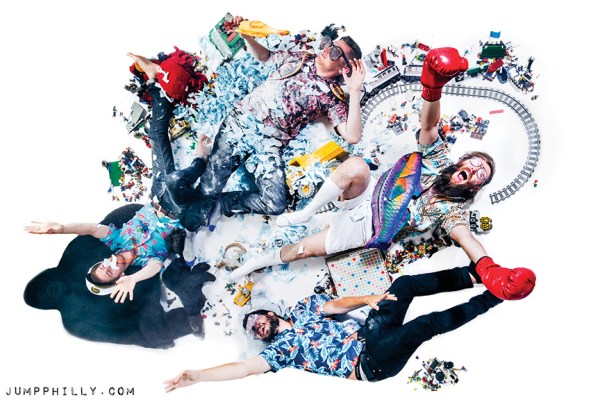
Fresh out of a typical songwriting session where Legos were used as inspiration and ideas were tested out on an audience of plastic snakes, spiders and dinosaurs, the guys relax before their next gig.
Between shots straight out of the bottle, memory-soaked laughter tells the story of how they all ended up together. It goes a little something like this: a Craigslist ad landed frontman Ari Rubin and guitarist Ian Brick on a reggae tour in 2012 and something just clicked. They initially tried to start Minka with a dude whose arms became paralyzed in a freak sleeping accident, creating a need for some new talent. After humorously watching Rubin absolutely sabotage a live show with some side project, Max Perla was sold and slid in behind the drum kit. Bassist Joe Flack jokes that he made it on the team for being a “warm body with two working arms.”
The rest is history, marked with a few footnotes: weird, loud and most likely naked.
Rubin, better known as Dick, isn’t shy when it comes to entertaining an audience. He fondly recalls stripping during 90 percent of shows in Minka’s early days.
“Ari likes to expose himself,” Flack says as Rubin nods approvingly. “It always started with the shirt, the belt, the socks. Always, the socks get thrown at me for some reason. I’m just trying to hold it down back there and I’m getting socks thrown at me. Then the pants come off. But he’s never gotten beyond the underwear.”
“That’s not true,” Rubin adds confidently, recalling that night at Bob & Barbara’s when the button over his fly went missing and the whole crowd got a revue.
Rubin’s unabashed stage presence leaves the rest of the band wondering if he’ll get naked at any given show.
“That’s one of the jobs of bands,” Brick says. “To get noticed, you have to have a gimmick of some sort. But then, once you understand that it’s a gimmick and that’s separate from your band, you kind of have to slowly phase it out. He’s done that for the most part.”
“We’re on to a new shtick,” Perla offers.
So, the birthday suit got a replacement.
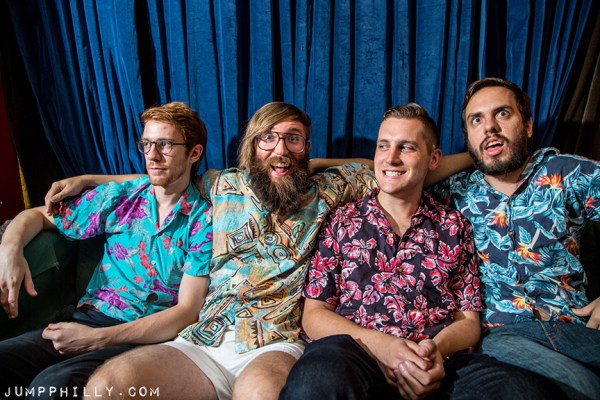 Before the smell became an issue, the men of Minka played shows in the paint-splattered suits that they crafted while making the music video for “Jackson Pollock,” the lead song off their latest EP, The Republican (think South Philly after-hours strip club, not the GOP, which has no place on this record). More recently, Rubin struck gold digging through his 86-year-old dad’s closet when he found four matching, nude turtlenecks and some sweet valour tracksuits.
“We were really in touch with our South Philly roots at that time,” Brick says of their faux athletic wear. For a while, Rubin paraded around in the loudest suit of them all, leading the band in American flag apparel.
What’s the fun in coming dressed as themselves, anyway?
“We’re all a bunch of different people inside,” Brick says. “We focus on one specific part of us that we can really bring out. We try to think of ourselves as scientists and we’re in the lab doing a controlled experiment on ourselves – a controlled, schizophrenic episode.”
The byproduct has been two EPs full of tongue-in-cheek lyrics and a high standard for a stage presence that physically illustrates them. With less-than-subtle songs like “Let’s Fuck,” Minka is all about taking risks.
“We’re not afraid to do something a little strange, clearly,” Brick says. “I mean, this guy is our lead singer. That was a huge risk.”
“It was a risk, in actuality,” Rubin says. “I had never sung before the band at all. I was a piano player and I hurt my hands real bad. I didn’t think I’d be able to play again, so I started singing.”
Contrary to the band’s style, Rubin was brought up on opera and classical music. His piano training would stretch 10 to 12 hours a day with no breaks up until 2012, when a bad case of tendonitis redirected him to the mic.
His tense, often shouted vocals fuse the influence of artists like the Talking Heads and David Bowie, backed by synthed-up, dance-y drum beats that give Minka its signature sound.
“The ’80s birthed us,” Rubin remarks while fittingly sporting a retro pair of aviator eyeglasses and beard he hasn’t shaved since Jan. 1.
In their newest single with that ’80s vibe, “Kids These Days,” Minka hits on the inevitable truth that in any generational transition, the old heads will criticize youths walking their beaten path.
In a nearly theatrical chorus, the band sings, “Kids these days just don’t get it, they don’t think like me…they don’t take life seriously.”
“We enjoy the fact that they don’t take life seriously,” Brick says, capturing the ethos of the age-old complaint. “We want to be like them. We are complaining about them only because we desire to be like them.”
He then makes the distinction that they are not, in fact, grumpy old men.
On the contrary, Rubin would describe Minka as a silly, childlike band who often ask themselves what the opposite is of what most people would do in any given situation.
“We zig when they zag,” Brick says.
He elaborates on how the band occasionally encourages Perla to ditch his skills on the drums to play like a child with no musical ability would, and hold down the beat when Rubin sporadically jumps from instrument to instrument that he doesn’t know how to play.
“That’s what the music scene is missing – bands that just want to freak out and have fun and don’t worry about looking cool,” David Sweeny, better known by his alter ego Johnny Showcase, says of Minka. “We’re kind of kindred spirits.”
Sweeny and his friends in the electrifying funk outfit Johnny Showcase and the Mystic Ticket handpicked Minka to open their record release show for The Octopus! at Underground Arts in October because their ideals align.
“I think we both think that music should be fun and should be about pleasure and doesn’t have to take itself seriously, but can also be really good music,” Sweeny says. “They wear turtlenecks. That’s the ugliest thing you can think of and they still have hot college girls freaking out to them. It’s great.”
The guys all have day jobs where they manage to take themselves seriously, so when Minka gets together they turn the focus to having a good time. Perla says the band wants to break the humdrum cycle of bands that stand on stage to play slow and sad tunes.
In modern music, Sweeny says it’s par for bands to just get up in front of a crowd who just stand there and then everyone goes home.
“Minka aren’t afraid to be absolute fools for the audience and totally give it to them,” he says. “That’s what makes them head and shoulders above most other groups in the city.”
“We just feel like there’s missing a loud, fast, coked-out, fun band on the scene,” Perla says. “We want to try and be that band.”
“Coked-out, figuratively,” Brick adds. They just like the idea it represents.
“We play mostly sober…” Perla says, with “at this point,” echoing in from all sides of the table as sunshine wafts through the half empty bottle of tequila.


In Minka’s infancy, Rubin would black out before every show, the rest of the guys trailing somewhere behind him. He recounts their first 15 shows being long, foggy nights before the band made a change.
The era of getting smashed before every show has passed. Instead, Minka focuses on being, ‘loud, fast and a little raggedy’ on their own terms, turning their main focus to playing small, local spaces.
“Right now we’re just trying to cultivate Philly,” Rubin says. “If people don’t give a shit about us here, why would they give a fuck about us anywhere else? We’re doing tons of house parties and we’re open to playing anybody’s soiree.”
No space is off limits – the smaller and sweatier, the better. Minka thrives on a stage all to themselves with no regulations on their eccentric performance style. They make themselves right at home, from the pool to the kitchen. Perla cites bonus points if the space is dirty and “in your face.”
So naturally, when super-fan Adam Weinraub reached out to the band to play his “crazy secret rooftop blowout kegger,” they were all in.
A cool breeze rolls in as the sun begins to fall on a mild Friday night, alerting the guys that it is time to pack up and head over a few blocks to 7th and Wharton streets for the show.
“I can’t believe he’s actually doing this,” says Caiola Katz, Weinraub’s longtime friend, as he shows Minka up to the roof. “We’ve been talking about this for months.”
It is perfect timing for the show, as the second and third floor tenants just vacated days prior.
New listeners to the local music scene, Weinraub and Katz caught Minka fever after watching a show at Bob & Barbara’s, where Rubin ended up on the floor with the mic stand between his legs, humping the stage.
“When we first saw them, we were a little disturbed,” Katz says. “But you can’t take your eyes off of Ari.”
Several shows and blurry house parties later, the pair are hosting their very own Minka show and aren’t sure what to expect.
“No show is the same,” Weinraub says. “It’s like going to a sporting event and seeing a different game every time. You go and you see Minka, and each one of them brings it like they want to entertain everyone in the crowd.”
Pale pink clouds have long fallen behind the skyline as a more-than-casually-late crowd begins to form on the roof deck to find Minka dressed in thrift store Hawaiian shirts. The open-air playing space is dimly illuminated only by a waxing crescent moon hanging in the distance and a lone floor lamp stuck smack in the middle of the band.
“We’re going to play the fastest, best show we can before the 5-O show up,” Brick murmurs, preparing himself while soaking in the last moments of peace before Minka turns up the volume on an otherwise quiet night.
“We are Minka, and we’re here to fuck your brains out,” Rubin opens, and they were off to start the set with a cover of Weezer’s “Hashpipe.”
The crowd of about 40 strong – with dudes in plaid button-downs in every which direction – warms up quickly, grooving along with Rubin’s wild footwork as the sounds of crashing cymbals take over over the streets, rattling the fence of an empty alleyway across the way and echoing through the neighborhood.
“This is the greatest shit I’ve ever seen,” Katz says to a friend as songs like “My Room” and “Justice” fill the air, exposing the residential neighborhood to amusing lyrics and overtly sexual comments from Rubin like, “I wanna see you grab some ass. Someone can come up here and grab mine, I’m inviting you.”
From above, an obviously intoxicated man can be seen dancing on the street in front of an unmarked police car.
“Fuck it,” Weinraub says, while going down to investigate. “I’ll get arrested tonight. I don’t care.”
Turns out the police are in a forgiving mood. They offer 30 more minutes of playtime until they will be up to pull the plug themselves.
No need for a reminder, Minka’s set is cut short right before the last song and the teetering 30 minute mark when Perla, who’s notoriously wild on the kit, breaks his kick pedal. No gripe from the band though – one less Prince cover isn’t going to kill anyone.
With the volume pulled down on Rubin’s Talking Heads playlist and the keg of Rolling Rock still flowing, the party wears on into the night.
“I told Dick, ‘I’m collecting money for you man,’ and he goes, ‘I don’t give a shit about the money, I just want people to have a good time,’” Weinraub says with a shrug. “It’s nice to see that their end goal is everyone having fun and enjoying themselves.”
From getting dressed up, to stripping and carving out a space in the crowd to throw down dance moves, Minka is all about having fun, and they label low-key spots the most human way to do it.
“At house shows, we can connect to people,” Rubin says, stressing the meaningful relationships he’s made. “And Adam is going to get laid tonight, that’s awesome.”
“That’s like community service,” Brick jokes.
Air is Human: A Duo With Depth.
 Text by Kevin Stairiker. Top image by Kara Khan/Pop Up Polaroid. Concert images by G.W. Miller III.
As with most great relationships, Air is Human met each other through a Craigslist ad.
Frontman Jeff Lucci, 28, put up an ad requesting various musicians that lined up with his interests including far – ranging bands from Radiohead to Mahavishnu Orchestra. Drummer Josh Aptner, 27, was the only one to respond.
Five years later, the duo consistently hypnotizes the city with their complex musical arrangements.
“Thank God I didn’t know shit about the city then,” Lucci says with a laugh. “If I would have wrote that today, I would have thought, ‘Goddamn, no one is going to respond to this.’”
It’s clear that the relationship is a successful one. The two live in Fishtown currently but are hoping to move to a nearby warehouse that is more conducive to store massive amounts of equipment.
To make up for the fullness that a two–piece sometimes lacks, Lucci’s setup includes both a keyboard and guitar fit with varied pedals. Their live sound is intense, with layered keyboards and looped guitars maniacally set against Aptner’s driving, almost dance–like percussion. All the while, both musicians face each other onstage so that any experimentation or delineation can be communicated with a simple head nod.
“Their music has great depth and it triggers visuals in my imagination,” says Joel DeMartino, lead singer of Moonstriker, a band that Air is Human have shared many show bills with over the years. “They always keep it fresh.”
That freshness has been put to the test this year as the band worked harder than ever to release four EPs in sequence with the changing of seasons. Each equinox and solstice brought along a new group of material that Aptner describes as “stressful but cool.”
“The original concept came from wanting a deadline,” says Lucci. “If we didn’t have a deadline, it wouldn’t get done. Our first album came out in 2011, so there’s a lot of procrastination. I want to tweak it ‘til it’s right.”
Each EP has managed to fit the theme of the season in some small way. “Throwing Knives at the Sun,” off the collection of songs predicating the summer solstice, rushes forward in a way that’s perfect for a long highway drive towards the horizon. The spring equinox is represented well by tracks like “Kierkegaard’s Last Words,” a spare, almost ghostly piano track that manages to be both wistful and trance-like at the same time. The winter equinox, which is the band’s final seasonal EP, is scheduled for December 22.


Air is Human are regulars at venues across the city and have been able to sustain residencies at Boot & Saddle, Bourbon & Branch and for the second time, a full month at Ortlieb’s.
“The thought process behind the residencies is that we can share the love with another band and that people can at least make one show,” says Lucci.
“If you’re actually maintaining your relationships and interacting with people, it becomes easier because it’s more of like, ‘Dude, you’re my friend, wanna come hang?’” adds Aptner. The band will likely celebrate the end of the year–long project with some shows and then take some time off.
“I’d like to put this last [EP] out and then take a break from playing shows,” says Aptner. “And then come back when we have a new set ready.”
Until then, the two moving parts of Air is Human will continue on their trail, uncompromising with the music that they make.
“The reason we do this is definitely because we’re compelled to do this, and I think that’s why other shit falls by the wayside,” says Aptner. “I’m not compelled to be on social media. I’m compelled to make awesome music.”
Eric Osman: Still Lame-O After All These Years.

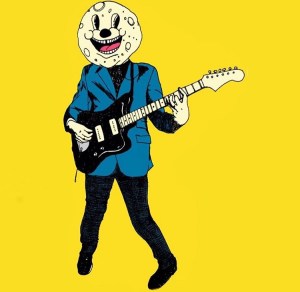
Lame-O Records started out as Eric Osman’s senior project at Drexel University in 2012. Now, he’s got a powerhouse label in Philadelphia with a catalog of bands that is exponentially growing. This month, Lame-O Records is hosting a “rock residency” at Boot & Saddle with shows every Thursday night.
Our Emily Scott spoke to Osman (pictured above with partner Emily Hakes in a photo by Rachel Del Sordo) about the residency and his plans for 2016.
 Can you give a little background on Lame-O Records?
We started in the fall of 2012. It’s now January 2016 and we have been doing it for a lot longer than we thought we would have. We had to submit our latest catalog number and we’ve reached our 30th release, so that is pretty crazy for us.
What were some of the releases you had in 2016?
We did a full-length for The Weaks, who are now The Superweaks, a full-length for Lithuania, a full-length for Three Man Cannon, a full-length for The Max Levine Ensemble, an EP for Modern Baseball, an EP for Great Cynics, and a seven-inch for lowercase roses.
What made you decide to host a residency at the Boot and Saddle?
We know Jeff Meyers from Boot and Saddle because he used to play in a Lame-O band called Ma Jolie and he asked if we would do a month of shows at Boot & Saddle.
How did you curate this show?
Three bands is so easy. I think less is more and no one wants to sit through a five-band show. Most shows at Boot and Saddle are either two or three and I definitely didn’t want to do two. I think three is definitely a sweet spot. We asked all the Lame-O bands that are around and we tried to pair them with other bands that we are friends with or we like that aren’t on the label. So it’s not just like here’s all the Lame-O bands on one show and here are all the non-Lame-O bands on another.
What are Lame-O Records’ plans for 2016?
I hope we continue putting out records that we love and I think we are going to keep doing that at least in the first half of year. I think we are going to keep it simple and put it out really good music.
Lame-O Records residency at Boot & Saddle kicks off tonight at 8 p.m. with Lithuania, The Spirit of the Beehive and Slaughter Beach, Dog.
All the shows are $5 when you buy tickets in advance online or at Long In The Tooth.
Posers: “The Realest Punks Don’t Look Punk at All.”
 Text by Elias Morris. Images by Michael Bucher.
“Poser” is a word you hear often when growing up in a certain scene. Everyone has a different definition of what makes someone a poser but there’s a common idea that a poser is someone who pretends to represent things of which they truly have no understanding.
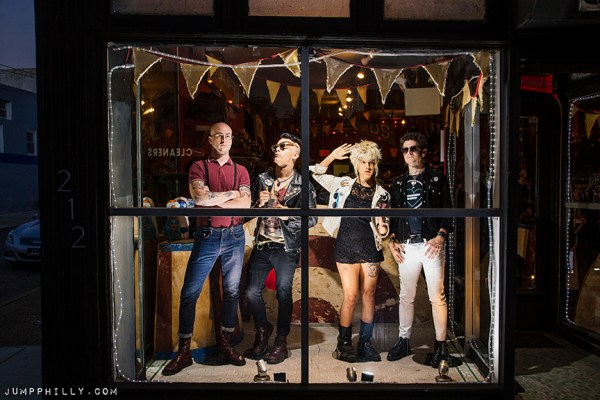
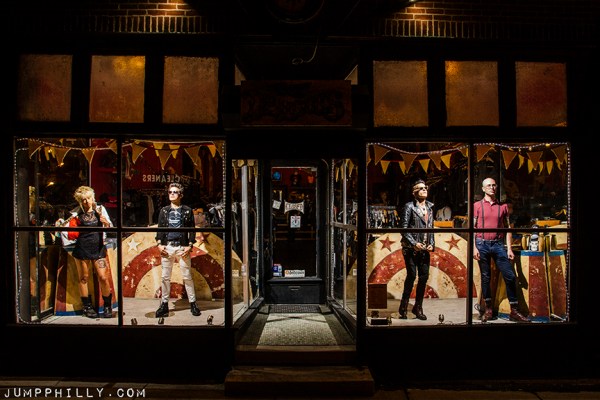
Posers, the band, are made up of self-proclaimed outsiders of the Philadelphia punk scene, consisting of musicians who are straightforward in discussing what being a poser means to them.
“It’s kind of a jab at the current state of the scene,” bassist Johnny Mick says of the band’s choice of name.
Mick and guitarist Rory Cain are both from southern New Jersey, growing up in the suburbs of the city but always embracing the punk scene over the bridge as their own. Singer Jade Baisa is a native of St. Louis who moved to Philadelphia in 2013. Drummer Brian Bullock has been a staple in the punk scene for years, easily spotted at countless shows, churning out plenty of music aside from Posers.
Although they have yet to release any physical albums (they do have plans for a fall release and regional tour), Posers have already garnered a reputation for being nonconformist and outspoken.
“To some people, not being from the city makes you a poser by default,” says Mick. “Everybody is content to be doing the same thing, falling under a nostalgia thing where it’s like they’re all playing the same music and most of it sounds like metal. And I’m not knocking anyone. Everyone has their thing that they’re into but I didn’t get into this because I wanted to be like everybody else.”
Their music is void of cliches and stereotypes usually associated with modern punk. The songs on their Bandcamp give a sample of the band’s sound – the self-titled online demo is full of unexpected guitar solos and intricately structured songs.
The music separates them from other punks who claim not knowing to play as a point of pride.
“You can’t be into punk without realizing that you’re doing something a little ridiculous,” Mick says. “No one is born wearing a leather jacket. It’s influence. You take it from everybody. The problem now is that people are mistaking influence with identity. You can’t just live somebody else’s life. You have to take your own individual influences and be an actual person and not just a caricature of what a punk should be.”
“If punks were genuinely all original and all creative, like they’re supposed to be, none of us would look remotely the same,” adds Cain, expanding more on the band’s poser stance. “But we come out in droves in the same thing. The punkest-looking people are the biggest posers. They’re the ones who are full of shit. Usually, the realest punks don’t look punk at all.”
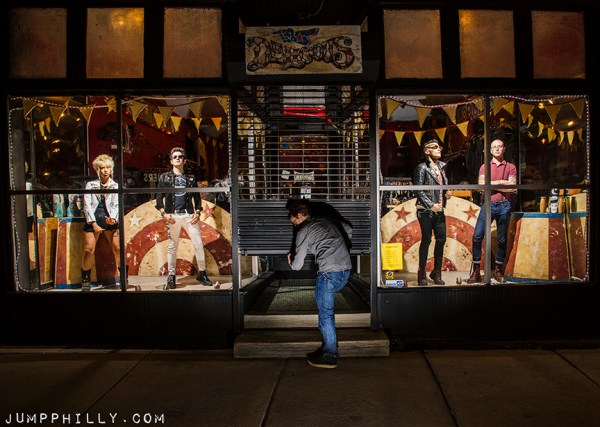 Despite having heavy opinions on social and musical trends, the band does not rely on that to sell their tunes. They are musicians who extend their talents beyond the limited frames of punk rock, absorbing influences from proto-punk, glam, powerpop and a variety of more melodic and skillful acts gearing towards the ’77 side of punk rock without full-on imitation. They effortlessly deliver a sound that serves as both new and refreshing, and they’re quick to call their music rock ‘n’ roll before anything else.
Allowing themselves to deviate from straight punk comes with the territory their name suggests. Posers aren’t trying to gain any punk points or fall into any hierarchy.
“It’s so that we’re free musically to do whatever we want,” Mick says. “If one of our songs is too catchy or poppy or not screaming enough or not hating the government enough, then we already warned you that we’re Posers.”


 JUMP: The Philly Music Project