Walla Fest @ PhilaMOCA on August 8 and 9, featuring Mannequin Pussy, Norwegian Arms and More.
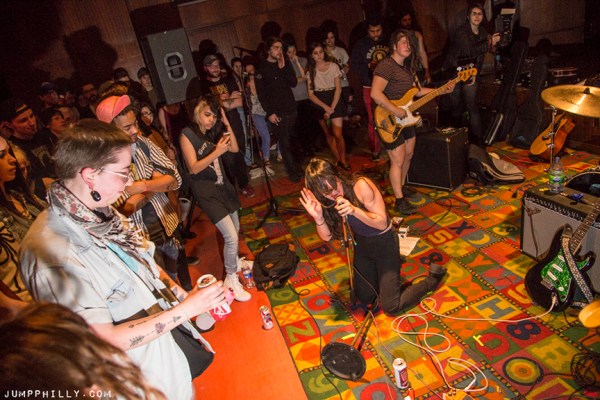 Walla Fest is a two-day music, art and film fest happening August 8 and 9 at PhilaMOCA. This is the fest’s first year in Philadelphia after spending a few years at The Center Theater in Norristown. Mannequin Pussy (above), Norwegian Arms, Shannen Moser, Clique, Kississippi, Elliot Bech, Cory McConnell and others are scheduled to perform.
Our Tim Mulhern caught up with Makeba Robinson and Yesenia Bello, the co-founders of the fest, and learned about the history and mission of the event.
 As a two-day event, Walla Fest is in its third year. How has the fest developed since its first year?
Makeba: I think our first two-night show, we only had an early show and a late show on the second day and then the first day was a typical one-day Walla Fest. Then, the second year, we did a two-day show was when we had an early show both days. This year, we’re having an early show and a late show both days, as well as screenings and vendors on both days. So I think this year is the first time that we’re doing everything on each day.
Yesenia: Also, I think before, our early show was smaller and more of our friends were playing.
Do your goals for each fest change or do they remain the same?
Makeba: I think each with show there are many goals. Some of them have been the same and some of them have changed. I think since the very first Walla Fest, we’ve always had a goal of just trying to make a place that people want to be in. Just an exciting environment where you could get into more than one thing at once. In terms of the music and the art that we have, I think maybe the goal for what those things should be has changed a little bit. I think something that we kind of enjoyed about Walla Fest is that it was a thing in the suburbs, which is unusual to have something like Walla in the suburbs. Now that we’re going to PhilaMOCA, that has changed a little bit.
Do you think the move to Philly will solidify Walla Fest’s place in the city’s music and arts scene?
Yesenia: I hope so. I think we’re kind of new to it all and we’ll kind of see. This whole audience is a little bit new to us.
Makeba: I feel like a good amount of people in Philly know about Walla Fest already. I hope it can be something that people will remember.
How do you decide what bands will perform and who will show art and films at the fest?
Makeba: I think we keep our ears to the ground. We keep up with who is playing music and we pay attention to it just naturally as people. We’re into finding new music. I think for the past couple Wallas, we’ve kind of made lists of who were interested in way ahead of time. It’s never really hard for us to know who we want to play at the show.
Yesenia: Usually people that are involved are also doing something else and have other side projects.
Where do you see Walla Fest going in the future?
Makeba: I think we want it to be something that is small but meaningful and exciting. I don’t think we see us becoming some big, outside festival. I think this next show is kind of close to what the future of Walla is. Every year really has been super different from the very beginning. Moving to Philly is a big thing.
Zuli, Shy Boyz, Wildflower and S.M. Wolf @ The Pharmacy.
 Text by Donte Kirby. Images by Briana Spause.
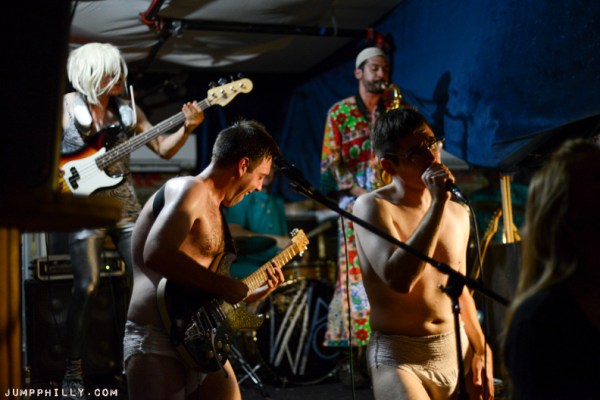
Zuli, Shy Boyz (above), Wildflower and S.M. Wolf put on a killer show last Wednesday at the Pharmacy, the venue/ coffee shop tucked away in the side-streets of South Philly.
Wildflower opened the night with a set that was pure, raw energy. From the first garage rock chord, the guitarist’s orange curly fro was banging harder than any bobble head I’ve ever seen. The set was full of theatrics, from teeth strumming to spinning on top of a bass.
S.M. Wolf traveled all the way from Indianapolis to grace the Pharmacy stage. The four piece gave those at the Pharmacy’s intimate setting a taste of their full length album coming this October in their highly polished set.
From the get-go, S.M. Wolf garnered respect and interest from the mostly fellow musicians in the crowd. Lead singer and guitarist Adam Gross face was red and his neck veins ever-present as he belted out songs like “The Meadow” from their cassette Canine Country Club.
The psychedelic four piece Zuli hit the stage and displayed the joys of their record Supernatural Voodoo despite having to combat some feedback issues. Feedback in one way, shape or form reared its ugly head in every band’s set but not one let it get in their way.
Zuli made a particular note to the crowd that “we’re going to power through,” and the feedback didn’t cause a hiccup in the harmonies of “Keep it Together” or stifle the cool vibes of the title track “Super Natural Voodoo.”
Closing the night was Shy Boyz, a motley crew of snazzy dressers that could be one show away from a cult following. To say it was an experience wouldn’t really do it justice. There was a literal love TKO, a dead lover’s ballad that included a zombie ghost grind fest, and I was given a lap dance by a man in a diaper. All that was backed by the sexiest sax in town and vocals that Ron Burgundy would sell his soul to have a tenth of.
By the end of the show I was personally drained and I didn’t even do the workouts guided by Jim “You don’t have to go to the gym” Daily, the band’s personal trainer.
Again, the show was an experience to say the least.


We were able to catch up with the guys from Zuli for a few Q’s and a few A’s…
Can you tell us a little bit about the album Supernatural Voodoo?
Ryan Camenzuli: I had just graduated college and I really wanted to do music, so it was an outlet that reflected the things you aspire to in life and everything that every 20-something goes through with kind of my own perspective on that.
What do you want listeners to get out of your music?
RC: If they connect to a lyric that’s awesome. If they just enjoy the melodies or enjoy the vibes that’s awesome. Most art is like you put it out there from a way that you see it and a way that you would feel towards it. As long as it’s positive, it doesn’t really matter to me.
Do you guys have a tour date you’re most excited for?
RC: I’m excited for everything but our home show will be at Baby’s All Right in Brooklyn. I’ve seen a lot of my favorite bands there. It’s going to be fun and it’s going to be a free show too.
Can you tell us a little bit more about Baby’s All Right and the Brooklyn music scene?
RC: We’re a little bit outside of the Brooklyn music scene because we’re from Long Island but we’re in there all the time. Brooklyn music scene is interesting. Obviously there’s a lot of awesome Brooklyn bands. I also think all these bands are very close and intimate, there’s definitely like a scene to it. Sometimes whether playing with this band or some others in the past, you definitely get a like “Okay, all the Brooklyn bands kinda sound like this right now. Alright, all the Brooklyn bands sound a little bit like this right now.” So I kind of feel like there’s like a bubble to it sometimes. Some bands that are from New York but not in Brooklyn sometimes have a little bit of a different flavor that they can bring because they’re not so zoned in, if that makes sense.
Joe Villafane: At the same time I would say Zuli’s music isn’t your typical Long Island sounding band. I feel like in New York, especially between Brooklyn and Long Island, you can kind of tell that “Oh that’s a Long Island, that’s a Brooklyn band.” This music is a lot more vintage and pyshcdelic sounding than what you hear off the Island usually. I can say that objectively because I didn’t write it and I just get to play in the live band.
Do you have any advice for any up and coming musicians?
RC: We don’t have any label backing us, no booking agent right now, but just not being “Oh I’m going to wait for so-and-so to do it for me.” Or like “Oh I would put my music out but I want this person to be in contact with me before I do it.” Just do it.
JV: I would just say go with your gut. Don’t let other people tell you what you should or should not be doing. If it doesn’t feel right, there’s probably a reason it doesn’t feel right. And if it feels really good, there’s probably a reason for that too. Don’t play music with people you don’t love genuinely. Don’t let anybody bring you down at all. Just create the music you want to make, not what someone else wants you to make.
Kyle Conlon: I would say just keep going. For me, I’ve been playing for almost ten years now and it’s just kind of like you’ll find the right people. That’s like the hardest part honestly and I found the right people. I’m happy where I’m at and that’s the main goal.
Greg Coffey: Do it now, don’t wait until tomorrow.
Anything you feel like people should know?
RC: We have an awesome van that has N64 points built into the walls of the van. That’s probably the coolest part of our tour, not the Baby’s All Right show, not any of the parties or people.
JV: We have a few off days up at Zuli’s lake house. We’re going to go paddle boarding and discover a 5,000 year old mask that if you touch it you can live forever. That I’m looking forward to.
GC: That’ll be an adventure.
JV: N64 and that (5,000 year old mask) borderline sums it up.
 Text by Lissa Alicia. Image by Chris Fascenelli.
Last Wednesday, Curtis “50 Cent” Jackson made a grand appearance at the Northern Liberties Fine Wine & Good Spirits Premium Collection Store on Girard Avenue to debut his new vodka, EFFEN.
By five o’clock, when the event was to begin, the liquor store was a complete madhouse. Hundreds of people had lined up to see the Get Rich or Die Tryin‘ rapper. And in a shop that is already disorienting due to the sheer size of the store, the excited crowd only made things worse.
In order to even get within three feet of 50, people were required to purchase a $24.99 bottle of his vodka. The line that zigzagged through half of the store extended all the way to the back door, where fans of the multi-platinum artist were required to wait outside in the scorching heat. For those who were uninterested in purchasing the liquor but wanted to catch a glimpse of 50 Cent, there was a wide aisle where people mulled around, unsure of what to do or where to go.
Around 5:15, 50 arrived in the building, creating much buzz. Ten minutes later, the man of the hour appeared before the crowd.
“He didn’t come in through the back,” said Ebonie Phillips, a Wine & Spirits employee and 50 Cent fan. “He just showed up. It was like he appeared out of the men’s room. He just walked by and I couldn’t do anything but smile.”
50 looked completely unbothered, as if he actually wanted to be there. As he walked toward the front of the store – flanked by his security and other personnel, all eyes were drawn toward his electrifying smile. He quickly posed for a few pictures, waved at fans and made his way toward a small area where he would sign bottles and pose for pictures with fans. Before taking a seat on the throne-like chair, 50 Cent stood on the chair and began recording video of the loyal fans going wild.
In addition to the visitors clutching the surprisingly smooth-tasting vessel of vodka, a few people were holding on to original artwork. Apparently there was some sort of art contest that was facilitated by the EFFEN team where creatives were asked to paint their version of the EFFEN bottle. A few people brought their work with the hopes of winning the contest.
“I am a self-taught artist,” said Michael Courtney, who was juggling multiple paintings and EFFEN bottles. “I was entering the contest, so I brought in some paintings to show him and try to get him to sign one.”
50 Cent’s vodka is actually pretty tasty and affordable. His fans seemed like the couldn’t get enough of it. But the real question is, will EFFEN take the top spot of rapper-endorsed vodka from Ciroc?
Only time will tell. Until then, grab a bottle and try it out.
The Blair Brothers: The Scene Stealers.
 Text by Brendan Menapace. Images by Stevie Chris.
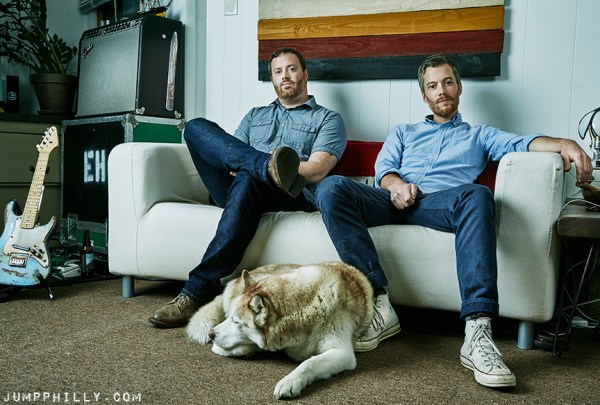
Walk into the Blair brothers’ studio on Frankford Avenue and the first thing you’ll notice (after petting the not-so-vicious guard dog) is the multitude of string instruments lining the back wall. After that, it’s the speakers and computer monitors that sit on a desk and two keyboards positioned around the desk. On the computer is an image of Patrick Stewart.
No, the two aren’t watching “Star Trek” while they write music for a new album.
They are composers for award-winning films, documentaries and television programming, creating the sounds and music that add suspense, depth and emotion to a director’s visuals.
Last year was huge for the brothers. IndieWire recognized the duo as Composers to Watch in 2014. Their music for director Jeremy Saulnier’s “Blue Ruin,” which was an official selection at Cannes and Sundance among other film festivals, garnered a Public Choice Nomination from the World Soundtrack Awards and an inclusion in ASCAP’s Composer Spotlight, as well as an honorable mention nod on IndieWire’s list of the best film scores of the year.
Today, they’re finishing a big project.
“It’s Friday, so we’re enjoying some beers,” Will, the younger Blair, says as he opens the door to the studio where older brother Brooke is sitting at the computer, Narragansett pounder in hand.
The two are putting the final touches on the score to an upcoming film by Saulnier, starring the aforementioned Stewart as a Neo-Nazi hunting down a punk band.
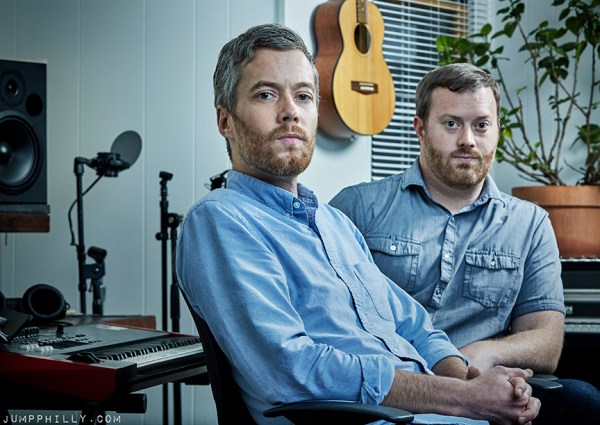 The Blairs, natives of northern Virginia, use their history of playing in bands like East Hundred, as well as influences of Philly music, to create their soundtracks.
When they were in college, their friends asked them to score short student films and they built their portfolio over the years. Brooke now lives in Chestnut Hill and Will lives within walking distance of their studio in Fishtown.
“We grew up with Jeremy,” Will says of Saulnier, the director. “As we went to college, we veered off toward music and he was heading toward film. We did all of his short college films and his first feature in 2007. We started looking at it more seriously but we were still busy with band-related stuff.”
“I had my little film posse with [Will and Brooke’s] older brother Macon,” Saulnier says during a phone interview. “They were very talented musicians and they were available and worked for cheap.”
The two did the score for Saulnier’s short film “Crab Walk” in 2004 and he wanted them to do more. In 2007, when Saulnier did his first feature, “Murder Party,” he brought them on.
“As we built our careers together, they just proved themselves as collaborators,” Saulnier added.
Now they are finishing his third feature, a film Will calls a “punk rock thriller,” which will also premiere at the Cannes Film Festival.
“There’s one scene where feedback almost becomes an instrument, like a deterrent,” Will explains. “The word ‘feedback’ is in the script as a sonic detail. It appears in different scenes where things are going crazy. We use that as a starting off point.”
To get this sound, Brooke records hours of guitar feedback in the studio.
“It’s like the one thing that you try to avoid in a studio situation,” Will says. “We try to encourage and create and control it. So we had tons of guitar feedback. We got a trombone to feed back and drums to feed back.”
“Also, the sound of it, it has an abrasiveness and a grittiness that goes well with a punk rock sound,” Brooke adds. “You think, ‘Oh, here’s a punk rock film. That’s probably what the score should be.’ But that’s already such a part of the film that our approach was to weave in and out of that as part of the story, but also not be totally noticeable.”
Brooke contrasts what they’re doing on this project to what some might see as a traditional film score, with sweeping orchestras taking over the film, like John Williams’ epic “Star Wars” soundtrack.
“They’re made to be felt and almost take over a little bit sometimes,” Brooke says. “Sometimes dialogue dies off and they become these moments. We’re kind of doing this the opposite way. We’re still sneaking in melodies here and there but for the most part it’s textural. It’s meant to be there and be felt, but not be overtly obvious.”
Their job is to find the right sound to enhance the emotion and tempo on screen. It changes with each project.
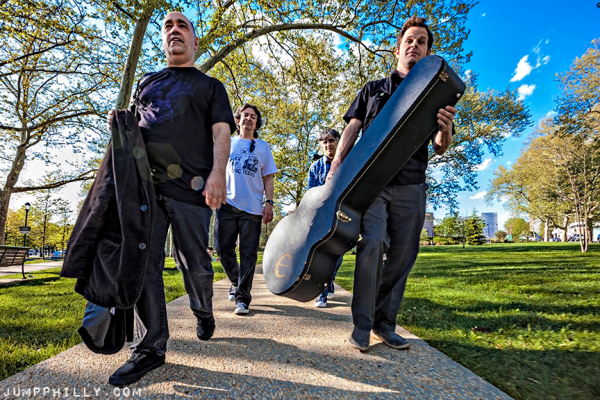
 The Blairs believe that they’re currently part of a shift in the industry’s dynamic, with more and more young composers establishing themselves. With Brooke, 37, and Will, 36, they’re certainly on the lower end of the age spectrum in the industry, but that’s changing at a fast pace.
“I think even like 10 years ago it was rare to see a young composer,” Brooke says. “Especially in, like, old Hollywood stuff. Now, part of it is the advent of home studios and that kind of thing, and being able to pull off that sound outside of an orchestrated Hollywood score, younger guys are getting into the game a little more.”
There are still a few scene cues yet to be crossed out on their whiteboard to-do list. After finishing this Saulnier project, the two are switching gears completely – from the distorted terror soundtrack to a documentary on collegiate swimming. A tub, which will be filled with water for an underwater mic to record the muffled aquatic soundtrack, sits patiently in the corner of the studio.
The Dead Milkmen are Still Dangerous.
 Text by Beth Ann Downey. Images by Jared Gruenwald.
A young looking 19-year-old sits in the first row of the upper-floor auditorium in the Central Free Library of Philadelphia, enthralled by The Dead Milkmen performing an acoustic show in front of her.
The event is part of local author Andrew Ervin’s book release party for “Burning Down George Orwell’s House.” He’s a friend of The Milkmen, and it’s hard to tell who of the hundreds of people in attendance came to hear his reading or their music. But what’s apparent about the Philadelphia-based punk band – with its more than 30-year stake in the local scene – is that people of all ages, shapes and sizes have come to enjoy their music. Some have young children. Some have gray, braided hair. Some sport shirts and bowties, others are dressed in casual tourist garb or sport black denim vests and purple mohawks.
After the performance, that 19-year-old in the front row snags frontman Rodney Linderman to sign her T-shirt before heading for the elevator. For her, the music of The Dead Milkmen is more about nostalgia than relevance.
“My dad was only 24 when he had me, not much older than I am now,” says Jade Richmond, a Temple University student. “The music he was listening to, he wanted me to listen to because that’s what he considered good music. So listening to it now reminds me of being a little kid and sitting in the back of my dad’s car, rocking out to The Dead Milkmen.”
The Dead Milkmen’s music presumably conjures many memories for many people, and means a lot to a lot of Philadelphians. Maybe people reminisce about the basement shows they attended in the early ’80s when the band started. Maybe they can imagine themselves walking down South Street as the punk haven it once was or can remember how it felt to cruise down to the Jersey Shore for a weekend or a summer.
As a satirical band – forever a perpetuator of wacky, intricate and out-of-the-box lyrics to complement a clean musical approach to punk – The Dead Milkmen brought humor to a genre and a scene they say was full of people taking themselves too seriously at the time. From the absurdity of “Gorilla Girl” to the mundaneness in “Punk Rock Girl,” the commentary of “Beach Party Vietnam” to the insensitivity of “Takin’ Retards To The Zoo,” the band has undoubtedly made fans laugh multiple times through the years.
But they’ve also made them think, or possibly even cry. They admit their lyrics are dark, and Linderman, otherwise known as Rodney Anonymous, jokes that they are sometimes even “a desperate cry for help.”
Dark humor is something he feels audiences often need from music, but has become harder to find in modern times.
“There’s a whole genre of what I call ‘happy, clappy’ music out now,” he says while perched on a plastic chair in the auditorium after the show. “It’s like, ‘Hey everybody, we’re having a good time, yeah!’ But I’m not having a good time. I’m angry. If you were angry in the 1980s, most of the music was Michael Jackson and basically people would say, ‘Come on, it doesn’t matter if you’re black or white.’ Well, it does if the cops are shooting at you! So I think that’s how bands like Black Flag and those began to get the undercurrent because not everybody was buying into that big lie. I think that’s why you really need somebody out there saying, ‘Hey, it’s not all pretty. Here’s an option for dealing with it.’”


Just as The Dead Milkmen may remember the 1980s differently than a Michael Jackson fan, their view of Philadelphia is different than that of current city-dwelling youths or young adults.
There was much less to do, they say, and places like the Northern Liberties, Fishtown and even South Street were without the booming businesses and attractions they have today.
The bandmates also remember punk music as much less restrictive than it is today in terms of maintaining a certain style.
“It was more an attitude and it was more DIY,” says guitarist and vocalist Joe Genaro. “The whole idea of the punk thing was that you didn’t even need to know too much about music. You could just play it.”
Linderman says punk bands arose back then due to two key factors: desperation and boredom.
“You literally had nothing to do, so people formed bands so that they had something to do,” he says. “It was like living on the prairie in the 18th century, where people were like, ‘Oh, I’m going to play the fiddle now.’ People didn’t like fiddle music but it was something to do. It was better than going out and sticking your face in the blizzard. So yeah, I would say that that sense of desperation, which I miss oddly enough, isn’t there anymore.”
The times and punk music have changed but the members of The Dead Milkmen haven’t really, aside from aging. They constantly joke with one another and carry absolutely no sense of ego or palpable realization of rock stardom. Linderman is loud and erratic. Genaro is quiet and guarded. Drummer Dean Sabatino is straightforward and level-headed. In other words, Sabatino seems like the one used to following the rules, Linderman the one used to breaking them and Genaro the one to run away at the first sign of conflict.
A steadfastness of self has allowed their music to change but remain relevant, as well as satirical and poignant at the same time.
“If you scratch the surface of our songs, they’re about being broke, they’re about junkies, they’re about crazy people in small towns, they’re about homophobes,” Linderman says. “So I never particularly found that we were a humorous band. I’m glad that people have to categorize it that way. Otherwise, they’d be as depressed as I am.”
The Dead Milkmen found fame when their debut album, Big Lizard in My Backyard and the song “Bitchin’ Camaro” got picked up on the college radio circuit. That led to the immense success of “Punk Rock Girl,” a single from their 1988 album Beelzebubba, which made it into MTV rotation.
“That was back when college radio meant something,” remembers Sabatino. “It doesn’t mean anything anymore really.”
“The radio used to be a life changing thing,” adds Linderman. “I love Internet radio now because it’s kind of, in some ways, the same way. When I get an Internet station that is regularly updated and the DJs are good, I love that. That’s kind of the magic of it. But I don’t think it will ever happen for young people again the way it happened for us, where you would tune in to the radio and just be blown away by it.”
Just as the radio once had the capacity to make or break bands, getting picked up by a major label could also change an artist’s career overnight. But for offbeat punks like The Dead Milkmen, it came with a price. Linderman recalls the band’s time on Hollywood Records, from 1991 to 1995, and he immediately says, “It sucked.”
“Back then, the only way to get heard was to be on a label,” he says. “Now you can make an MP3. You can do it at home. You have basically a recording studio at home and you can get it out there.”
Genaro remembers the band making their own tapes so that they could go out on tour. That was around the time that DIY and independent labels started gaining ground. But before they knew it, they were swept up into a wave of industry frustration, poorly performing albums and the threat of being dropped.
The band announced its breakup in 1995. Twenty years later, what was undoubtedly a very stressful decision can be joked about.
“The hiatus period,” Genaro says. “I think Rodney describes it as the happiest time of his life.”
Everyone, including Linderman, laughs.
“Yeah, but I thought hiatus was a wolf-like animal that preyed upon sheep,” retorts Linderman. “Turns out that’s a hyena.”
Nowadays, there is one fewer original member of The Dead Milkmen to laugh at outlandish jokes or make his own. After spending the hiatus studying the Serbo-Croatian language and even moving to Serbia for a time to teach English, bassist Dave Schulthise committed suicide in March 2004.
Linderman, Genaro and Sabatino remember him as a prankster who would put ketchup packets on trolley tracks or have long conversations with service people from the 1-800 call lines he would dial from hotel lobbies. He also had routines he stuck to, like lining the inside of dresser drawers with wrapping paper before putting his clothes in.
He always read the news. He read a lot of books on tour. He was always interesting to talk to about political events. He was an impeccable musician.
He always seemed bored – and seemed to be doing something to counteract that boredom, according to Linderman.
“He did not care what you thought about him,” he says. “He was going to have some fun and he was going to live his life the way he wanted to. If he was in Yugoslavia and you drop bombs on him, well, he’s having a good time down in the bomb cellar while they drop the bombs.
The surviving members of the band reunited for two memorial shows at the Trocadero in November 2004. Dan Stevens – who was playing in a band called The Low Budgets with Genaro at the time – played bass for the shows. In 2008, Graham Williams – a promoter from Austin, Texas who had sang on The Dead Milkmen’s album Metaphysical Graffiti – asked the band to reunite as one of the headliners for his Fun Fun Fun Fest.
“We thought it would be a one-off thing, but it was so much fun, too,” says Genaro. “At least I remember it being fun. Then we decided to do it on a regular basis.”
The Milkmen kept Stevens on bass. The band has since released two studio albums since the reunion: 2011’s The King In Yellow and 2014’s Pretty Music For Pretty People.
Linderman says the band’s new material is more complex now that they can “get more than three chords together.”
“You don’t want to keep making the same record over and over again,” he says. “You sit at night and you’re playing around with your stuff at home and you’re like, ‘That’s a really weird sound. I wonder if we could use that.’”
Brian McTear of Miner Street Records, where The Milkmen recorded their two most recent albums, says the band exemplifies the path ahead for anyone with an aim to make music until they die.
“To be a ‘recording artist for life’ was never something all that many people could do,” McTear says. “Not even The Dead Milkmen, as they learned when their careers ran out in the mid ’90s. Rodney, Joe, Dean and Dan are heroes to me because they realized they could start up the band again, so they did it. Now they’ll likely make records decades beyond what they probably ever thought they’d do when they were kids.”
Making records is certainly a priority for The Milkmen, but it’s not all they’re doing nowadays. Stevens is a family man with three kids. Sabatino works as an interface designer for an international consulting company, lives in Media and has a wife and 16-year-old son. Linderman lives and works in the city as a change manager for a financial firm and has been married for 20 years. Genero, also still a city dweller, is single and works as a software quality assurance manager for a company that provides marketing and technology solutions for the education market.
It feels just as unusual for the band to now play to older audiences as it does to play to fans who weren’t even alive when the band started out.
“I want to shake young people and say, ‘Why aren’t you at an Angelspit show?’” says Linderman. “I’m always amazed because there are these great young bands.”
The Dead Milkmen are fans of numerous young bands, evidenced by Sabatino’s Psychic Teens shirt he wears during the library performance and Linderman’s diatribes about the genius of acts like Gothsicles and Santa Hates You.
It’s almost as if they don’t realize they receive the same admiration.
“I can recall numerous times where I might be showing a young punk band the studio, and in walks Dean to drop off some records,” writes McTear. “The band might not know who he is but the second I tell them, their eyes light up and they completely change their demeanor.”
Most career people enjoy being taken more seriously the longer they’re in a job. For The Dead Milkmen, the thought of being taken seriously is upsetting.
“It’s like we’re not even dangerous anymore,” says Linderman. “It’s like we’ve become avuncular. ‘Oh, aren’t they cute? Let’s let them play in the cemetery. They’re not going to touch the bodies.’ It’s kind of a thing that’s upsetting me now when I start thinking, ‘What can we do to upset people?’”
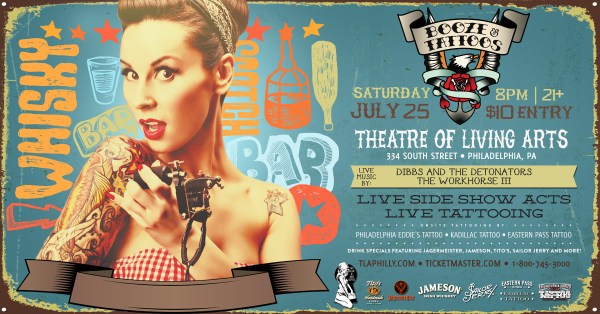
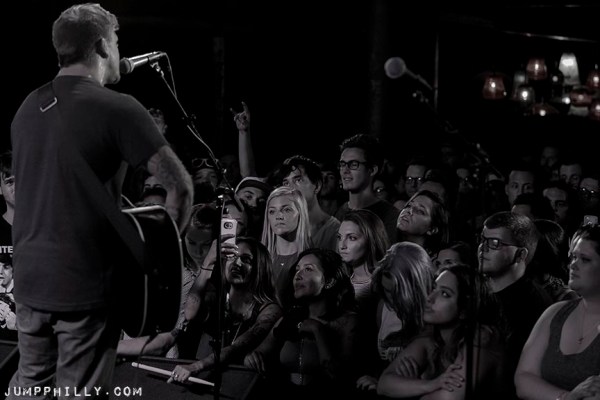
On Saturday, the TLA is hosting an evening of body art and booze, with live rockabilly from Dibbs & The Detonators and power rock from The Workhorse III. There will be sideshow acts, live tattooing and lots of people showing off their art.
Like us on facebook and email us at FreeJumpStuff@gmail.com to enter to win a pair of tickets (give us your name and put “TATTOOS” in the subject line).
If you want to play it safe and get your own tickets to the 21+ event, find details for the show here.
 Text by G.W. Miller III. Images by Chip Frenette and G.W. Miller III.
Big thanks to all who came out to our Red Bull Sound Select show featuring Anthony Green from Circa Survive last Thursday.
People began lining up to get into Underground Arts well before 5:00 pm. By the time we opened the doors at 8 pm, several hundred people were lined up along Callowhill Street, going around the corner and down 12th Street.
Those people wound up at the front of the stage in a packed house for a pretty amazing show.
Mannequin Pussy opened up the night with a loud, aggressive and energetic performance. They introduced their brand new bass player, Bear, who added that driving beat. CRUISR followed with a steady stream of summer-sounding pop songs. And then Nashville’s Boom Forest made their Philadelphia debut performance. DJ Wesley Bunch from Suburban Living kept the party going all night.
The fans who clearly arrived to see Anthony Green really took to the opening acts. They moshed with Mannequin Pussy, waved their hands in the air for CRUISR and swayed along with Boom Forest’s beautiful melodies.


Around 11:15, Anthony Green strolled out to the stage unannounced, simply with a guitar in hand. From the very first lyrics, the hundreds of people who had been waiting for hours began singing. And they sang along with him through his hour-long set.
Great vibes all night, with the musicians – even Anthony Green – mingling with the crowd throughout the evening.


Jazmine Sullivan: The Philly Girl Speaks Her Mind.
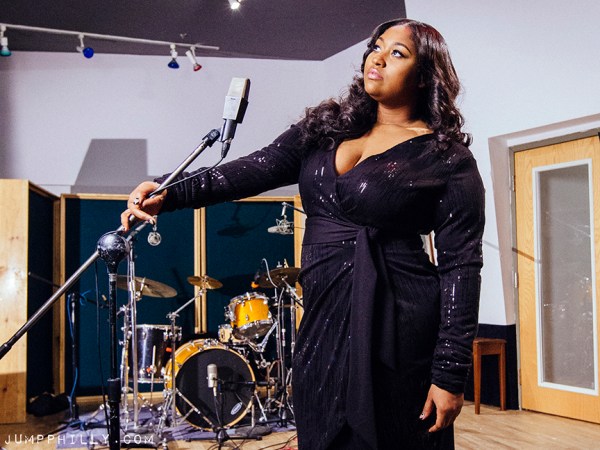 Jazmine Sullivan began performing when she was just a teenager. She garnered a huge fan base after the 2008 release of her debut single “Need U Bad,” which was produced by Missy Elliott. Her first album, Fearless, went to number one on the Billboard R&B charts. Her second album, Love Me Back, was also a smash success.
In 2011, however, the graduate of the High School for the Creative and Performing Arts told her fans in a series of tweets that she was taking a break from music because she wanted to find out who she was without “a mic, paper or pen.” Last year, she revealed that she stopped doing music because she was in the middle of ending an abusive relationship.
Her hiatus was filled with a lot of family time, writing and praying.
Last spring, Sullivan, now 28, returned to music with a new album, called Reality Show. Meek Mill rhymes on a track – the North Philly rapper happened to stop by Sullivan’s session after recording in another studio at Milkboy.
Our Niesha Miller spoke with the “Stupid Girls” singer about her musical roots, working with music professionals from Philadelphia and why she considers herself a regular girl. Portraits by Michael Bucher. Show images by G.W. Miller III.
What role would you say Philly played in helping you break into music?
I went to Black Lily when I was younger, so I got a chance to really hone in on my live performance skills watching Kindred, Jaguar Wright, The Roots and Jill Scott. And all of them, all of those people who came through when I was just a kid, definitely helped me with being comfortable now with singing live.


Would you say any of those individuals served as a mentor for you after you got involved in Philly’s music scene?
Well, Kindred, I would say, was the most influential when it came to me because they really took me under their wing and actually put me on their record [I AM]. That was the first record I was ever on. Their first one. And they were like the big brother and sister. But just all of them. Being able to see everybody perform was helping me to become the entertainer I am now.
Our theme for this issue of JUMP is “Young Bols and Old Heads.” What old heads would you say helped you get to where you are today in music?
I don’t know if my mom would want me to call her an old head but definitely my mom. She’s the most influential person ever. Everything that I do, I kind of model after her. She’s like the most creative person that I have ever known. I’ve always just tried to emulate her and just kind of follow in her footsteps. She actually used to write my songs when I was younger. I got to a point where I was like, “You know what? I want to try this.” Then I started writing because of her. She did it first.
Do you have any other people in your family that were influential musically?
My grandma. She was a playwright. I mean, my mom was a playwright. My grandma was a poet. I grew up around women who weren’t afraid to express themselves. I don’t know if I was thinking about it earlier but once I did start thinking about it, I had people to look up to.
You said the women in your life helped you express yourself more. How would you say that played a role in the lyrics that you write?
They’re just real. I just try to write stuff that I’ve been through. It’s not sugarcoated or anything like that. I get that not only from my family but just from being a Philly girl. We just say how we feel and it’s kind of how I write.
On your latest album, Reality Show, you released a few intimate details about a previous relationship. What made you want to tell such intimate stories about yourself?
First of all, it’s therapeutic for me. It’s helpful for me and I think sometimes we go through some things to share it and to possibly help somebody else. Just letting people know that they’re not alone with whatever they’re struggling with. There are some things that I keep to myself but for the most part, when I’m experiencing it and I’m working my way through it, I almost feel like it’s my duty to talk about it and possibly help somebody else.
I noticed a few favorite songs of fans that stand out on the album are “Stupid Girls” and “Brand New.” What inspired you to write “Brand New?”
I was just observing some rappers and their lifestyles. I was just looking and seeing that it didn’t seem right. It just didn’t seem like the women that they started with were the women that were on their arms, you know? Once men blow up, they kind of upgrade in every kind of way. I just felt like there was a story that needed to be told for the regular women. I’m an artist and some people may consider me a star but I identify mostly with regular women because I don’t look like the typical “star” and I don’t sound like the typical star. I just felt like that story needed to be told on their behalf. On our behalf.
Philly producers Dilemma and Joe Logic produced “Stupid Girls.” Do you actively reach out to work with people from Philly?
My whole band is from Philly. Joe was actually my engineer for like two years. We worked on the record and I didn’t even know he produced. So, we started getting to the end of the record and … he kind of felt like he knew what it was that I had been missing. I was coming in the studio and he had, I think, not “Stupid Girls.” It was another song playing. And I was like, “This is dope. What is this?” He was like, “Oh, this is mine.” I was like, “I ain’t know you produced.” I just started listening to stuff and it just happened naturally. That’s the kind of thing I like. I like when it’s natural. It’s not forced. And we spend so much time together just recording and goofing around and being friends.
“Stupid Girls” has a bit of that bluesy-jazzy flare. Would you say performing at the Black Lily helped shape your sound?
After hearing so much neo-soul every week, it definitely influenced the way I sounded and performed. It might still have an influence in the way I sound now but I think now, because I’m older, I’m able to draw from different influences. It’s not just neo-soul. It’s R&B. It’s gospel. It’s jazz. It’s hip-hop. It’s everything that I’ve listened to growing up.
What’s your favorite Black Lily memory?
My mom used to have these themes for the night. She used to dress me up in these costumes. So I started becoming known not only for my singing but my costumes that my mom would put me in. I would hate it so much.
You’re honest about your relationship in your music and in interviews. What made you want to incorporate your life into your performances?
My songs are a reflection of my life. When I’m on stage I have the chance to talk to people about my songs and what I’ve been through, so I just take that opportunity to do it.
What is it like performing for your hometown?
It’s amazing. You have your family in the audience. You have your friends in the audience. And just people who watched you grow up. It all just feels like family. After you go different places, you get love from different places because everyone’s a fan that comes to your show. But when you’re around people who watched you grow up, it just feels a lot more personal.


PhilaMOCA: Eric Bresler and The Unlimited Art Space.
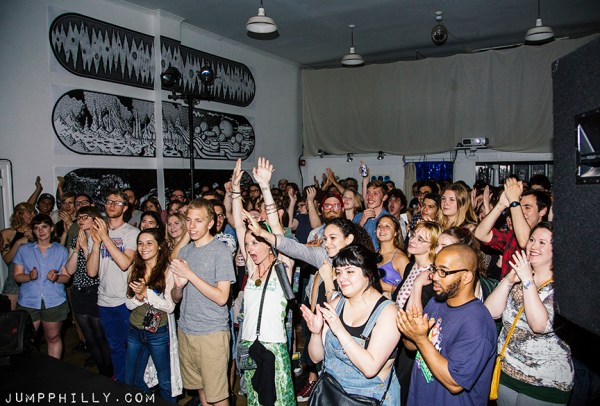 Text by Justin Dowdall. Images by Michael Bucher.
For those who have not been to PhilaMOCA, you may have at least stumbled down Spring Garden Street one night and noticed the fantastic mural and homage to David Lynch’s Eraserhead painted on an exterior wall.
This flexible art/performance space at 531 N. 12th St. is carved out of a former mausoleum showroom and unique to the Philly arts and culture scene.
In an age of house and converted factory shows, PhilaMOCA is sort of a hybrid of the two. That is, PhilaMOCA is a place where art, music and film coalesce under what PhilaMOCA curator Eric Bresler calls “organizational madness.”
Bresler, a former South Philly punk rocker and lover of the arts, also uses terms like “living room” and “welcoming” in conjunction with “professional” to express the ethos of the space, where the Mad Decent Block Party originated and Diplo and his crew threw countless parties over the years (fun fact: he still owns the building).


It is obvious that Bresler wants patrons to feel welcome and even a part of PhilaMOCA. The door is often open at 3 p.m. on a Wednesday for people to come hang out as a parade of volunteers and community members come and go. These artists and friends seem to be the life-blood of the space. Funded completely by the revenue generated by shows and kept going with the passion of its interns and volunteers, the space plays into a Felliniesque atmosphere.
Bresler’s DIY and art-focused roots are a welcome part of the greater Philly music scene. Still, one may soon realize that he has moved past a singular idea of what makes a great show or piece of art. He is quick to note that they schedule events five nights per week and that each event will often bring a completely different audience.
This is all made more tactile by the relatively small, intimate space. Filled with posters of past shows and creative works, including a limited edition baby Eraserhead doll, the space is professionally developed, yet remains open and chaotic. Lineage is easily acknowledged for this post No Wave, DADA revival art inspired experiment.
Artists such as No Age, Lydia Lunch, Parquet Courts, The Pizza Underground (Macaulay Culkin’s pizza-themed Velvet Underground cover band), Hop Along, Modern Baseball and Steven Severin from Siouxsie and the Banshees have all played the space.
“My favorite ever was post-punk legends The Monochrome Set,” says Bresler of his most cherished performance in the space. “It was their first U.S. tour in over 30 years,”
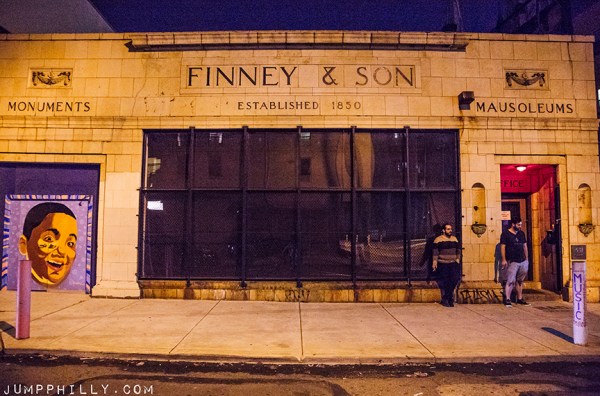 PhilaMOCA is also a place for outsider art but you are just as likely to see a great hip-hop show one night and an LGBT film festival the next. Limits are not a part of Bresler’s vocabulary. This is not one place. It is an almost blank canvas that he allows the performers and artists to paint.
This is indeed a collaborative environment. For example, many of the shows that come to the space are booked by R5 productions.
“The space is great,” says Andy Nelson, an R5 promoter who is also the bassist for Paint It Black. “We continue to remain a part of what’s going on there. It’s great that there is a place for all-age shows. I think that the space fills a need.”
PhilaMOCA has even adopted a local youth as an integral part of their space. “Lil” Sean Coleman is PhilaMOCA’s 12-year-old neighbor, who can sometimes be seen riding into the space on his skateboard and just hanging out. He has even recently screened his own film.
The greater music and arts scene has been equally responsive.
“We get a lot of names that just come to see events but we don’t usually mention them, like Kurt Vile, Talib Kweli,” Bresler says.
Nevertheless, this is just an extension of the sense of community surrounding the space. This idea of a diversity of acts, small space, true fans and everything in-between highlights why the space works.
WIN FREE TICKETS: X @ Underground Arts on Saturday!
We’re working with the folks at one of our favorite joints, Underground Arts, and we’ll be giving away a ton of tickets to their shows in the coming weeks.
On Saturday, the club will host the legendary LA punk band X.
Like us on facebook and email us at FreeJumpStuff@gmail.com to enter to win a pair of tickets (give us your name and put “X” in the subject line).
If you want to play it safe and get your own tickets, find details for the show here.


 JUMP: The Philly Music Project