Don’t Tread On Me House: DIY From The Start.
 Text and images by Darragh Dandurand.
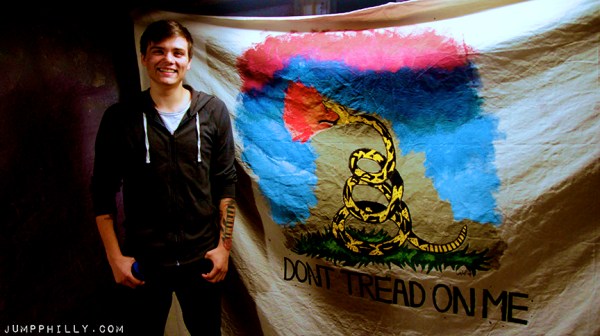
“No one ever really thinks that there would be a house venue in East Falls,” says Jake Detwiler, founder of the Don’t Tread On Me House and one of the three people that live in it. “It’s kind of like uncharted territory.”
The 19-year-old music producer from Willow Grove alternates between playing with his nose ring and tugging the strings of his gray hoodie as he talks about the DIY venue, which he started in May. It’s the only house venue he knows of bringing shows to East Falls.
“None of this was planned,” Detwiler confesses. “My roommates and I were just looking for a place in a decent location that was cheap. We have a relatively cool basement, neighbors that don’t care about the noise and there’s a recreation center across the street where people can park. Everything was just kind of serendipitous about the situation.”
Auctioneer and The Walls Of Sounds.
 Text by Nikki Volpicelli. Image by Kate Harrold.
It’s a dimly lit studio in the basement of a hive of recording spaces that sit on American Street, in an unassuming warehouse that acts like a peninsula of life beside a wide plain of nothing – cement, road, an office building that’s been closed for hours. It’s spacious.
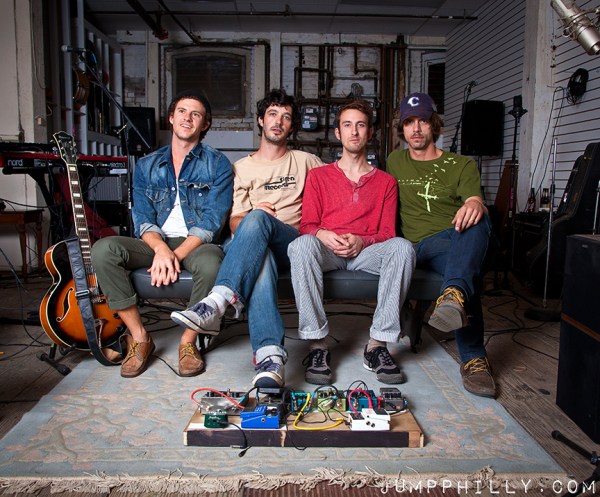
“You laugh so hard,” frontman Craig Hendrix tells keyboard player Jesse Moore, who roars with laughter.
Then, they launch into “Devil is a Mockingbird” with the rest of their indie pop band, Auctioneer, which also includes bass player Todd Erk and drummer Tommy Bendel. The studio is cavernous – it makes everything a little more huge – and you can hear Moore’s belly laugh through the sound of their playing.
“With Craig, he’s always thinking about space and sound and how to push yourself to write new music,” Moore says. “I always feel like whenever we start working on music, no matter how grand or simple the song is, the theme that’s always there is that it’s very composed. It’s very considerate.”
Their last album, Future Faces, was no different – louder and wider than the band’s 2011 self-titled EP, for which Hendrix adopted a more stag songwriting technique. He says Future Faces, which dropped last June, was a “band” record, crafted with super-sonic deliberation, marking out each musician’s deep strengths with a variety of paced arrangements.
Lux Perpetua: Three Thanks To Mambo.
 Text by Brian Wilensky. Images by Michael Bucher.
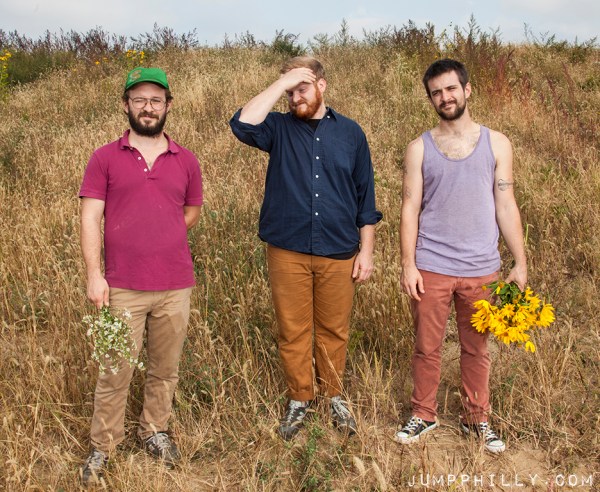
Lux Perpetua is adventurous. And they’re open-minded. But Lux Perpetua has only been “they” for about a year.
Singer/guitarist Justin Wolf and bassist Matt Gibson have known each other for years, having grown up together in Charlottesville, Va. They met drummer Spencer Carrow while working together at Mambo Movers, a relocation company known for employing lots of creative people, such as musicians, artists and writers.
Before Wolf teamed up with his moving partners, he’d written and recorded everything by himself. It was a “labor of love” sort of project, with Wolf basically releasing albums for years, just to hand out to his friends. That sort of independence allowed Wolf to play and write however he felt inclined, which shows on his recordings.
“I really enjoy when a song speaks to me,” Wolf says. “Heavy Shreds the Left Hand was kind of written through the recording process. I’d write a rough outline and then kind of jam and edit it into a full song. It was a weird way to record but it was a fun experiment.”
That may explain the many parts and variety of the 2011 Heavy Shreds’ songs, for example, the change from mirage-like and angular “Little Slice of Heaven,” to the many movements of “Here Comes the Red Witch.”
Gibson and Carrow joined Wolf over the last year, making Lux Perpetua a three-piece band rather than Wolf’s exclusive recording project. His unconventional songwriting has meshed well with Gibson and Carrow thus far.
“Now we’re able to communicate with each other like a band,” Gibson says, “which is to play and jam and get ideas that way. I feel we have the best of both worlds. There’s a prominent songwriter and there’s a rhythm section that can bounce ideas off each other.”
Sammy Roland: Raised By the Philly Music Scene.
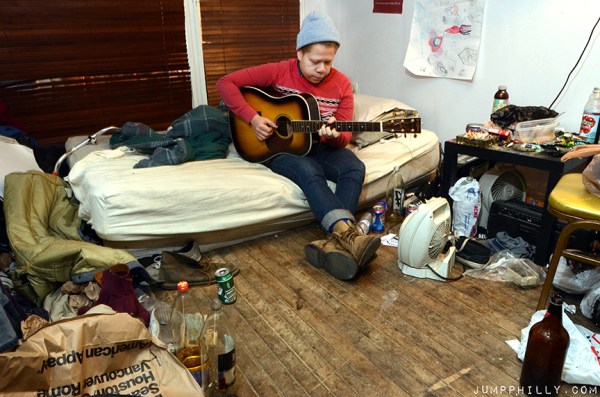 Educated by Dom Angelella and inspired by Ruben Polo, young Sammy Roland is quietly making a name for himself in the Philly music scene. The Cheltenham native is the frontman of Vivre Sa Vie. He now lives in Girard Hall, a warehouse/music space, with seven other people. He writes about arriving as a teenager (he’s now 21) and learning from his mistakes.
I have been booking shows and bands in the Philadelphia music scene and nearby areas since I was a ripe, young lad of 15.
The first band I was in was a prepubescent, mildly embarrassing (as all first bands are), pop-punk band called Dope Sick Girls. During that era, another bandmate and I would spend hours aimlessly emailing venues, booking agents, press contacts, record labels, party houses, older kids in the scene and every other imaginable (and unimaginable) contact. This was almost always to little or no avail.
While this haphazard way of putting ourselves out there was not always effective, it worked sometimes. And sometimes was good enough for us. We were only kids.
Eventually Dope Sick Girls split up into numerous bands and we all found our respective sounds and scenes (or so we thought). As separate entities, we all continued to spread out, finding gigs through word of mouth and through people we met at shows, parties, etc. Being from the suburbs just north of Philadelphia, all of us would routinely play shows at dives, 18+ venues and anywhere that would allow us even a few minutes of performance.
When I moved into the city, I found that the connections seemed to sprout up more than they ever had before simply from associating with new people who knew about newer sounds, looks, gear, bands, houses and anything at all.
Since I’ve made contact with the Philly music scene at its heart, I have beheld a sea of possibility.
Spring Issue Launch Party: SteveO (from The Holy Mess) and Likers at Ortlieb’s on Friday 3/28!
 Come celebrate the release of our spring issue next Friday (3/28) for happy hour (5:30 to 7:30), featuring half-price drinks, $1.50 tacos and performances by Likers and SteveO (above, on the right) from The Holy Mess.
This is a FREE show! Find details on the facebook event page here.
The new issue is AWESOME. It features The Menzingers, RJD2, Get Up, Zilla Rocca, Man Man, Modern Baseball, Needle Points, Fergie’s Pub and so much more.
Find the digital version online here.

 By now, I’m hoping you’ve all recovered from the spring break, Mardi Gras and St. Patrick’s Day festivities that have taken place over the past few weeks. If you haven’t – and let’s admit it, we’re all still feeling a bit groggy – then I think I’ve finally got the cure you’re looking for: live music. That’s all there is to it. When all else fails, live music is there to clear your head, refresh your senses and cleanse your soul. Philadelphia will be hosting a number of amazing acts this upcoming weekend, from rock ‘n’ rollers to singer-songwriters and everything in between. So get up, go out and experience something exciting, unique and new. And yes, there will be beer. – Derrick Krom
FRIDAY
Jake Clemons at World Café Live
Not only is Jake Clemons an extremely talented multi-instrumentalist, but he’s also the nephew of legendary late E Street Band saxophonist Clarence Clemons. He has spent a large part of his young life playing for and with music royalty—Bruce Springsteen, The Roots, Eddie Vedder—and is now taking his own rock and roll solo project on the road.
The Sideshow Prophets and A Brood of Vipers at Ortlieb’s Lounge
The Philadelphia-based seven-piece punk rock R&B band The Sideshow Prophets has been tearing up stages for over 10 years. Joined by A Brood of Vipers, The Sideshow Prophets will be bringing their unique blend of punk attitude, rebel rock ‘n’ roll, sweet Sixties soul and old-time R&B to Ortlieb’s Lounge this Friday night.
Sharkmuffin at Murphy’s Tavern
Murphy’s, apparently, is in Roxborough, which is way too far to bike to. But Sharkmuffin, a noise-pop trio of Brooklyn-based babes, makes the trek well worth the effort. The new-ish band makes garage-like fuzz rock with an attitude and they’ve been garnering impressive reviews over the past year or so. Murphy’s may seem like an odd venue for the band – there will also be karaoke happening that night – but this stop is but one on a mini-tour of odd stops. Sharkmuffin played in a barn in Texas, a coffee shop in North Carolina and will hit a house show near Rutgers on Sunday.

SATURDAY
Ex Hex, Lantern and Cayetana at Boot & Saddle
Ex Hex—an all-girl Washington DC punk power trio of bass, guitar and drums—will be performing at Boot & Saddle this Saturday night. Formed towards the end of last year by Wild Flag, Helium and Autoclave member Mary Timony, Ex Hex is coming off the release of its new 7” on Merge Records and will be joined by local maniacal rock duo Lantern and Philadelphia punk trio Cayetana (pictured above).
Oldermost, Dead Professional and Song Dogs at Johnny Brenda’s
Celebrate the release of Oldermost’s debut full-length album I Live Here Now at Johnny Brenda’s this weekend. Praised for soft beautiful melodies and delicate harmonies, Oldermost are the perfect band to help clear your head. Local rock and roll band Dead Professional and the dynamically vintage-sounding Song Dogs will round out the bill.
SUNDAY
RAC, SPEAK and Prides at First Unitarian Church
RAC used to be known for creating more than 200 official remixes of popular songs, taking the focus away from dance-ability and attempting new and interesting arrangements. But now it’s the solo project of André Allen Anjos who is releasing a two-part album of original material titled Strangers, featuring a slew of popular singers. RAC will be performing this new material live along with dreamy pop rockers SPEAK and Prides.
The HYPE! returns to World Café Live this Sunday for a night featuring some of the region’s best and brightest new singer-songwriters. Drawing on a number of modern and classic influences, Jamie Kent & The Options will close out the night with Philadelphia riot-girrrl trio The Gang Age and numerous other singer-songwriters completing the lineup. It’s bound to be an amazing night.
Mr. Sonny James: Carrying The Torch For Philly DJs.
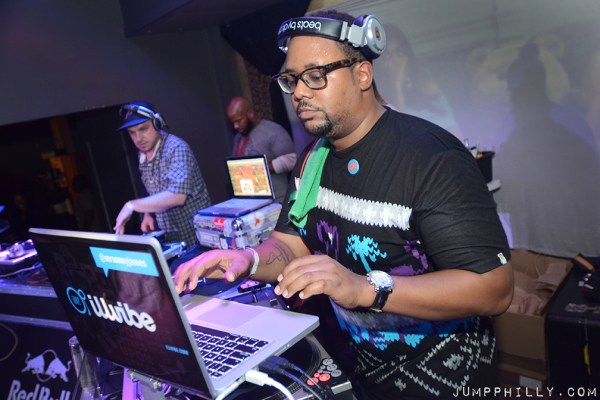
 Here’s our third installment of our monthly mixtape series, which is curated by GUN$ Garcia. Today she brings us Mr. Sonny James, co-founder of Illvibe Collective.
He’s been spinning records in Philadelphia since the age of 12, with the intention of making even the shyest of wallflowers dance. You can catch him spinning hip-hop and classic soul every other month at Body Rock, held at Kung Fu Necktie. He and DJ Lean Wit It will spin at Maxi’s, on the Temple University campus, Thursday evening. Our Lissa Alicia caught up with Mr. Sonny James and talked about tattoos and his passion for music.
How long have you been in Philly?
My whole life. I grew up all over the place. When I was real young, I lived in Northeast Philly, not too far from Franklin Mills. Then when I was 13, I moved to Southwest. I lived I’m Southwest for a couple years, then I moved to South Philly for most of my teenage years until I went to college. When people ask me where I am from, I usually say South Philly because that’s the place where I kind of got my identity.
How did you begin DJing?
I’ve been DJing since I was 12. I guess I started because of my family. Both my mom and my dad had pretty deep record collections, so I would always play around with them. Also, my sister had a friend who was a pretty accomplished DJ in the area – Philly, Delaware, New York Jersey, so I would hang out and watch him. I watched him and listened to the radio – you know, guys like Cosmic Kev, DJ Ran and Jayski. I got inspired and heavily into it. The first time I got paid, I was 14.
What was the gig?
I was a friend’s wedding reception. It seemed normal at the time. My son is 12 now and when I think about it, wow, I can’t imagine him doing something like that.
Philadelphia Songwriters Project: Enter the Songwriting Contest and Win a Chance to Perform at Firefly.
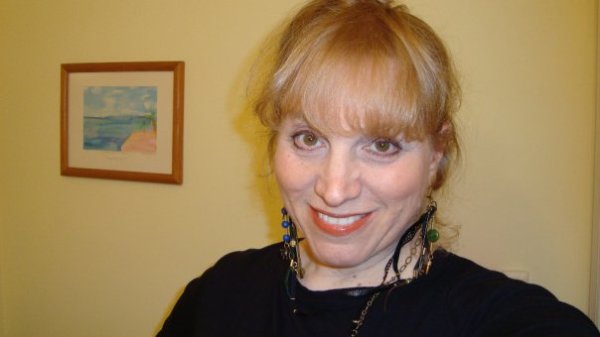 Currently embarking on its 11th season, the Philadelphia Songwriters Project is a grassroots non-profit arts and education organization that “is dedicated to providing local and regional songwriters a place to showcase their music, improve their work and advance their career.” Our Derrick Krom spoke with Dena Marchiony, the executive director and co-founder of the PSP, about the origins of the organization, the influence of the city of Philadelphia and this year’s songwriting contest’s world-class prize package. The deadline for submissions is today, so enter now! Final judging will take place live at Underground Arts on May 18th. More information about the songwriting contest can be found here.
Tell me a bit about the Philadelphia Songwriters Project and how it got its start.
 Philly Songwriters Project started in 2002. Basically, our concept was that there were, at that time, so many amazing songwriters that we knew but none of them had a chance to just kind of do their work. There were mainly two places where people could play. It was either The Point or the Tin Angel. That was it. It was not like you see now. There was just nothing, and you couldn’t really play those places unless you had a following. So it was just a bad kind of catch-22 where somebody was really good but they wouldn’t get the chance to develop an audience.
So, the original concept was that we would create a space where people could develop their fan base and develop their work. We would do these showcases and then we also began to have educational events because we could see that everything was moving more towards the do-it-yourself model rather than just somebody getting a record deal. There were a lot of skills that people didn’t have or things people didn’t know how to do—like, “how to I get in touch with a venue?” or “how do I know when to get a manager?” So we just developed this entire curriculum. We did these workshops for a few years on a monthly basis and that was kind of the beginning and where it all started. Then it evolved and we started doing contests and we’ve been doing contests now for the last nine years. We give people the opportunity to play these really amazing, high-level shows.
Rick @ SXSW: The Disticts, St. Vincent, Kelis and More.
 Text and images by Rick Kauffman.
During the early morning of Thursday, March 13, almost two-dozen people were run down by a drunk driver in downtown Austin. Outside a venue called Mohawk, 23 people were struck, killing two and leaving seven more with critical injuries.
Mohawk was hosting a capacity show featuring members of the Odd Future crew while just around the corner were the 1000 plus stage space where Kelis performed her now decade-old “Milkshake” track while opening for the majestic St. Vincent before Damon Albarn headlined.
Two days into the largest music showcase in the world, a festival as much for journalists as musicians, and one moment will forever undo what seemingly was once a joyous occasion, a celebration of music.
Nothing is sadder than to see something as unifying as the sound of music torn apart as a result of innate carelessness. Our sometime reckless lifestyles, lived vicariously through the words, notes and songs by the musicians we love, can lead to long days of excess only to lose total regard for the very life you hope to cherish.
One could want nothing more than to just get lost in the music.
And yet, the morning will be another day. The artists will return, the people will flock back to the same corner — some unaware of the atrocity committed just the night before — and the music will remain.
Nothing stops the train. Not even tragedy.
And with that, back to the music…
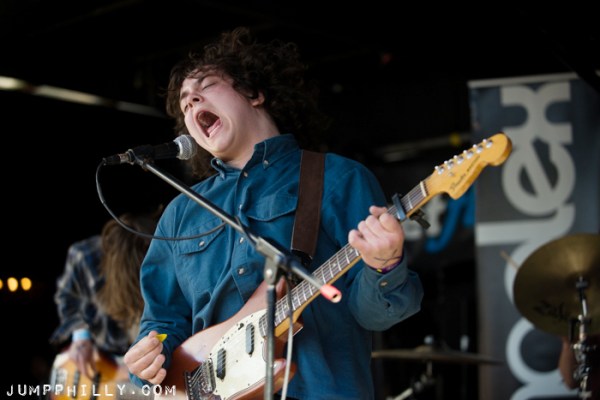
The Districts (above) played the Red 7 outdoor stage mid-afternoon to a shoulder-to-shoulder crowd Wednesday afternoon. Their high-intensity show was only magnified by the vigor of the Austin crowd who helped still the 18-to-20 year olds into a frenzy.
Dilemma: Finding The Magic Moment.
 Text by Ashley Coleman. Images by G.W. Miller III.
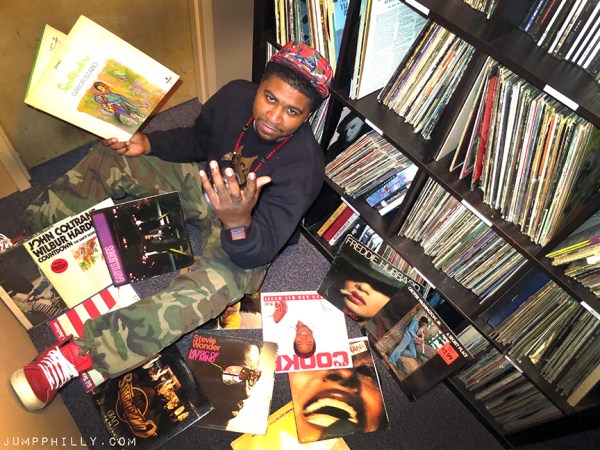
Late in the evening, music producer Dilemma walks in the B room at MilkBoy The Studio and slaps five with fellow producer/engineer Joe Gallagher, a.k.a. Joe Logic, who is laid out on the peanut butter-colored couch, gearing up for a long night.
When most people are winding down for the day, Dilemma’s work is really just beginning.
“I stay up all night in those late-night studio sessions because there is something called ‘the magic moment’ that happens, usually after 3 o’clock and before 8 o’clock in the morning,” Dilemma says and snaps his fingers. “At any given time, the magic spirit will come by and whisper something in your ear and that magic happens, everything comes together.”
Sometimes the magic moment is when Dilemma finds the perfect sound to complete a track, or when he gets in the booth and lays a melody of gibberish over the music that may be used as a guide for the artist to finish the song later.
Reaching into his book bag, Dilemma pulls out his laptop, plugs it into the console and begins playing tracks that he worked on this past week. He scoots up in his chair, adjusts his rose-patterned hat and hits the space bar on his keyboard as Gallagher listens and gives his feedback on each one. The two speak in production language, which sometimes includes words like “warmer,” “fatter,” and more often than not, just sound effects instead of actual words.
You can’t identify Dilemma by what has become a watered-down definition of a “producer.” Not just a “beat maker,” he excels at vocal production, songwriting and engineering. He is a creative ball of energy, full of ideas that come to life in his music. He’s thinking about it all the time and even puts down ideas in an app on his phone.
“One of the things that he does really well is his understanding of arrangement,” Gallagher explains. “It comes from him being a talented writer and performer.”
The University of the Arts is what brought Dilemma to Philadelphia in the early 2000s. He played saxophone and studied to become a music teacher. The idea of becoming a producer had never crossed his mind. It was there that he roomed with longtime friend (and now musical director to the stars), Adam Blackstone. He taught himself how to produce on equipment left behind by Blackstone while he was away touring.
Working diligently at perfecting his craft, Dilemma eventually became a part of the resurgence of Sigma Sound, helping to bring the studio back to prominence within the Philadelphia music scene. He was one of the first in-house producers at the renovated studio, and has worked with some rap juggernauts like Meek Mill, Black Thought, Chill Moody (below) and Joe Budden.
 Dilemma recently put out a remix project that is a unique mash-up of Nas’ Illmatic and Kendrick Lamar’s Good Kid, M.A.A.D. City, entitled illkidmaticcity. He even had the opportunity to share the project with one of the original Illmatic producers, Large Professor.
His production has opened numerous doors for him outside of the music industry, as well. He produced the theme music for TV One’s new series “Verses and Flow,” which just entered its third season. He also just wrapped the first season of Fuse TV’s “The Hustle After Party,” where he served as co-host/DJ. Dilemma created all the music played during the live performance and interview-based show.
With a TV show, noteworthy production credits and finding himself instrumental in the movement of the next generation in hip-hop and R&B music in Philly, Dilemma remains in awe of the power of music.
“You never know when you are going to make that record that could possibly change the world, or get to that person who hears it and goes on to change the world,” he says. “That makes the late nights worth it.”


 JUMP: The Philly Music Project