The Bird and the Bee, the talented duo from Los Angeles, will bring their futuristic-sounding retro pop to Underground Arts next Wednesday and we’re giving away tickets.
Like us on facebook and email us at FreeJumpStuff@gmail.com to enter to win a free pair of tickets (give us your name and put “Bird/Bee” in the subject line).
If you want to play it safe and get your own tickets, find details for the show here.
Angel Olsen @ Union Transfer with Alex Cameron.

Text by Migs Kaufman. Images by Grace Dickinson.
The crowd jammed into Union Transfer last week for a sold out show with Angel Olsen, who recently released her genre-bending (and soon to be classic) album My Woman.
As the crowd eagerly awaited Olsen, they were treated to the 80s-tinged sounds of Alex Cameron, who pranced and grooved in a velvet suit with a saxophonist by his side, straight from the Newark Airport to the stage. Cameron wooed the audience with his slicked back hair and even slicker music as the venue slowly filled to the brim with people.


Soon after, Olsen and her band strutted onto the stage in matching cowboy attire and blasted straight through three songs before saying a word to the crowd, letting the music speak for itself. She then blurt out, “That was fun.”
She is touring to support her most daring album yet, full of breathtaking wails, prickling guitar licks and many songs surpassing 5 minutes. These are not simple folk tunes. But the band kept it cool, hitting every note flawlessly, with Olsen as their fearless leader.
While the band had fun on stage, the crowd stood awestruck, barely able to move as they admired Olsen, who discussed greasy food and beer one minute and belted out “all my life I thought I’d change” from “Sister” the next.
After a strong set, the band returned for an encore of “Intern,” straight into a seven-minute psychedelic jam of “Woman,” giving Olsen a chance to really show off her chops as she hit every haunting high note.


I first heard Angel Olsen when I was going through a big change in my life, moving from New York to the City of Brotherly Love and worrying I wasn’t making the best move. It was both terrifying and exciting all at once – a new chapter in my life. And Olsen was the soundtrack. Maybe because of this, Olsen’s music always brings about memories of change, of something big about to happen.
But maybe that’s just her music, evoking a strange and powerful sense that something big is coming and you better be ready for it.
Savoring the Sights, Sounds and Tastes of South.

Text by Dan Halma. Images by Charles Shan Cerrone.
The scene behind the front doors of 600 N. Broad St. provides a sharp juxtaposition to the flat gray façade – directly ahead lies a decidedly rustic dining area replete with wooden tables and chairs, accented by foliage and dyed glass bottles hanging from the skylights in the room’s center. By the entranceway, a door leads to a secluded patio area lined with flowers and fresh herbs. Directly ahead of the entrance is the bar, wrapping around the corner of the room, and behind the bar the staff is dressed in uniform button downs, bow ties and aprons.
The atmosphere is Southern without showing allegiance to any one state in particular – fitting for South, the latest restaurant from brothers Rob and Ben Bynum of Warmdaddy’s and Zanzibar Blue fame.
“Encompassing the entire South is a challenge,” says head chef Paul Martin, dressed in a black polo underneath his apron.
In front of him lies the open kitchen area and as he speaks, staff members rotate bread in the oven and prep meats coming off the grill.
“I’m from Louisiana but the entire menu can’t be New Orleans focused,” he continues. “It’s gotta spread out a little bit and open up the borders. So the idea is to try to represent Southern food as a whole.”
There’s a lot of square mileage to cover in the American South, but Martin’s background in Southern cuisine handles the challenge. Born and raised in Lafayette, Louisiana, Martin got his start cooking in his dad’s restaurant before working in Austin, Texas at a couple of French bistros. Martin moved around the U.S. for a few years before settling in Philadelphia in 2004, when he signed on with Steven Starr at Washington Square (now Talula’s Garden). He left there to work at Catahoula, which is where he met Ben Bynum.
The two hit it off and when Bynum approached him with the idea of a new restaurant, Martin signed on. South opened in September of 2015.

The menu at South is as eclectic as the regions that it embodies. Diners can expect a range of dishes, with starters including chicken fried oysters and smoked tuna rilette and entrees spanning from cornmeal crusted trout and Carolina shrimp and grits to Berkshire pork chops and wood grilled chicken.
Although several mainstays have remained, Martin points out that the menu always changes.
“The menu’s sort of an organic process,” he adds. “I think it’s more of what people are in the mood to eat right now. Things come on, things come off as they’re relevant – as they’re seasonal or not seasonal.”
“Everything you see here,” he explains, motioning to the shelves that comprise nearly every available inch of wall space, each filled with pickled vegetables and hot sauces, sealed with clear glass cabinet doors, “are all done by my former sous chef, Kieran McSherry. He’s our ‘Pickle Master.’”
In addition to the sauces and vegetables that dress the interior, the herbs and fruit in the garden get used on the menu, including the Summer Berry Cobbler – a cocktail comprised of compote made from the fresh berries in the garden alongside Fishtown’s Stateside Vodka.
“It’s the marriage of the front of the house and the back of the house,” declares Harry Hayman, the director of operations for the restaurant.
Hayman has been with the Bynum’s for 24 years, starting his career with the brothers at Zanzibar Blue and, like Martin, has been at South since day one. Hayman’s duties range from purchasing for the restaurant to marketing, including special events and food ideas.


The Southern Regional Series is one of these ideas, inspired by the ROAM (an acronym standing for Regional Original American Menus) dining series at Heirloom, another of the Bynum’s restaurants. The Regionals are a monthly event on the first Wednesday of every month that revolve around crafting a menu that pays homage to one specific region of the American South and the food associated with it. The series kicked off with a Louisiana-focused menu on July 6, with South Carolina and Alabama being the respective features for August and September.
“We’ve already farmed a ‘table on steroids,’ bringing in Anson Mills and trouts right from the Georgia/South Carolina border,” he says, noting the concern for the highest quality ingredients carries over from their approach to cultivating the restaurant’s regular menu. “We’ve already tasted, like, 10 different trouts until we found this guy who likes to grow the fish out so the 10-ounce filet is on one side of the fish instead of having to butterfly the trout to get a nice filet.”
In addition to the Regionals, South has their classic series every Tuesday, a three-course meal for $25 that changes monthly and pairs well with their “Hours of Happiness” happy hour from 4–7 p.m., featuring both food and drink specials. South hopes to add brunch as a regular offering beginning in the fall.

Though quality and adventurous Southern food is the backbone of South, the heart of the restaurant lies in the live jazz that happens six nights per week in the intimate venue section of the restaurant, tucked behind a set of glass doors. The restaurant works closely with local jazz musicians, curating special events, including Tuesday’s Open Jazz Jam led by percussionist Leon Jordan, Sr. and pianist Orrin Evan’s What’s Happening Wednesdays. In addition, they will book larger, nationally touring acts looking to pick up dates in between New York or D.C.
“Back in the day, Philadelphia was known for jazz,” says general manager Rian Mitch. “There were so many great artists here in the ‘50s and ‘60s. Philadelphia was a bustling bed of all this jazz energy but it’s been forgotten. The idea of this place is to bring back that culture – the energy and drive that the old jazz heads had.”
A former “hopeless musican in doom metal bands,” Mitch’s interest in jazz was fueled by working the restaurant and running sound at one of the Bynum’s other ventures, Paris Bistro.

“Jazz is like punk rock,” he continues. “It’s like the underground of music. It’s where musicians go to be musicians, to break out from tradition and push the envelope.”
The concert programming includes performances by trombonist Robin Eubanks, singer and pianist Freddie Cole, Blue Note recording artist José James and saxophonist Grace Kelly. In September, South is participating in the 2016 Philadelphia United Jazz Festival, curated by bassist Warren Oree of Arpeggio Jazz Ensemble fame.
“We’re always planning,” says Hayman, regarding future events at South. “We’re gonna do the ‘Young Lions of Jazz’ series, bringing in some younger up-and-coming stuff. We’ve also got the ‘Living Legends of Jazz’ series with more mature artists.
“But generally we’re just booking the best goddamn jazz in Philadelphia.”

Open Mic Philly: A Slice of Humanity.
Text by Tyler Horst. Images by Rachel Del Sordo.
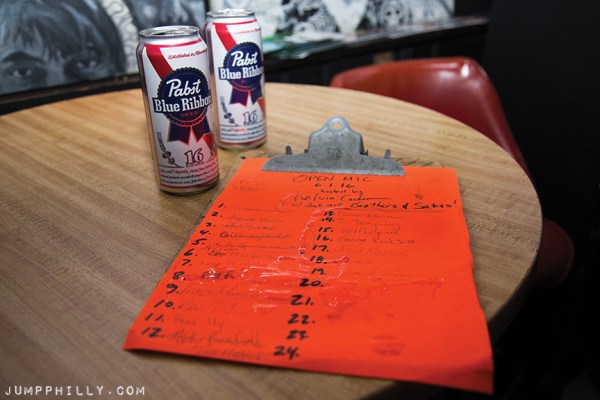
It’s 11:48 at night, and there are still about 10 performers left to go at Connie’s Ric Rac in South Philadelphia. Their names are written on an orange list that at this point is covered in spilled beer.
Kelvin Cochrane, the host for the evening, bounds on stage.
“This is where the Connie’s Ric Rac Open Mic gets real,” he says to the assembled crowd of musicians and friends. “Up next is none other than the Reverend TJ McGlinchey, a certified Connie’s Ric Racketeer!”
McGlinchey, blond hair pulled back in a ponytail, walks on stage with a guitar. Just before he starts playing, he catches the eye of a tall bald guy in a sleeveless basketball shirt that had played earlier that night. Barry Dwyer—another open mic regular—nods back to McGlinchey and climbs on stage with a harmonica.
“I’m going to play in C. You play something in C.” That’s all the instruction McGlinchey gives before they launch into a version of “Dark Hollow” by the Grateful Dead that feels like it was rehearsed, but wasn’t.
That’s just part of the magic of open mic.
On a different afternoon, during the daylight, McGlinchey sits in the tiny backyard of his South Philly home sipping coffee.
“Open mics are pretty much how I learned to play,” he says.
Though he doesn’t have to grind away at open mics looking for exposure like he did in the past, the 35-year-old singer-songwriter and Philly Folk Festival favorite can’t shake his love for those grab-bag weekday nights that he credits with giving him the confidence to play and bringing him into the city’s music scene.
The democracy of the open sign-up sheet means everybody gets a chance to prove themselves, and through years of seizing that opportunity at open mics across town, McGlinchey was able to build his base amongst the other musicians looking for an open stage or just a place to hang out on a weeknight.
When McGlinchey released his first album, Tell Me To Stay, in 2012, he used the network of the open mic world to get the word out for the release show at World Cafe Live.
“The only promotion I did for that album release was Facebook posts and promoting the show at open mics,” he says. “We had over 200 people downstairs at World Café Live.”
For McGlinchey, and for others, open mics aren’t about sharing a half-assed cover of “Wonderwall.” They’re about building community.

It’s a Monday night on the other side of town. The door hangs open at The Fire on 4th and Girard as the sounds of an acoustic guitar float out to mingle with a few scruffy guys taking a smoke break.
Inside, it’s dark and somewhat dingy. The only lights are on the stage. The wooden floor sinks just slightly beneath people’s footsteps. The host throws on some music while Mike James Patrick Robinson, who performs under the name Big Cuz, hands off the beats he’s going to rap over. Robinson takes the mic.
“Welcome to the greatest shitshow on Earth,” Robinson says from the stage.
According to Derek Dorsey, who’s been booking The Fire since 2003, Open Mic Night has been a staple since, well, before he really knows. It started long before his career at the venue and it’s gone through many different stages. If someone had come back in the early 2000s for instance, Dorsey says you were almost guaranteed to see someone who was destined to be your favorite artist.
“It was a scene,” he says. “You wanted to be there.”
Dorsey says open mics are integral to providing a space for acts with real talent to first discover themselves as artists, even if they don’t realize it yet.
Scott McMicken and Toby Leaman started performing at Open Mic as a duo that they would later fill out with other members and call Dr. Dog. Kurt Vile used to perform here. John Legend was so popular at Open Mic Night that he got a residency at The Fire. Amos Lee signed his first record contract here.
The list goes on.
When Birdie Busch – who now has five albums to her name and a captivating voice – first stepped on to a stage at The Fire’s Open Mic Night, she was noticeably green.
“She was nervous, fragile, her voice was cracking,” Dorsey says. “But even in her imperfection, she was perfection.”
All scenes come and go, and though Dorsey says the halcyon days of the singer-songwriter are over since most of the big names outgrew their need for open mics and The Fire now attracts a more diverse set of genres, Open Mic Night has remained a home for musicians in the city.
“This is our living room,” says Robinson after his set.
The redhead rapper says he has been coming to the open mic since 2002 to try out new material and hang out with other musicians. At this point, he guesses that about 70 percent of the weekly crowd is made up of regulars, some of whom are content not to play anywhere else.
“Open mics are the first frontier and the last frontier,” Dorsey says.
The first, because it introduces serious performers to what may be their first platform. The last, because open mics are the last place casual musicians can be anonymous and as Dorsey explains, “feel special in [their] art.”
Bill “Bongo Billy” Clancy (pictured above) is one of the most beloved regulars on Monday nights. He doesn’t really play anywhere else.
When he takes the stage, Clancy pounds out a rhythm on a floor tom taken from the drum kit on stage and half-sings, half-recites lyrics that are either full originals or parodies of other songs. Two out of the three are all about how much the open mic means to him. He closes with these lyrics from a re-imagining of “Chim Chim Cher-ee” from Mary Poppins:
“Here at The Fire, you’re family,” Clancy sings.
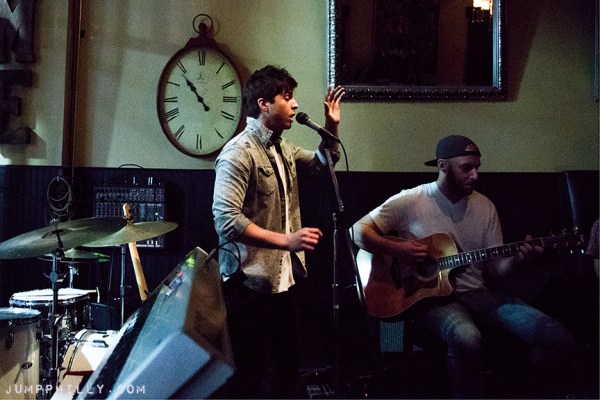
A petite singer named Kriss Mincey stands on the stage at Time and belts out “Summertime, and the livin’s easy,” the jazz standard. Whoops and cheers come from the crowd at the bar, made up of men in jackets and loosened ties and women in nice dresses – the after-work crowd in Center City.
It’s open mic at Time but it doesn’t feel that way. A lot of the performances are acts you’d pay to see, and in fact, performers like Mincy are there to promote a show she’s doing later in the week.
Earlier in the night, Drew Breder played looping bass lines in an entrancing solo performance. The trippy style was somewhat of a departure from the heavy jazz and R&B lineup of the night, but no less polished.
Breder works from his home in Center City as a computer programmer, a job which he says pays for his open mic addiction. He’ll take time off and plan road trips with the sole purpose of hitting as many different open mics as possible.
“I’m just playing open mics but I live like a rock star!” he says.
Many come to Time’s open mic as solo singers, but collaborate with the house band for back-up. You really need to know your stuff musically if you don’t want to completely blow your spot.
“We don’t allow anyone to use backing tracks,” says Anam Owili-Eger, who runs the open mic at Time and plays keys for performers who need it.
Owili-Eger says this is not a limitation, but an intentional choice to make Time’s open mic all about live performance. Nothing pre-recorded or canned. Owili-Eger accepts submissions from performers who don’t want to go it alone, but would rather send in their track ahead of time so Owili-Eger and the Time band of seasoned musicians can devise a live arrangement.
“It’s an open mic,” he says. “A place where you should try new things, and be willing to step out of your comfort zone from time to time.”
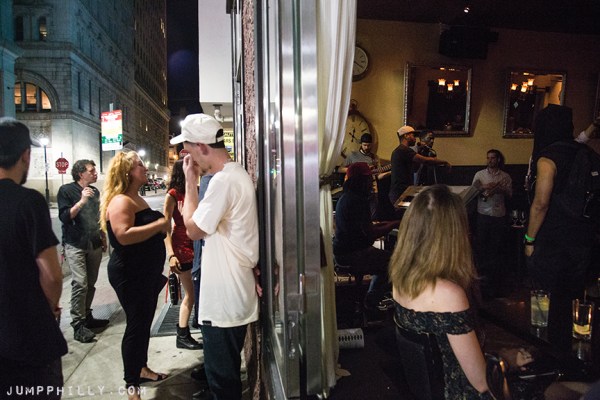
The line stretches all the way around the lobby of World Cafe Live. Young musicians nervously check and re-check their instrument cases to make sure they have everything they need. Inside, right in front of the red-curtained stage sit rows of chairs like the waiting room in a doctor’s office.
World Cafe Live’s “Philly Rising” event is no ordinary open mic. It’s also a competition, and it certainly plays up the intimidation factor.
“Raise your hand if you’re playing tonight,” says host Boy Wonder after a sound check.
Diligently, the front rows put their hands up.
“I’m going to be doing that a lot tonight, so you better be paying attention,” Boy Wonder continues.
He then rattles off a long list of rules that covers everything from how to hold the microphone to instructions on putting the stage back together after a performance. It feels like a parent giving their children rules to the house before going on vacation.
But the most important rule of all is, “Give yourselves a round of applause.”
First up is Joselito “Lito” Gamalinda, singer-songwriter.
“I play piano by ear, so excuse me if this goes wrong,” Gamalinda says.
Gamalinda sings with a beautiful falsetto, but his hands occasionally falter over the keys. The songs aren’t ready yet. They’re freshly written, being tried on stage for the first time.
After his performance, Gamalinda explains that he’s written more than 180 songs since 2014. It was in that year that he decided he wasn’t fully satisfied by his job as a bartender and wanted another way to express himself. Gamalinda performs these songs as often as he can, exclusively at open mics.
On a good week, he says he’ll hit seven: three on Monday, two on Tuesday, one on Wednesday and one on Thursday.
His reason for putting in all these hours just to perform for free is simple:
“It’s my outlet,” he says.
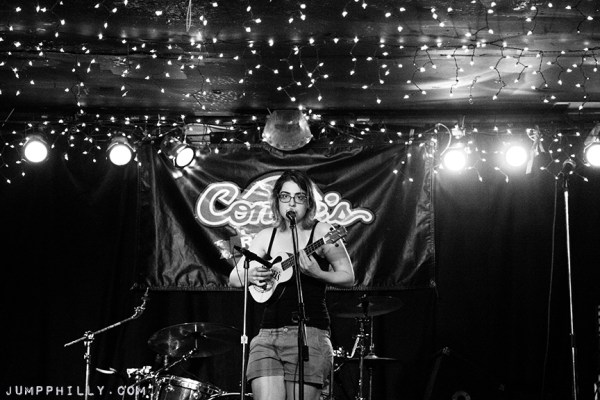
The open mic scene is varied, says McGlinchey, but so are the people you see in the same place on one night.
Cochrane agrees.
“I’m never going to leave this place,” he says of his hosting spot at Connie’s. “It’s like a little slice of humanity.”
Whether it’s an old punk trying new songs or an introverted businessperson playing out for the first time, at an open mic anyone can try, can maybe even fail, and be welcomed into a community of artists.
“Because of open mics,” McGlinchey says, “artists and fans have a home to occupy together.”
Drum Like a Lady: Led by Women. Governed by Percussion.

Text by Cameron Robinson. Images by Branden Eastwood.
When entering Dahlak Paradise bar in West Philly, the first thing you notice are the walls decorated with traditional Eritrean pieces of art from the east African country. From masks to pottery, the art stands out under dim lighting and the smoke from the hookah that fills the bar. It’s ambiance that can speak to the soul.
As the musicians set up for the Drum Like a Lady sister event Jam Jawn, in the center stands the talented mastermind behind this gathering, LaTreice Branson.
While joking with the other musicians, Branson begins to organize everyone by placing a conga here and setting up a keyboard there.
On every third Friday of the month, Branson gathers musicians, women and men, here for a jam session. Little known, yet swiftly growing, is this musical collective Branson has been expanding called Drum Like a Lady.
Branson, 32, first decided to create Drum Like a Lady as a form of therapy for both physical and mental health issues. In 2013, one year from tenure at Cheyney University as an assistant professor of graphic design, doctors diagnosed Branson with borderline personality disorder, PTSD and depression among other disorders. Not helping matters, she received a letter from the PA State System of Higher Education appointed psychologist stating that she was unfit for duty.
“Realizing that I was unfit really took a toll on my depression,” says Branson. “I didn’t leave the house much. Still it’s a struggle.”
While looking for an outlet to express herself, Branson recalls her friend saying, “Why don’t you drum it out?”
At the time, she felt that playing drums wasn’t the outlet she needed. But she tried it anyway and people began to notice her gift. People’s repetitive question of where she learned – to which she explained that her mother was a drummer (below) and taught her – led her to come up with the idea for Drum Like a Lady.
“I was trying to figure out, ‘Where’s my place now,’ coming from academia and now mourning my career,” Branson recalls. “Realizing what to do next or how do I teach when there’s no university to hire me. Drum Like a Lady was something that was important. It was something that could resurrect me from this despair that I was in. But in order to do it I needed other people’s help.”
Branson decided that if she was going to organize this, it wouldn’t be only to help her, but also to aid others like her.
One of the musicians who got involved, Barbera Duncan, currently plays for the band JJX and has been a part of the collection from early on, once she met Branson at one of her shows.
“[JJX] performed every third Thursday. That’s how I met LaTreice,” Duncan says. “Eventually, she asked me if I wanted be a part of Drum Like a Lady. I’ve been coming ever since.”
A young up-and-coming saxophone player, Art Crichlow III, is the featured conductor for this night’s event. As the conductor, Crichlow leads the jam session with Branson’s guidance.
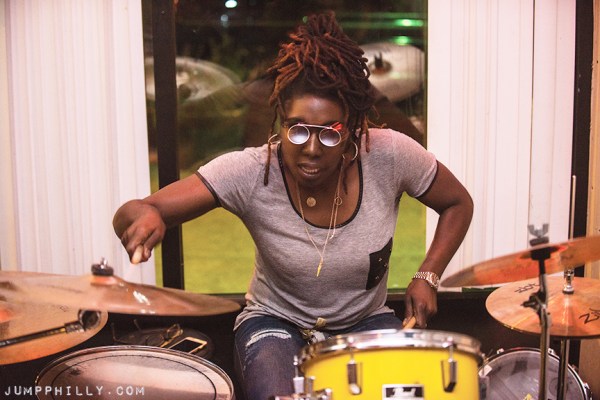
After set-up, Branson introduces herself to the crowd and includes information about Drum Like A Lady, openly inviting anyone to join, with one rule: Ask her or Crichlow first.
As soon as her intro is done, a low rumble escapes from the drums.
The session includes a bassist, a keyboard player, Crichlow on the sax, three congas and a drummer on a kit. The synchronized music make it feel like they have been playing together for years. Not a single beat is missed and smooth transitions are commonplace but most of the people playing together have never met.
After leading most of the night’s session with his stylish and funky notes on the saxophone, Crichlow takes a moment to explain the open environment of jam sessions held by Drum Like a Lady.
“You just walk up and play, man,” Crichlow explains of the relaxed vibe (as long as you ask, of course). “It’s not really that deep!”
People switch out to let someone new step in or borrow one another’s instruments, letting the music slip out of them, while consistently adding to the organic mixture of sounds.
It’s no wonder that Bernie Sanders once recruited them to play for his presidential campaign visit to Philadelphia.
For two hours, they play with unimaginable vigor. Yet in this moment, sitting off to the right, playing her conga decorated with the Puerto Rican flag, Branson looks at peace.
“It’s led by women,” says Branson with a sly smile as she grips her instrument and explains Drum Like A Lady, “and governed by percussion.”
Voltage Lounge: The Intimate Showcase.
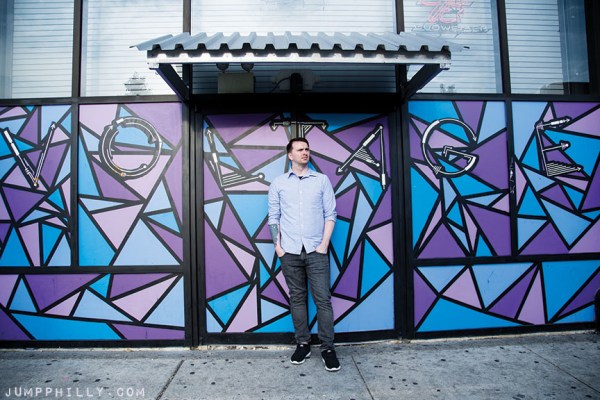
Text by Matthew Hulmes. Top image by Rachel Del Sordo.
Some people stand back as some of the crazier people mosh around, spread out in a circle. Rings of Saturn, a heavy metal band and headliner of the night, scream hoarse lyrics. A big guy with a thick black beard marches towards the bathroom yelling, “Bleeding!” while holding out his elbow with a gash in it.
Voltage Lounge, located at 421 N. Seventh St., wasn’t always like this. It started as a hookah bar and nightclub with a few showcases. Those days are in the past.
Now, it is no stranger to sold-out shows, having hosted everyone from Black Dahlia Murder, a popular Michigan-based death metal act, last March to Mobb Deep, a classic New York hip-hop duo, in April.
“Those shows have definitely helped, you know, and they were great memories,” says Sean Salm, the booking manager (pictured above). “It’s crazy to see the room filled like that… and to have them in an intimate setting with Voltage.”
Things started to change once Salm started working there.
“I saw it had more potential as a music venue,” he says.


“We have a really dynamic show that’s energetic and Voltage was one of the first places to really cater more to our sound,” says Ray Lewis, lead singer of Last Minute Hero, a local five-piece alternative rock band who have been performing for a couple years now. “We truly stand behind the venue and its growth.”
That growth included a vision to show-off the up-and-coming acts and the legends who have been around. The space inside Voltage has less capacity than places like its neighbor, the Electric Factory, or the TLA. This makes them suitable to showcase acts that are on the cusp of the mainstream.
Salm’s experience with booking shows began at Rio, a bar in his hometown of Levittown, Pennsylvania. There, he booked Dice Raw, a songwriter and collaborator with The Roots.
“Dice played our showcase,” Salm says. “He loved it. He loved the organization behind it.”
From this, Salm was given the chance to work with Dice Raw again, organizing an after-party at Voltage for the annual Roots Picnic.
The big guy who cut himself shows up with a bag of ice taped around his elbow. He gets back into the pit, unafraid. It doesn’t look like anyone at Voltage Lounge is letting anything slow them down.
Outlaw Country Comes To Philly.
Text by Dave Miniaci. Top image by G.W. Miller III.
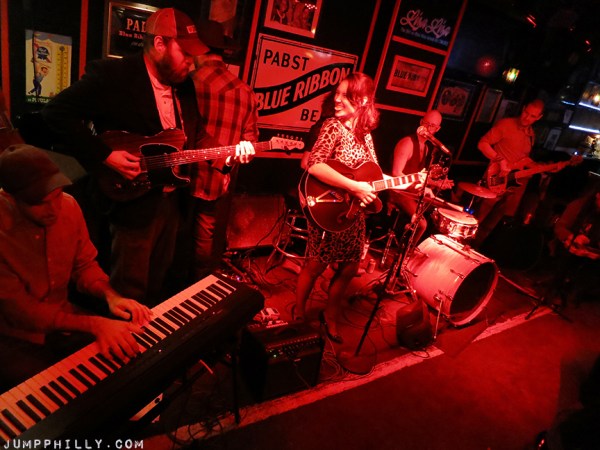
It’s around 9 p.m. on a Wednesday night at Bob and Barbara’s on South Street. The crowd at the legendary bar huddles in various groups, downing cans of PBR under dim lighting and PBR memorabilia-lined walls.
The spot claims to be home to the original citywide special, a shot of Jim Beam and a can of PBR for $3.50. But tonight, it’s home to something else.
Anticipation is building. A pounding sound on the back door. An attendee opens it and four men file in with their equipment, beards, plaid, hats and all.
“The cowboys are here!” shouts an excited patron. Within an hour, loud country and bluegrass music blares through the amps and the increasingly growing crowd starts rocking.


In a city that wears its indie rock and hip-hop hearts on its sleeve, Country Night at Bob and Barbara’s, hosted by the Wallace Brothers Band, reminds Philadelphia there are other genres that draw a crowd. And with it comes a cowboy swagger, whiskey drinking and screaming guitars.
“We were playing out in Kutztown a lot and moved to Philly for a change of scenery,” says Zach Wallace, of the Wallace Brothers Band.
He makes up one-third of the band’s core, along with twin brother Colby on drums and longtime friend Khoa Pham on steel pedal guitar. The group is rounded out by a revolving door of friends on bass.
“We took this road trip to the South and discovered some really great country that wasn’t being portrayed accurately up here,” he continues. “We were at this bar in Nashville called Robert’s Western World, where it was a different live band every night and everyone was drinking and dancing and we were like, ‘We have to do something like this.’”
His searching brought him to Bob and Barbara’s, which had jazz nights and drag shows, but no country. Though aware of the bar’s history as a black jazz and R&B venue, he attended a jazz night he describes as “whiskey-soaked,” with a lot of dancing. It was the perfect vibe he envisioned.
So Wallace went to the bar and proposed his idea, which was met with hesitance at first because nothing like this had been done there before. Bob Dix, one of the bar managers, didn’t think it would work.
He was proven wrong right off the bat.
“That first night was incredible and we kept bringing them back,” says Dix. “I expected every single time for it to drop off and it never did.”


That first night was just the start. A wide array of bands wanting to play traditional country came calling.
Many local country fans and musicians, such as Mike Clemmer of the Montgomery County-based band The Keystone Breakers, agree that Country Night and Bob and Barbara’s became the hub for area country music.
“[The Wallace Brothers] created this outlet, this consistent place to play for country bands,” Clemmer says. “Out in the suburbs, you hear the word ‘country’ and it can take on several meanings and can be traditional or the mainstream you hear on the radio. At Country Night at Bob and Barbara’s, you know what you’re gonna get. It’s gonna be folky and bluegrassy. I don’t know of anyone else doing anything like this. Especially in a city like Philadelphia, country can be few and far between, but they’ve been able to shine a light on it.”
The Wallace Brothers curate the lineup at Country Night, which has been going strong for around two years, usually every other Wednesday night. Zach Wallace says his band and several others come from a folk or alt-country background and can cater to any fan base, making it easy to create a Country Night lineup for any given night.
“I went one night and I was just floored,” says singer Hannah Taylor, a fan and frequent attendee of country night before finally playing it herself. “I was like, ‘This is fucking great, this is in my wheelhouse,’ and I kept going.”
After attending, she approached the Wallace Brothers Band about performing there too. She joined them onstage, admitting she loves harmonizing with other singers and has performed both solo and with a backing band.
“I kinda weaseled my way into playing,” she says with a laugh. ”I’ve played it like six times but I’m there every time. I’m kinda like the hype-woman. It’s a shit-kicking good time.”
It’s a tight-knit community, one which sees bands helping with each other and performing with each other when possible. Case in point, bands are frequently invited back to play and even play with each other elsewhere.
“Most of the bands we have play are regulars at this point,” joked Zach Wallace.
A big draw for the genre is honesty in the music. Several artists remarked how they always appreciated the musicianship and sincerity of old country music. And they try to abide by the spirit of the music.
Lance Davis, aka Grady Hoss, singer of Philly-based Grady Hoss and the Sidewinders, played in various bands over the years. When his dad was diagnosed with Alzheimer’s, Davis wanted to play country as a way to continue connecting with his father who grew up listening to country. He wrote several songs but never intended to record. At the behest of friends, he got a group together on his birthday weekend.
“I said to these guys, ‘It’s gotta be fun or I’m not going to do it,’ and we got some beer and some Jack Daniels and spent the entire weekend in the studio and it was a lot of fun,” Davis says.
In keeping with the style of old outlaw country, and wanting to have more fun, Davis insisted each band member have a nickname. His came from his dad’s middle name (Grady) and the Southern term of endearment for friends (Hoss). He also credits his bandmates with keeping things fun and heartfelt.
“In country, you gotta have a steel pedal guitar, and we got one of the best around in Dave Van Allen,” Davis says.
Van Allen has performed solo and in various bands for decades and was recommended to Davis by a mutual friend.
“He actually brought us all to tears in the studio,” says Davis about bringing in Van Allen. “A bunch of grown men crying. That was something.”
The area bands feel the national trend of traditional and outlaw country taking back the genre – with artists like Chris Stapleton, Sturgill Simpson and Jason Isbell coming into prominence aside artists like Luke Bryan and Blake Shelton – has been felt in Philly, and that has brought some local bands out of the woodwork.
“There’s a lot of pop country out there but now you’ve got stuff making a comeback,” says Jesse Lundy, who in addition to playing guitar in the Rekardo Lee Trio is a Drexel professor and owner of Point Entertainment, a booking agency in charge of the Philadelphia Folk Festival and Ardmore Music Hall. “You have a lot of kids whose parents were listening to Garth Brooks and Alan Jackson and Shania Twain when these kids were little and there’s that nostalgia to it. Now they’re grown up and looking for country.”
Lundy adds there is a lot of good country that hasn’t been fully appreciated up North and country music has earned a certain reputation because of pop country music that dominates the airwaves.
“What’s on the radio is this pop country and no band I know is doing that. Most bands have a background in folk or alternative. What’s up here is something that people won’t think is too hokey or twangy,” Wallace says, adding that the nature of traditional country has an edge to it, as opposed to the clean pop sheen on some mainstream country. “If we came in as just some guys all dressed like cowboys and said, ‘Now we’re gonna play you some Jason Aldean,’ this wouldn’t fly.”
The Philly country artists even acknowledge that nostalgia themselves. Various performers credited hearing their parents and grandparents listening to Merle Haggard, Johnny Cash, Willie Nelson, Hank Williams and other old-school outlaw country when they were growing up.
In Bob and Barbara’s sits a sign declaring it the home of the original citywide special, “Often copied, never duplicated.” The slogan rings true for the state of modern country and the Philly-area country acts that serve as a local look into this idea.
“I think Willie Nelson said it best,” says Clemmer. “He had this quote like, ‘Country music is just three chords and honesty.’”
The national trend in country music is felt in Philly. Zach Wallace has noticed a spike in steel pedals around the city and he has received steady interest from bands wanting to play at Bob and Barbara’s.
“This has kind of centralized the Philly country scene,” Zach Wallace says of Country Night. “If there’s a Philly country band, they’ve probably played here or will at some point. We have taken the country scene and put it under one roof.
“It’s a heavy drinking night,” he adds. “It’s not for the amateur partier.”
Text and images by Brianna Spause.
“Student loans suck.”
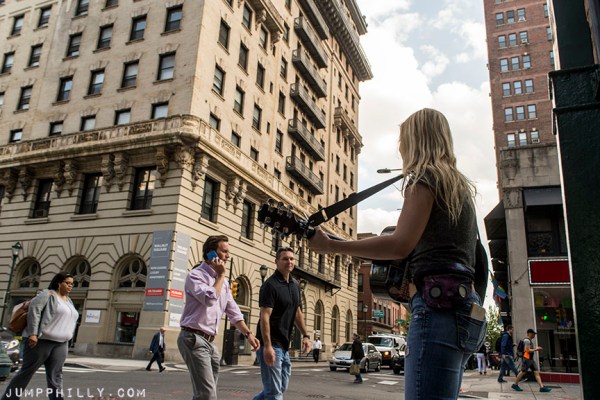
Written on a humble cardboard sign, the overwhelmingly relatable notion of crushing debt is her hook as Lily Maopolski, 21, performs on the corner of 13th and Walnut streets.
As herds of people pound the pavement through Center City, Maopolski greets the rush hour crowd with nothing but her warm, raspy vocals and acoustic guitar.
When Maopolski puts her talents out on display to the thousands of eyes that sweep the crowded streets, she gives a piece of herself to the city and finds a little bit of magic in human interaction in return.
Some stop and listen, others sing and dance along in stride and sometimes the stars align.
A cab driver stops in the middle of the street and leans admiringly out his window for a listen as Maopolski sings “Irreplaceable” by Beyoncé in the afternoon sun.
With a wink she sings the verse, “Baby drop them keys/ you better hurry up before your taxi leaves.” Letting out a deep chuckle, the driver pulls off down 13th Street and on with his day.
Music has the ability to freeze a moment and, as her songs echo down crowded streets, Maopolski brings her constantly shifting audience into the present.
Not everyone passing the performance on the corner pays any mind. But presented with an unexpected excuse to connect with art, street performance allows people to stop and exist, even if only for a moment.
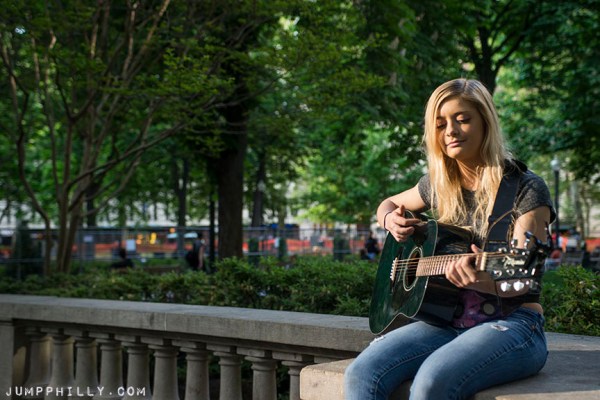
A year ago, Maopolski didn’t even know what busking meant. Now, it encompasses her lifestyle.
She says busking has changed her life both personally and artistically, as she feels more confident when she connects with people through music.
“I put 100 percent of myself out there when I busk and I get that in return from the people passing me on the street, whether it be a smile, a quick compliment or a 15-minute conversation,” Maopolski says. “Playing guitar and singing in the street alone in the city can be a vulnerable thing but I’ve received nothing but love.”
It’s been a whirlwind year for the young artist who plays cover songs on the streets of Philadelphia several times a week. Maopolski leaves her originals at home. She says people don’t pay attention if they don’t know the tune.
Maopolski started busking in earnest after quitting her job at Café Crema, a little cannoli shop next door to Geno’s Steaks, where she had been reserved to busking on her lunch break.
“I was making more money in 15 minutes than in a seven-hour shift,” Maopolski says.
Quickly, her passion turned into a non-traditional way to keep the lights on and those pesky student loans at bay.
“But it’s not even about the money,” Maopolski says as she starts packing up her guitar after about an hour playing in Center City.
She pushes aside today’s haul to carefully make room – some singles, an overripe banana, two mixtapes and a business card for the Ritz Carlton Hotel with scrawled handwriting that reads, “We do live music in the lobby.”
“I just want to perform, all the time,” Maopolski says. “There’s no rules to busking, which is the best part. Sometimes I’ll get that pit in my stomach before I play. But then I’ll think, why am I fucking stressed? I’m just going to have fun. Who cares?”
The freedom of the streets is appealing to Maopolski. She tried out the house show scene for a while with her indie rock band, Space Boner. But that was short-lived and more just about people coming together to jam.
When busking, Maopolski can show up where she wants, when she wants and without any expectations. She says it just jives better with her lifestyle.
Sophiya Sydoryak brought Maopolski out for her first busking experience. With Sydoryak on the hula hoop and Maopolski on the guitar, the pair made a dynamic busking duo.
Maopolski was hooked, and began going solo. Sydoryak says Maopolski’s demeanor and laid-back attitude is what draws people in.
“She just busks because she wants to share art with the world,” Sydoryak says. “There’s something simple and untouched about that. I find that if you share your passion aimlessly, just because this is what you love to do, success finds you.”
And for Maopolski, that seems to be a trend.
She was once belting the chorus to Radiohead’s “Creep” outside of Café Crema and caught the attention of an American Idol producer.
“He was getting a cheesesteak from Geno’s because he’s a fucking tourist,” Maopolski says, noting that the producer said he liked her style.
He invited her to film a brief appearance for the opening credits of Idol’s final season. The next day, Maopolski was riding her skateboard and playing the guitar for a professional film crew.
Without ever auditioning for the show, Maopolski was featured performing for more than 10 million people who watched the season 15 premiere.
Then there was the time the Pope was in town and, while busking, she landed herself a part-time gig selling merchandise and recording parody videos like “Cray Cray for Tay Tay (Girl Craze)” with The Swiftees.
“They think I’m funny and energetic,” Maopolski says. “If my dumb videos go viral, I can get some attention in the media and further my career in doing so.”
It was fitting for the girl voted class clown in high school.
Whether it’s on film or on the streets, Maopolski’s energy is contagious. Especially when she’s busking. Her sense of openness is key, Sydoryak says.
“Lily is light-hearted and never judgemental. That really shines through in her personality,” she says. “People are drawn to her.”
By sunset, Maopolski has made her way to Rittenhouse Square for a second session. Upon arrival, she finds her typical spot has already been taken by two young kids playing the cello.
Out of respect for the kids, Lily plays quietly. A thin, middle-aged man hops off his bike and onto the wall next to Lily for a listen, handing her a dollar folded into a paper airplane after listening intently to her rendition of Christina Perry’s “Jar of Hearts.”
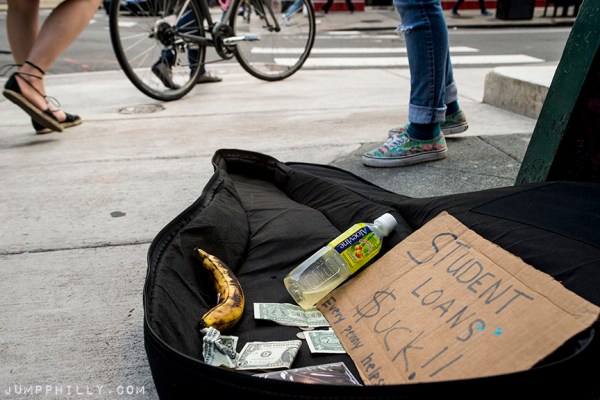
Maopolski says donations could be as small as a smile or as large as the time in Old City, when a mysterious guy stopped his car, gave her a vintage guitar and drove away.
“People are so cool. That’s what you learn out here,” Maopolski says. “You don’t see it every day. You just have to put yourself out there and good things come.”
Those small interactions add up to a massive stage when Maopolski performs on the streets of Philadelphia. That’s what really matters to her.
With no ticket sales, no tours and no rules, Maopolski says busking is special. No matter the street or the stage, it feels like where she belongs.
“It’s a little piece of magic I found,” she says.
The Moon and the Tiger: Long-Distance Music-Making.

Text by Emily Scott. Images by Ben Wong.
Like playing a video game, Dwight Dunston says he enters new worlds when creating music with Brian Miller.
Dunston, also known as Sterling Duns on the microphone, along with Miller make up The Moon and the Tiger: a cohesive fusion of indie rock, soundscapes and hip-hop.
The 28-year-old Dunston says he has always had a “hip-hop sense.”
“I was always making up songs, writing lyrics,” he says. “My dad would always walk around the house and make up songs and I think he was pivotal [to] me as a lyricist.”
These sensibilities attracted Miller to Dunston the first time listening to him perform, which he says was like seeing an attractive person at a party.
“I was like, ‘His voice is so good, his lyrics are so good and just the spiritual presence of his voice.’” Miller says of Dunston. “I was immediately very moved and awakened.”
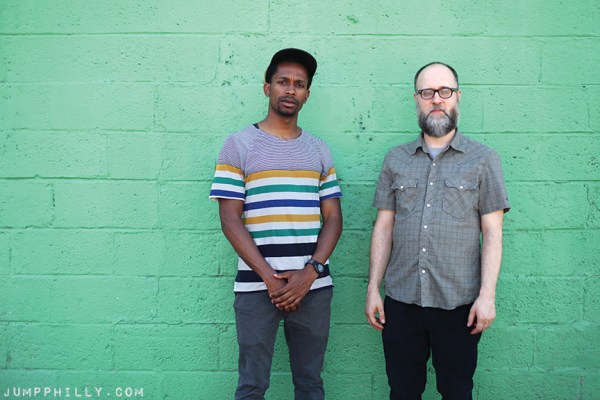
About two years ago, Miller saw Dunston rap in Hardwork Movement, another musical project he’s involved with, at a house show in West Philly. After witnessing the performance, he went home and emailed Dunston, who didn’t reply until an additional email was sent.
Shortly after their correspondence, they began collaborating on music together and discovered the worlds they could create via music, whether it was Miller’s soundscapes or Dunston’s poetry.
“I would just live in them,” says Dunston, who is originally from West Philly. “Listening back to our first EP, I couldn’t tell you where the words came from. When I had to learn the words for the live show, I was in such a trance and daze because of these worlds he creates with sound.”
Dunston, who has both an undergraduate and master’s degree in poetry, says this art form had a strong effect on his lyric writing.
“I feel like studying poetry taught me how to be critical of my own work,” says Dunston. “I got a message, I got 16 bars to do it and do I really need that word?”
Miller adds that learning more about hip-hop is like learning a new language, which he also experienced while playing guitar in a country band.
“I had to learn a new way of music and also a way of how I can have a conversation with what I’m not an expert on, and that’s similar to what we do, I think,” he says.

The 41-year-old also describes his music as having soundscape and movie soundtrack aspects.
“I feel like movie music has the ability to make a mood and I feel like that’s what I try to do,” says Miller, who also noted Peter Gabriel’s “funky beats and introspective quality” as an influence.
Dunston and Miller lead busy lives. Dunston works in education, makes music in both Future Mama and Hardwork Movement. He also does social justice work through City Love, an acoustic duo that assists with workshops in schools and communities in Philadelphia.
Miller is married, works as a psychotherapist and homeschools his children. The two consider their music collaboration like a long-distance relationship, Dunston says.
“We know we love each other and we trust one another to know that we will give everything we got for when a track comes out,” Dunston says.
In March 2016, The Moon and the Tiger released their first self-titled EP. The four-track record was a two-year-long project.
Miller notes Hans Zimmer, a composer for Christopher Nolan films like “Batman” and “Interstellar” as an influence for the record. During his writing process, Dunston listened to a lot of Kendrick Lamar, who he says “paints great stories.”
In the song “Freedom” from the EP, Dunston paints an image of a hip-hop artist who becomes engulfed in the materialistic world and loses himself.
“It is all my fears of what would happen to me,” Dunston says. “He loses touch with family and friends but [gains] all this power and notoriety and at the end the last line is, ‘It’s never too late to look in the mirror and start again.’ It is this idea of starting over and there’s always a second chance to be renewed.”
During their first house show at Silverton band member Julie Beth’s house, the duo were able to recreate their complex sound by having musician friends like Hardwork Movement members Jeremy Keys on cello, Dani Gershkoff on flute and Beth on vocals, percussion and flute, along with Miller’s guitar loops.
“Dwight and Brian just have these beautiful messages they get across so joyfully,” Beth says. “It was one of the most meaningful projects I have worked in and I think they are doing something that is meaningful to them personally, but also on a larger level.”
Although their schedules are conflicting, they hope to put out more music and play more shows in the future.
Miller added that their music combines the rigid rules of hip-hop and indie rock, bleeding together indie rock’s sincere, homemade multi-instrumentation with hip-hop’s simple beat-and-chorus composition.
“It is kind of neat to have these two rigid rule structures come together,” Miller says.
WIN FREE TICKETS: See Two Door Cinema Club @ The Fillmore on 11/19.
Straight from Northern Ireland, Two Door Cinema Club makes danceable rock music that will stick in your brain for a long time. On November 19, they’ll bring their infectious music to The Fillmore and we’re giving away tickets.
Like us on facebook and email us at FreeJumpStuff@gmail.com to enter to win a free pair of tickets (give us your name and put “TDCC” in the subject line).
If you want to play it safe and get your own tickets, find details for the show here.


