Text by Brendan Menapace. Images by Rachel Del Sordo.
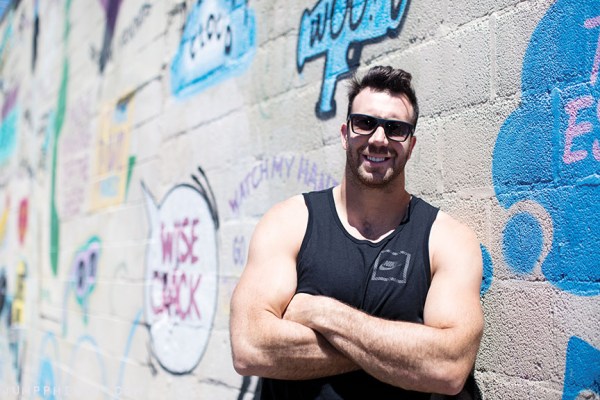
Connor Barwin is hard to miss. With his NFL linebacker size, he’s kind of towering over everyone else at the bar at Prohibition Taproom, just a few blocks from Union Transfer. After introducing himself, one of the bar patrons perks up.
“Oh shit, you are Connor Barwin! Yo, I love you dude!”
He gets that a lot. But by now, he’s pretty used to it. The 29-year-old Barwin who lives in Center City is a far cry from the type of NFL player who keeps to himself. Barwin makes his presence known in Philly. Chances are, if you go to enough shows, you might run into him at the Electric Factory, where he’d just seen Courtney Barnett earlier this night. Or at Union Transfer, where he hosts the annual benefit concert for his Make the World Better foundation, which funds playgrounds and parks in Philadelphia.
“It’s kind of weird,” he says. “Some people are surprised when they see me. But then it’s like, ‘Oh, not really. Like, I’m not really surprised.’”
One might be surprised to learn that the fixture of the Eagles’ defensive line and the city’s music scene was born with complete hearing loss.
Clearly, that didn’t sideline him, on any front.
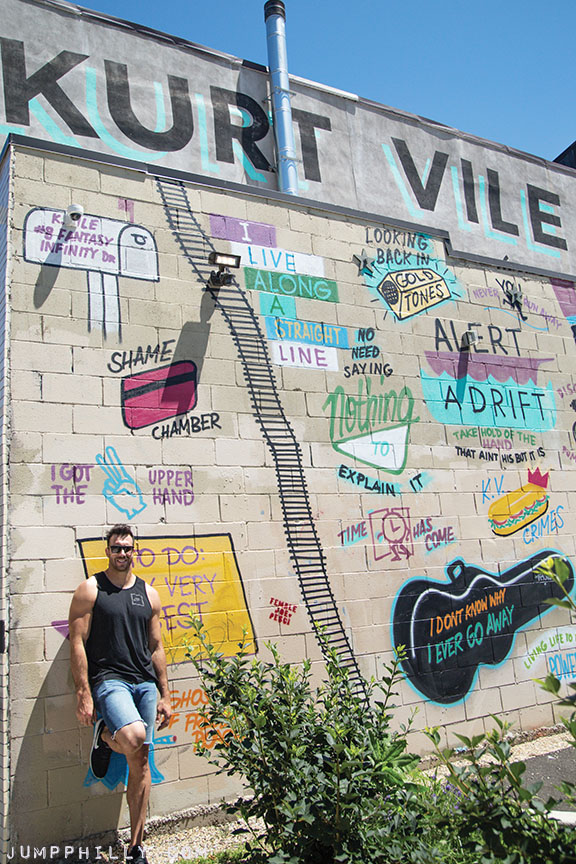
Since signing with the Philadelphia Eagles in 2013 from the Houston Texans, Barwin has used some of his free time taking in the city’s music scene. After meeting Sean Agnew of R5 Productions, Barwin got the ball rolling on his benefit concert idea.
“I remember I went to an Animal Collective show at Union Transfer and Grantland wrote an article about it,” Barwin says. “After that article came out, Sean Agnew reached out to me. I think that’s how I met him.”
Not that Agnew had not already been in communication or anything prior.
“I tweeted at [Barwin] in 2014 when he batted down a ball that secured the Eagles’ spot in the playoffs,” Agnew remembers. “I jokingly said, ‘Free shows for life for Connor Barwin,’ right after he did.”
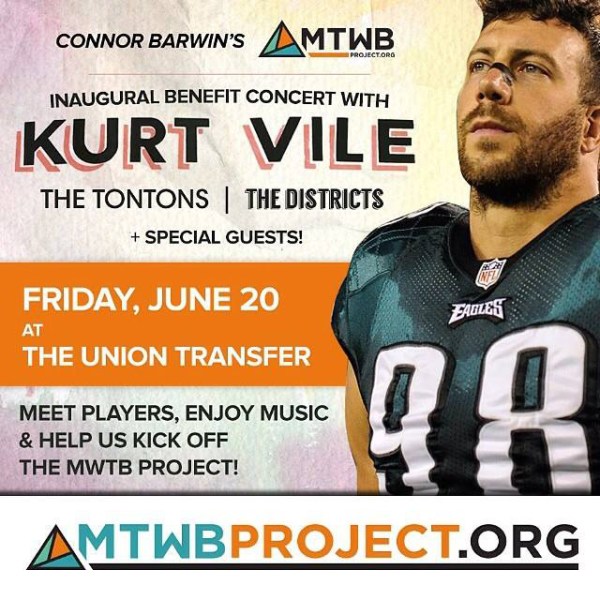
Attending shows didn’t only appeal to Barwin’s musical appetite. It fueled his philanthropic desires too.
“After that first season with the Eagles, I was like, ‘Hey, Sean, maybe we can do this benefit thing,’” Barwin recalls. “And he was like, ‘Yeah, let’s do it! I’ll donate the whole venue, productions, the bar, everything.’ And now we’re going on our third show.”
This show at the beginning of June included a cast of Philly bands, including Hop Along, Waxahatchee and Amos Lee, and benefitted the Waterloo Playground in Kensington.
“It was something special that we just couldn’t say no to,” says Frances Quinlan of Hop Along. “It was a great cause. Parks in Philadelphia are needed and we were really happy to be a part of it. And we love playing hometown shows. We just have such a great time. Our whole families were present. That was really great to see them there and know that they’re a part of it, too.”
Barwin, who was born completely deaf and underwent numerous surgeries through his adolescence to gain any hearing, still lacks the ability to hear in his left ear. But gaining some hearing didn’t give him a newfound appreciation for auditory experiences.
“I wish it did,” he says. “That would be a cool story. Maybe I’d like music even more if I could hear out of both my ears.”
Music was always a passion but he rarely had time to indulge when he was younger, when he was always either practicing football or studying.
“I was in sports all the time,” he says. “It was really when I got to Houston and started playing in the NFL that I had some free time for the first time in my life. And that’s when I started going to shows.”
Agnew says that having the city’s music and sports worlds so close-knit is rare, and the value isn’t lost on him.
“I think it’s super unique and I’m so proud of it,” he says. “I know a bunch of peers who do shows, and they have no athletes coming to their shows. Love Philly for that.”
“I would say that Connor strikes me as a special kind of person,” Quinlan says. “He doesn’t, by any means, have to do any of the things he’s doing. While I’m sure there are lots of people in all sorts of fields who love music, he uses his love for music in a way to give back to his community, which I think is such a generous thing to do – obviously in a financial way, but agian, just wanting to enjoy music with other people. He really seems to genuinely want to do that and I really respect that. I really respect his particular passion for the arts and community.”

After Barwin took some time to also establish himself as a legitimate star in the NFL and watching the veterans’ examples of how to carry themselves on and off the field, he decided to use his position and do some good. He would use his love of live music to do so.
“When I got to Philadelphia, I said, all right. You’re not 21-years old anymore. It’s time to do this if you’re going to do it,” he says. “You’re going to live in Philadelphia year-round. If you want to make a difference, now is your opportunity.”
Barwin chose playgrounds and parks partially due to his upbringing in Detroit. His father was a city manager and was heavily involved with public spaces.
“There’s a lot of playgrounds in neighborhoods that have fallen on hard times and I think playgrounds had a big effect on my upbringing,” he says, referencing research that shows the importance of safe and fun places for kids to play for their development, as well as a playground’s importance in communities and neighborhoods. “Every kid deserves that. There’s no reason because of where you’re born, you don’t have a safe place to play.”
For each playground the foundation chooses to work with, the team at Make the World Better goes through a year-long process of assessing what the community wants and needs and how they can make it happen.
“We try to implement what they want,” Barwin says, noting the relationships he and the foundation have built in the public and private sectors. “And I think that’s the biggest reason we did it. I felt like we were capable of doing it. We could make the biggest impact by doing it to make Philadelphia a better place.”
Flume and Besenji @ Electric Factory.
Text by Christopher Donahue. Images by Teresa McCullough.
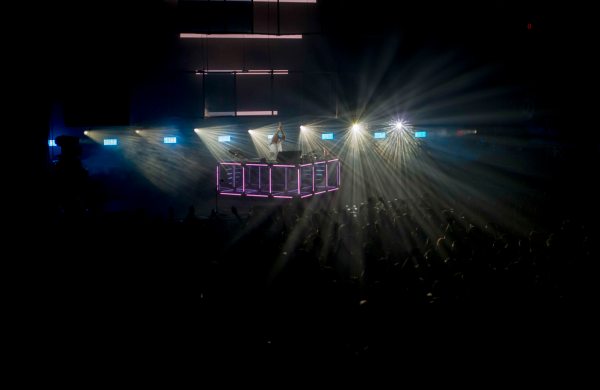
This past Wednesday, the Electric Factory hosted one of Australia’s biggest names in the electronic community: Flume. Last time the beatmaster rode into Philadelphia was two years ago, and with his absence you could feel a yearning in the air from hungry fans.
Besenji, a fellow-Future Classic labelmate, took to the stage first, providing a range of mixed beats to match the eclectic crowd pouring through the doors. But it was the hype and praise surrounding the anticipation of the headliner that could be felt in full force.
The lights went off and the entire place fell silent. The audience scanned the stage for their mix-meister to start dropping his magic, remaining on edge in the darkness as the current sounds went from high to low in a sea of pitch black. A strobe started to flicker and a beat began to rumble. Flume popped out of the shadows as the crowd cheered him on, cell phones in hand trying to capture every moment of his appearance.
If there’s anything a die-hard Flume fan knows, it’s that he will take fans on a journey of emotions through light and sound. He started this trip with the RnB/electronic fused single “Holdin On,” the track that landed him a 2013 ARIA award in his homeland.
From there on, he performed popular singles including the trip-hop track “The Top” that had every mouth rapping the lyrics, to the soulful “Left Alone” keeping the crowd captivated in a spacey groove.
The visuals for Flume’s shows followed his usual theme of a multicolored kaleidoscope feel which mirrors the dream-trap sound he is praised for. While the visuals became more vibrant, Flume took the opportunity to take his fans further into a trance-like experience with favorites such as “Sleepless” and “Insane” which truly sent the crowd into a frenzy. The insanity didn’t stop there as Flume quickly transitioned into “Never Be Like You,” the lead single off his second studio album Skin, and the notorious track that landed him commercial success. The crowd was as antsy as ever as Flume eased them into the Tove-Lo collaboration “Say It,” another fan favorite off the new album.
Flume ended his set with his uber romantic remix of Disclosures “You & Me.” Under his final control of the night, the majority of concertgoers locked lips with their partners as they swung and swayed back and forth to the synth-heavy, bass-fueled anthem that all Flume fans know and love.


Coldplay, Lil’ Wayne and Much More @ Made in America on the Parkway.

Text by Tyler Horst. Color images by Rick Kauffman. Black and white images by Magdalena Papaioannou.
For the 5th year in a row, Jay-Z brought the Made in America Festival to Philly and the Parkway this past weekend. Festival line-ups can vary widely as artists traipse back and forth across the country during summer months to take the stages alongside dozens of other artists on the event bill. The lineup this year in Philly included Jay Electronica (pictured above), DJ Khaled, FKA Twigs, Lil Wayne and 2 Chainz, Edward Sharpe and the Magnetic Zeros, Jamie xx, Grimes, Chance the Rapper, Madeon, Desiigner, Gary Clark, Jr., A$AP Ferg, Bibi Bourelly, Lil Yachty, Bryson Tiller, Sza and Levi Carter with Rihanna and Coldplay each headlining on one night of the two-day music fest during Labor Day weekend.

DAY ONE
The skies cleared up just in time for the gates to open for the first day of the Made In America festival. Thousands came out to see their favorite acts—Rihanna, Lil Wayne, Jamie XX, and more—across five stages spread along the Ben Franklin Parkway.
Things got rolling early with Philadelphia’s own Lil Uzi Vert. Fans sprinted across the Parkway toward Rocky, the main stage, a full half hour before the rapper was scheduled to perform. Uzi Vert then rewarded the crowd’s enthusiasm by showing up a half hour late. The North Philly native appeared genuinely happy at the massive turnout, smiling through the set and hopping down to greet his fans at the barricade. During his hit song “Money Longer,” Uzi Vert ran off stage, around the perimeter of the crowd and out of view of the cameras. After several minutes of an empty stage, he then appeared on top of the camera platform behind the crowd for the final chorus. After the final song, his mic was unceremoniously cut before he was able to say goodbye and the confused crowd slowly filtered out.
While most come to the festival for the big names, the smaller stages did fill the afternoon up with fantastic acts worthy of attention. Punk rockers Cherry Glazerr thrilled a small crowd at the Skate Stage, ripping through a noisy, grunge-filled set while a cadre of skateboarders took to the side stage ramp.


Will Toledo, frontman of Car Seat Headrest (a favorite of XPN’s), told an enthusiastic crowd of their assigned stage, “The Tidal Stage is the best stage, IMO.” Drummer Andrew Katz thanked the sizable crowd for giving lesser known bands like theirs a chance at the big festival.
Later, R&B rising star Gallant wowed a crowd at the Skate Stage. The singer, whose impossible falsetto is just as crisp live as it is in the studio, commanded the stage with wild dance moves and a well-timed kick to the mic stand, sending it flying across the stage. When he moved to his ultra-smooth number, “Skipping Stones,” he told the crowd, “This next one is sadder. I’m going to need to calm down.” Even the skaters stopped to sit and watch the captivating performance.


Though their names weren’t at the top of the bill, you wouldn’t know it looking at the crowd for the joint set of rappers Lil Wayne and 2Chainz. The duo was billed as their two-piece act, Collegrove, but with only two cuts played off their eponymous collaborative album (one of which doesn’t even feature Lil Wayne), the performance was more of a tradeoff between each rapper’s own cuts with the other playing hypeman.


Though 2Chainz commands his own considerable following, getting the crowd hype with hits like “Birthday Song” and “I’m Different,” it was Lil Wayne the crowd wanted to see. Wayne’s had a rough career as of late–he’s been embroiled in a protracted dispute with his label Cash Money Records, and the morning of the festival even let fly with a tweet that suggested he might be retiring from music altogether—but his legendary status hasn’t been forgotten. He dipped back in to classics like “A Milli,” “Duffel Bag,” and “Mrs. Officer.” It was almost like group karaoke, the crowd rapping along word-for-word. At one point, a beaming Lil Wayne said, “I have to say this before the beat hits. Y’all turnt as fuck!”


As the night came to its final act, some left the main stage to warm up with Jaime XX, or dance at the EDM-centric Freedom Stage to Montreal-based duo Adventure Club. Most stayed to get a good spot for Rihanna.
As the opening chords for “Stay” rang out across the crowd, a giant mirror dropped to the stage as fans strained their necks to see where RiRi might appear. Then her voice came from a raised stage behind the crowd and she stood lit by a spotlight in a baggy hooded robe.
After a few numbers, Rihanna stepped out onto a small plexiglass walkway suspended by cables above the middle of the crowd. As it slowly transported her across the crowd toward the stage, lowering her closer to her fans, she danced and sang her way back and forth across her precarious catwalk.


Once on stage, she thanked the ecstatic crowd for having her at the festival. “This is my first time at Made In America,” she said, remarking that she had never seen a crowd of the same size at her shows before.
Rihanna played classics like “Umbrella” as well as popular cuts off her recent album Anti like hits “Work” and “Needed Me.” Part of the performance was dedicated to a medley of her featured hooks on songs like “All of the Lights” or “Run this Town,” plus her more EDM-flavored hits like Calvin Harris collaboration “We Found Love.”
Fans of any era of Rihanna were not disappointed in the wide-ranging set, which closed on a few softer songs and a heartfelt thank-you from the beloved singer.
DAY TWO

Made in America’s second day was star-studded both on-stage and off, if you knew the right places to look. Stages were filled from early in the afternoon to the late evening with heavy-hitters like Travi$ Scott, Chance the Rapper and headliners Coldplay.
Bill Clinton was also spotted wandering around the festival grounds, apparently supporting the campaign to get people registered to vote (for Hillary). Several artists also gave thanks to festival curators and celebrity uber-couple Jay-Z and Beyonce, who were present but far out of sight from prying eyes.
The afternoon got off to a predictably rocky start, with folks waiting for an hour or more outside the festival in lines that barely moved.


Once inside, fans were treated to a jam-packed afternoon. Gary Clark Jr. took the Liberty Stage at 3:30. The guitar virtuoso took fans on a ride through cuts off his recent album The Story of Sonny Boy Slim and first effort Blak And Blu. The singer/songwriter expanded many tunes into adventurous long-form jams, especially the bluesy “When My Train Pulls In,” which had the crowd howling for more.
In contrast to most of the afternoon, the Skate Stage featured acts like the oft tongue-in-cheek emo-punk of Kevin Devine and the Damn Band, who between songs joked and bantered directly with fans in the crowd. Before starting his last few songs, Devine quipped, “Be sure to check out Coldplay later. We’ll be doing stuff with them.”


Soon after, the area around the Liberty Stage was choked with fans of Travi$ Scott (above), the Texas-born rapper and producer known for his punk-rock antics. The stage was decked out with Terminator-style set pieces, and Scott wasted no time getting the crowd off their feet with complex, bombastic music that is almost tailor-made for stadiums. A rowdy Scott kicked the festival cameramen off the stage saying, “The crowd is the only cameras we need.” Toward the end of his set, Scott pushed through the crowd to climb a tree and rap verses from hits “3500” and “Antidote” and nearly brought the tree down with him.


Around the same time, crowds for the up-and-comer Lil Yachty barely fit in the area around the Tidal Stage where he performed. The rapper, who brought a number of his friends on stage to play hypeman, demanded “at least five moshpits” and ended up with ten from his enthusiastic crowd.
Whispering R&B singer FKA Twigs dominated the Liberty Stage with a beautifully choreographed performance of music and interpretive dance, with a live band playing the glitchy, heavily electronic music behind her haunting voice. Rapper Desiigner, who had a massive moment with his hit “Panda,” took the Tidal Stage in the afternoon as well.


The most unique concert experience had to be Edward Sharp and the Magnetic Zeros. The lead singer, Alex Elbert, spent the majority of his set jumping into the crowd bringing the excitement right to the people. Shaking hands and sharing hugs all the way through. Elbert shared the stage with fans bringing two young ladies who held a sign asking to play a tambourine with the band. The highlight of crowd participation had to be the anonymous freestyle rapper who put on quite a show. The band showed no star syndrome whatsoever, performing for the crowd and not themselves.


The night kicked into high gear with Chance the Rapper. The young Chicago rapper, who came from nowhere in 2013 with his hugely popular Acid Rap mixtape and released follow-up Coloring Book this year, gave fans a taste of both old and new. With members of his band, The Social Experiment, backing him up on a colorfully lit stage, Chance moved the crowd with bouncy cuts like “Pusha Man,” “Favorite Song,” and “Smoke Again.”
Chance paused to give the fans a heartfelt thank you and also sing happy birthday to Beyonce, before taking the crowd to church in the second half with Coloring Book cuts like “Blessings” and “All We Got.” Lil Yachty even got to move up to the main stage and join Chance for “Mixtape.”
After Chance, the stage was covered in flowers in preparation for the evening’s headliners, Coldplay.
The hour-and-a-half set was full of sweeping, crowd-pleasing numbers from the band’s deep discography. Fans swayed to old ballads “The Scientist” and “Clocks,” jumped up and down for “Viva La Vida,” then moved their hips to newer hits like “Adventure of a Lifetime.”


A magnificent light show accompanied the performance, including wrist-lights given to everyone who entered the gate that morning. Throughout the set, and at it’s culmination, fireworks soared over the parkway, signaling the end of this year’s festival.
The festival itself was just as much of a mess as years previous, but the strength of the lineup made it hard to miss.
Something about Made In America seems to attract only the drunkest of teenagers, fresh off the train from the suburbs and ready to vomit in the bushes through their red, white and blue kerchiefs. Maybe it’s the all-ages festival saturated with beer advertisements? This time, the EMT buggies got busy carting off passed-out underage patrons to the medical tent before 2:30 had even rolled around on the first day.
The good news is, for those actually of age looking to ease their headache with a drink, the festival is sponsored by Budweiser, so all of the beer was served at a discount.
Just kidding!
It still cost $9.50 for a Bud Light pounder.
If you could stand the litter, the constantly bottlenecking foot traffic, steep ticket prices and the obnoxious crowds, you probably had a hell of a time.
WIN FREE TICKETS: See Violent Soho with Yankee Bluff @ Underground Arts on Saturday!
Aussie alt-rockers Violent Soho will play in the Black Box at Underground Arts on Saturday and we’re giving away tickets.
Chicago punks Meat Wave will open, as will Yankee Bluff, the latest project from former Algernon Cadwallader/Dogs on Acid frontman Peter Helmis.
Like us on facebook and email us at FreeJumpStuff@gmail.com to enter to win a free pair of tickets (give us your name and put “Violent Soho” in the subject line).
If you want to play it safe and get your own tickets, find details for the show here.
Mad Decent Block Party @ Festival Pier.
 Text and images by Justin Swan.
Diplo‘s Mad Decent Block Party graced the City of Brotherly Love on Saturday, August 13th, at Festival Pier.
The event – which was originally housed on an actual block on 12th Street near Spring Garden – brought powerhouse DJs such as Baauer, Party Favor, Valentino Khan and Diplo himself, as well as up-and-comers Herobust, Slushii and Wax Motif.
Mad Decent is the Philadelphia-founded record label spearheaded by Diplo, boasting artists like Dillon Francis, DJ Snake, Major Lazer, Yellow Claw and Sean Paul. The label has even worked with Snoop Dogg. Every summer, the Block Party bounces from city to city, from July through October, ending this year in Los Angeles.


The Claypool Lennon Delirium @ The Fillmore.

Text and images by Ed Schick.
The Claypool Lennon Delirium rode their “Southbound Pachyderm” from New York to Philly last Wednesday night stopping at the Fillmore with their unique brand of rock. The tour is in support of their first collaborative album Monolith of Phobos.
Les Claypool and Sean Lennon came together in 2015 while Lennon’s band, Ghost of a Sabre Tooth Tiger, were opening for Claypool’s main band, Primus. They hit it off on and off stage and decided to get together after the tour to see what would transpire. The end result is the album full of catchy, funky, psychedelic, pop-infused, prog-ish art rock tunes that brought them here.
The Delirium set kicked-off with an empty stage and the prerecorded sounds of “There’s No Underwear in Space,” the last song on Monolith. Claypool and Lennon seamlessly transitioned from tape to live as they headed into a cover of prog giants King Crimson’s “Thela Hun Ginjeet” with Claypool singing lead. It was immediately obvious you were hearing a Les Claypool project as soon as his distinctive bass playing and tone kicked in along with his trademark bounce. At one point, he even threw in a little tease of “Dueling Banjos” which really got the crowd going even more than they already were. I would be hard pressed to find a better song from the set to give an introduction to Sean Lennon’s perhaps surprising guitar prowess. He showed many hallmarks of many a great guitarist: fast and accurate picking, expert use of his tremolo, and deft use of effects. Drummer Paulo Baldi also had a shining moment to open the show with this song and proved to be quite good all night.
Lennon took the mic for the next song, “Cricket and the Genie (Movement I, The Delirium).” Keyboardist Money Mark started it off with an eerie haunted house intro which gave way to a heavy, psychedelic, and bouncy shuffle. The eeriness of the intro was a perfect setup for your first taste of Lennon singing. The moment he started, there was no denying you were listening to John’s son which itself was eerie if not prepared. This was not a bad thing, however. His voice works perfectly for the music being played.
After a few minutes of this tale of child prescription drug dependency, the transition to “Cricket and the Genie (Movement II, Oratorio Di Cricket)” began with Claypool taking over the lead vocals and Lennon singing haunting harmonies. This finished with the first real break for the crowd to show their enthusiastic appreciation. After some brief banter between Claypool and Lennon, of which Claypool was clearly more comfortable doing, it was on with the show.


It was back to Claypool with lead vocal duties on “Breath of a Salesman,” which was a very Primus-sounding song with Beatle-esque choruses. This combination may seem a bit strange but it works incredibly well. Lennon shows off again here to the crowds delight with a soaring guitar solo and a section using the talk box that would make Peter Frampton proud. This was followed by the title track of the album. “The Monolith of Phobos” is where they really started to bring out the psychedelia, and the joints. Lennon’s work on the guitar was pretty impressive as he channeled his inner David Gilmour with perfect use of effects and slide I have not seen since Gilmour himself. Claypool was Claypool on this one from his distinctive leading vocals to his ever unmistakable sound and playing.
Then, it was back to the prog portion of the program, with an abbreviated and instrumental version of Yes’ “Heart of the Sunrise.” This was one of the fan favorites of the night and the subject of much chatter in the hours after the show. This was where the whole band, not just Lennon and Claypool, seemed to shine brightest as a group.
It was a relatively new song to their set but you would never know it by listening to how tightly and precise the song was executed. All parts, from Bruford’s drums to Wakeman’s keyboards to Squire’s bass and Howe’s fretwork, were performed flawlessly. As close to a perfect cover as I have ever seen. “Heart” was the perfect intro to the next number, “Cosmic Highway” which is from another of Claypool’s projects, The Les Claypool Frog Brigade. They stretched this one out to about eleven minutes. There were heavy Yes and Pink Floyd influences on this one. Yet it is undeniably a Les Claypool original at the same time. This was the crowd’s chance to kick back, smoke another joint and sway away to the groove that just about everything Claypool does seems to have. And that’s a good thing. A really good thing.
“Boomerang Baby” was up next which seemed to obviously be a largely Lennon composition. In just about every way imaginable, it sounded like a modern version of a song that could have been on about any album from The Beatles’ Revolver to Abbey Road period. Claypool used an upright bass using both a bow and his fingers to play for an even more vintage sound.
This was followed by the low point of the show. I know most in attendance will disagree, but this is my review. Dean Ween joined them bathed in red lights to perform the Ween classic “The Mollusk.” This is in no way a slight on the song or Dean Ween. It just didn’t seem to fit the whole vibe of the show. Nor did it fit musically. This is one man’s opinion but it was the only point in the show I was bored and uninterested.
Once that was over, the journey continued with fan favorite, “Mr. Wright,” from Monolith. There were classic Les Claypool bass lines as only he can play them. This may have been the best example of the night of his funk bass prowess with lyrical content that harkens back to Pink Floyd’s “Arnold Layne.” This began what was the best stretch of the show.


From there it was a trip “In the Court of the Crimson King,” by King Crimson, of course. Once again, the band shone on this one, especially keyboardist Money Mark. With no break, the band went right into the Syd Barrett led Pink Floyd classic “Astronomy Domine.” Lennon and Claypool on vocals sounded less like themselves and somehow summoned the voices of Floyd’s Barrett and Wright. Another combination of the genius of the mixture of the Lennon Beatle influence and the incredible quirkiness of Claypool followed in “Captain Lariat”. The Beatles’ psychedelic classic “Tomorrow Never Knows” was the next and last song of the set. This was as much of a mini jam session as it was a classic cover song. Once again, Lennon’s guitar skills were on much deserved showcase here. It was, not surprisingly, the crowd’s favorite among many spectacular performances.
The band left the stage to cheers continuing for a couple of minutes before Les Claypool appeared on stage alone to do a fantastic solo rendition of the Primus song “Too Many Puppies” to a very energetic crowd. The rest of the band returned upon completion to perform the Primus song “Southbound Pachyderm.” A great choice as it highlights their versatility by combining elements of funk, psychedelic, prog, pop, blues, and just about everything else they mix into their stew.
Finally, they did a nice tribute to the late great Gene Wilder by playing a version of “Just Imagination” as only they could before returning to “Southbound Pachyderm” and closing the show.
The bottom line is that this was one of the finest musical performances by a band I have ever seen. If you enjoy watching and listening to real musicians performing music, this was a great show. On the other hand, if you need pyro and inflatables and giant light and video shows, you may want to stay home. Eight of the 11 tracks on the album were performed and performed to perfection. The cover songs were just as expertly chosen as you never felt like they were just grasping for songs to round out a two hour set list.
It is not uncommon for bands with only one album to fill out the set list with covers to put together a full show. It is, however, rare for a band to pick songs that so perfectly match their style, sound, attitude and overall vibe. The Claypool Lennon Delirium did this flawlessly and put together one of the best sets I’ve ever heard. I will definitely be returning to see them should they return whether or not they have a new album to promote.
Agent Zero: Honoring a Fallen Agent.
Text by Dan Halma. Image by Charles Shan Cerrone.
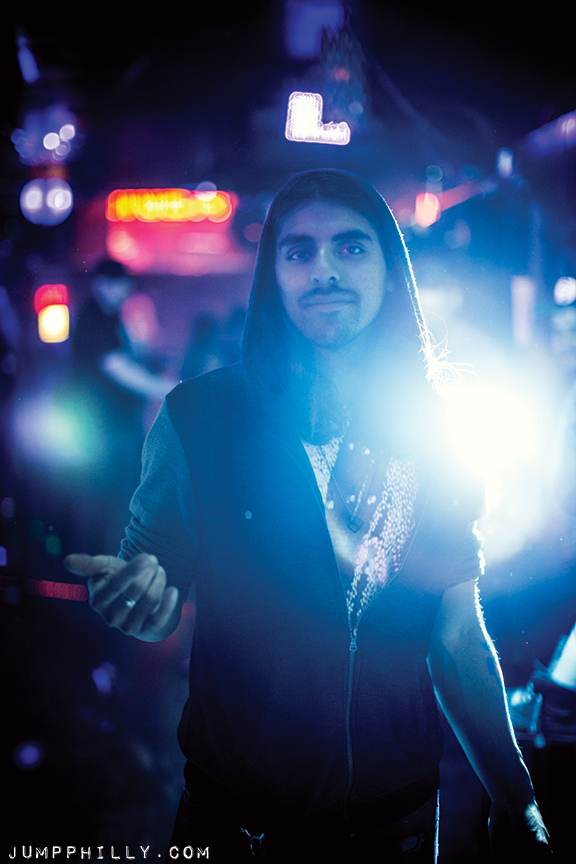
For Noah Selwyn, life in 2016 shows no signs of slowing down.
Since celebrating the release of his latest EP, Mechanisms, with a release show at Silk City, Selwyn, who produces under the alias Agent Zero, has had a heavy roster of Pennsylvania festival dates including slots at Gala in the Grove in Jonestown and Freeform Arts Festival in Honesdale.
When he isn’t performing live, one can find him scoring plays like “Head of Medusa,” engineering at Fishtown’s Boom Room studios or meticulously crafting and experimenting with the sounds that will eventually become his next release.
This weekend was spent playing early morning sets at Mysteryland, but in spite of performing only hours before in upstate New York, Selwyn isn’t phased. Since moving from Connecticut to Philadelphia in the fall of 2008 to work for the non-profit City Year, Selwyn’s had his sights set on the music scene.
“I came to Philly because of the music,” he says. MIDI controllers and studio monitors flank him as he’s seated in front of the home studio in his Fishtown house. “I was really into bands like The Disco Biscuits, Lotus, STS9… so I knew that the Biscuits were from Philly so I’m gonna pick Philly because I like this band a lot and I’m sure there’s gonna be some cool things there.”
As part of working for City Year, Selwyn received aid for college and had originally wanted to pursue a degree in jazz drumming but didn’t get into any program. With community college as a back-up, he enrolled at Community College of Philadelphia, originally for social work before discovering its music production program.
“It turned out to be a really big blessing in disguise,” he’s quick to point out.
At CCP, Selwyn met his mentor, professor Paul Geissinger, better known as Starky, one of the earliest U.S. adopters of U.K. Grime. Geissinger inspired Selwyn to start experimenting with electronic music production in addition to playing in other musical projects. Geissinger’s guidance proved valuable to the budding music producer’s career.
“I gotta give him endless props for not only showing me what the buttons do,” Selwyn says of Geissinger while turning a knob on the keyboard next to him, “but just the drive that it takes to be fast and be precise. How to work on a mix to make it sound as good as it can be with the tools that I have.”
But it wasn’t until the passing of Moses Malloy Jiggets, Selwyn’s close friend and first musical connection in the city, that he found his identity. The two met at an outdoor party during Selwyn’s time at City Year and shortly thereafter Jiggets, who performed under the name Agent M03, and Selwyn played several house shows together and became close friends. When he passed in the fall of 2011, Selwyn knew he needed to honor his friend’s memory.
“[He] was my first musician friend in Philadelphia so I was like, ‘Alright, I need to name my project in this guy’s name,’” he explains. “I came here for the music and this guy was my good friend and his music lives on through the name with me. I took the zero out of ‘M03’ and that’s where the name comes from.”
On New Years Eve of 2011, Agent Zero was born. Over the course of the next year the producer would begin writing and recording what would become his debut album, Sound Sorcery Vol.1, released on Funkadelphia in November of 2013. It was around this time that he met Jason Luber, his long-term guitarist and collaborator.
“I’ve been there every step of the way for the last three or four years,” says Luber over a phone call. The two met when Selwyn joined Luber’s electronic jam band Eudemon, and behind the drum kit proved to be exactly what the band needed. Luber and Selwyn bonded quickly on the way to band practice over their similar taste in music, and soon Selwyn would hit up the guitarist to come over and write with him. Shared musical interests weren’t the only thing that drew him to the budding producer.
“I admire his hard work ethic,” Luber says. “He’s really dedicated and in-it-to-win-it — grinding and grinding every day. We also get along well creatively and there’s very little clashing when it comes to ideas.”
Following the release of Sound Sorcery Vol. 1, the two expanded the live line-up to include Rob “Potter” Green on saxophone, and for the second Agent Zero album, Sound Sorcery Vol. 2, added drummer Ryan “DJ Ha” Aloisi. At the release party for Mechanisms, the Agent Zero lineup grew once more to include vocalist Spenser Michaels.
Considering bands that blend electronic production and more traditional musical performances shaped Selwyn’s aesthetic, it’s a natural progression for him to expand the Agent Zero live show out into a full band.
“It really makes it come alive,” Selwyn says, smiling while pressing play on the live recording from the show. “The fusion of analog and digital is where shit gets real interesting. DJs are cool, bands are cool, but when it’s both, it’s crazy. It’s what I need to listen to.”
Anomie Fatale: “If They Feel It, and They’re Connected to The Song, That Song is Now Theirs.”

Text by Beth Ann Downey. Images by Gabriela Barrantes.
Anomie Fatale knows that in Blondie’s “Sound Asleep,” when Debbie Harry sings “heart beat too fast for sleep,” she’s not singing about tachycardia — the condition of having a faster than normal heart rate at rest. She also knows that “Fade Away and Radiate,” with its lyrics “vibrate soft in brainwave time,” isn’t about dealing with brain surgery issues.
But like what many do with music, she ascribed her own interpretation and meaning to her favorite Blondie songs as they relate to her life – in Fatale’s case, a life of becoming disabled in her early 20s due to complications of brain herniation that was a symptom of her Ehlers-Danlos Syndrome.
“Music for me, I guess throughout most of my life, was just a fun, freeing escape from all the non-fun, non-free stuff,” she says. “Now, it’s not only become an escape but also an expression of the things that were going on which were things you can’t really talk about to most people.”
Originally from New Hope, Pennsylvania, Fatale now resides in a comfortable, first-floor apartment off Shunk Street in South Philly. The walls are painted a happy pumpkin orange and her cat happily slinks around the apartment, jumping up on the sunny sill of the living room’s main window.
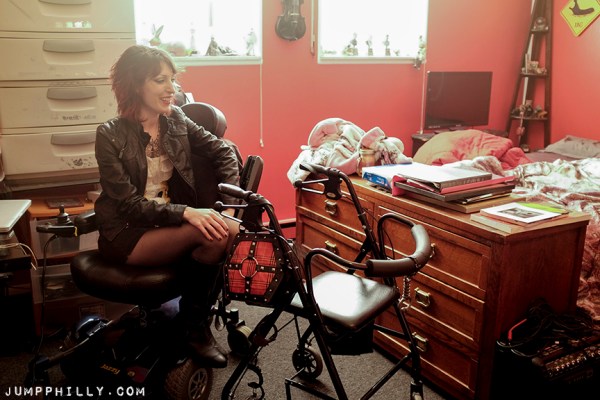
What allows Fatale to have a cat and her own clean apartment are attendant care services — the people she relies on to help her complete tasks like cleaning and shopping. Fatale has come a long way since her first independent housing in North Philadelphia – a sixth floor apartment that was regularly on fire, where she would have to rely on the help of her neighbors to get out of the smoky building because the elevators would turn off.
 It’s experiences like these that were the inspiration for I AM Great Neck, Fatale’s first solo album, released earlier this year. From “Angels in the Ghetto,” about those neighbors who would never hesitate to carry her down six flights of stairs to safety, to “Prison of Care,” about her trials and tribulations gaining attendant care and the institutional hardships many with disabilities face, Fatale uses music to both express herself individually, but also to bring awareness to these issues as a whole.
“If I had to put everything [about my life] to music, that would be a really annoying thing to listen to,” she says with a laugh. “But I think that by having a song, it being catchy and getting into someone’s head, they want to know what that’s about and it makes them ask questions. If you can plant that kind of seed, then that is doing advocacy because it’s like, ‘OK, you can come to me and then I’ll talk to you about it.’ So then they actually know what it’s about and feel even more connected to the song itself.”
Born Kelianne Murray, Fatale relates her medical history to Lemony Snicket’s “A Series of Unfortunate Events.” As a college student studying for a biochemistry degree and with a very active lifestyle, her first warning that something was wrong with her health was headaches and visual disturbances. She had not yet been diagnosed with Ehlers-Danlos – a genetic connective tissue disorder that usually exhibits itself later in life.
“For me, growing up, I dislocated my arms a lot. I had [other] problems and we just thought, ‘Oh, I’m just fragile,’” Fatale says as she pushes her thumb down to meet her wrist and twists her arm one and a half times around, showcasing the signs of the syndrome.
Ehlers-Danlos caused her brain to herniate, and Fatale still remembers that day quite clearly. She was in a Walmart in South Jersey when, all of a sudden, her vision went dark and she felt like her heart was about to leap out of her throat. After this, she was bedridden with tachycardia and other problems until doctors finally found that pressure on her brain stem was what was making her heart rhythm go out of whack. They planned to stabilize her spine by fusing it, explaining that she would only lose slight side-to-side head motion.
When she woke up, she couldn’t move her head at all. It was also fixed downward with her mouth shut — a nightmarish scenario for anyone but especially for Fatale who had been a musician and singer since high school.
She then went around the country to try to get doctors to fix the fusion. After finally finding someone to do the procedure, the complications from that surgery are what made her a quadriplegic due to a wire that came out of place and lodged into her brain stem. Fatale also has a slipped vertebrae which leads to varying degrees of arm weakness and nerve pain. To fix that, doctors would have to fuse her more, and would have to go in through the front with the vocal chords.
“That’s just where I’m at right now,” Fatale says. “It’s like a statement to me to be like, ‘This is how stupid fusion is.’ I’d rather be completely paralyzed then let them fuse me more because I hate it. There’s not a single day that I don’t feel weird. I feel like a mannequin. You’re not comfortable in your own body and skin because you can feel all that metal. You’re not free to move and express yourself.”

Despite her disability, Fatale does a lot of moving around and expressing herself. She brings her music and her message to people by playing various shows and open mic nights around the city, her favorite being Connie’s Ric Rac because it’s easily accessible through the front. Scooting her power chair just in front of the stage and strumming her acoustic guitar as the house DJ plays the backing tracks she created in GarageBand, it’s clear Fatale doesn’t need to be on stage to command the stage.
Katie Feeney, a monthly open mic night host at Connie’s, says she’s always excited to see Fatale perform. Though she says Amanda Palmer is an obvious comparison, Feeney also says that Fatale is definitely her own unique artist.
“Anomie has a really powerful voice both in terms of what she is choosing to say with her music, but also her actual vocal ability,” Feeney says. “She has this deep, booming, lower register that’s really gorgeous to listen to, like honey or molasses pouring slowly out of a pitcher, if that makes sense. I’m always excited to see her at my monthly open mic at Connie’s Ric Rac because she’s so genuine and what she chooses to do musically always excites and interests me.”
This opportunity to invite others into her experience isn’t lost on Fatale. She injects advocacy into her art but does not aim to jam her views down the throats of her audience. Much like her love of those Blondie songs, Fatale invites anyone willing to listen to interpret their own meaning.
“Maybe somebody else had an experience that didn’t exactly fit into what I intended for the song,” she explains, “but if they feel it, and they’re connected to the song, that song is now theirs.
“That’s how songs should be, I think. They shouldn’t just be straight forward.”
Iris Barbee Bonner: The Clothing Is The Canvas.
Text by Hannah Kubik. Images by Ben Wong.
Imagine turning on a nationally broadcasted award show and seeing a celebrity pose for pictures dressed in something you made. For aspiring designers, this sight could be validation, signifying success of their artistry.
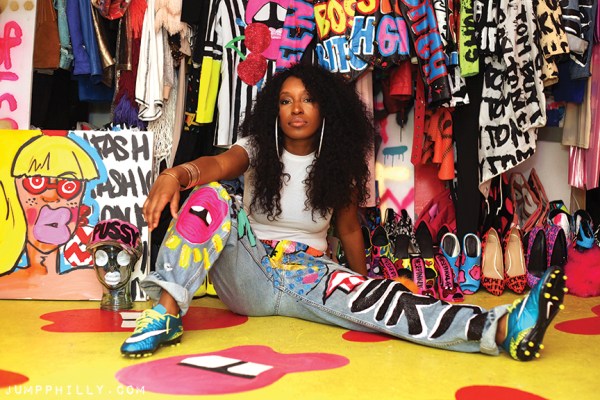
Mount Airy native Iris Barbee Bonner, the fashion mastermind behind These Pink Lips clothing line, has made this dream a reality. For the 2015 MTV Video Music Awards, singer/actress Amber Rose wore a jumpsuit designed by Bonner with words and phrases like “gold digger,” “slut” and “bitch” painted in bright pinks and greens.
Vivid colors are a key element to Bonner’s artistic style, representative of her readiness to come out of the shadows and showcase her work.
“You have to be confident to wear some of the things I make because people will stare,” Bonner states. “I went to the post office and wore a shirt of mine that says ‘Pussy Not War’ and the lady asked me who would wear that? I said, ‘You have one between your legs, what’s the big difference if it’s on your shirt?’”
To draw inspiration, Bonner will listen and watch the visuals in music videos and start painting.
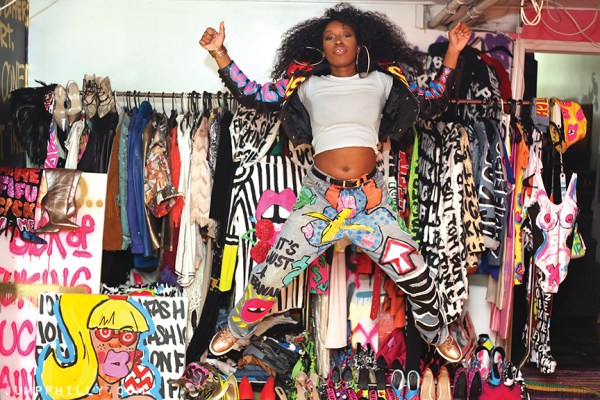 “One day my little sister asked me to come watch Beyoncé’s music video [for] Lemonade and I got so inspired by the music and visuals that I just started painting whatever came to my head,” says Bonner.
Her “Queen Bitch” collection, which Bonner explains is for strong females who do not concern themselves with what others think, was inspired by a Lil’ Kim song with the same title.
“She is a music artist I truly love,” Bonner says. “In college I did a project on her for graphic design, and that was the first time I really felt like I did something cool. I’ve even made some pieces for Lil’ Kim and I keep emailing her, trying to find a way to get her to wear them.”
Walking into Bonner’s Mount Airy studio, it is clear why Bonner is drawn to the bold music icons like Lil’ Kim and Beyoncé. Immediately noticeable are big pink and red lips on the floor with exposed teeth, a silhouette painting of a bare chested woman hanging on the wall, a rack of hand-painted, neon leather jackets and three-inch lace-up boots ready for purchase.
“I still don’t see myself as a fashion designer,” Bonner says. “I see myself as an artist and the clothing is my canvas.”
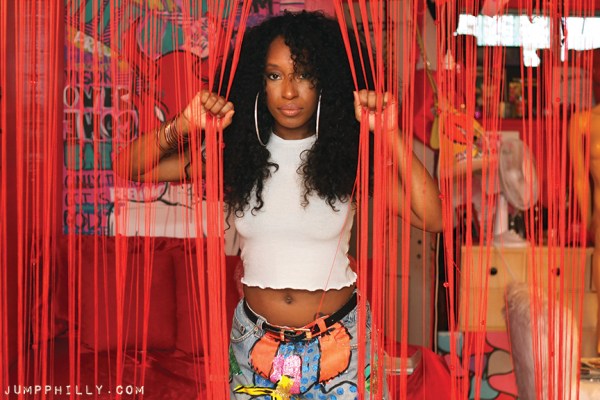 Starting at a young age, Bonner, now 31, explains she always had a love for drawing and wanted to be a fashion designer but never thought she could do it. Instead, when it was time for her to go to college, she used her artistic talent and interest in graphics as a graphic design major.
The first steps toward recognition as a designer were unanticipated. They were the result of using her graphic design skills to begin painting images and phrases on clothing.
“I was making T-shirts and sweatshirts for me and my friends, and people would see us and ask me to make them one,” Bonner says. “I never thought it would become my way of living.”
Seeing the public’s response to her clothing, Bonner’s friends convinced her to have an art show that featured some paintings she had been working on.
“I didn’t want it to be the traditional white walls with hanging paintings because that’s just not me,” Bonner says. “My paintings at the time were very provocative with naked women, and I wanted it to have a brothel feel under black lights.”
The show was called Black Light District and was presented in March 2012. Her friends helped with money, supplies, food, music and even lent her the space. To make some extra cash, Bonner brought some of her clothing to sell also.
“Iris is actually very shy and introverted, which is funny because, based on her art, you would think she was bold and aggressive,” says Angelique Hunter, a close friend of Bonner’s. “She must create her art to express all the things in her head.”


Black Light District sold out before the doors even opened and people left with her hand-painted clothing. Shortly after, Bonner made an Instagram account for her wearable art pieces that drew the attention of fashion guru Patricia Field, who styled for Sex and the City.
“What makes her clothes unique for me is the female expression that we are experiencing,” says Field. “I call it feminist hip-hop, with a great sense of humor.”
Field also sold Bonner’s clothes in the Philadelphia store bearing her name, in addition to the New York location, before it closed. Such exposure proved worthy for Bonner, as celebrities like Missy Elliot bought Bonner’s items.
“Her clothing empowers women in several ways,” says Hunter. “I think it’s a way for women to express their sexuality and feminism. The message is something that everyone thinks but won’t say.”
Today, Bonner’s clothes are featured on Field’s website along with seven other hand-picked artists. In the meantime, she is hopeful overcome her fear of leaving her comfort zone and support system in Philadelphia to travel abroad to Tokyo, where her out-of-the-ordinary clothing can meet a new market.
“I love Philly but I feel like you have to leave your city to be appreciated by your city. I’m seeing I have a lot of customers out of state and I plan to travel to those places to do pop up shows. I’ve already made steps to do so and I won’t let fear hold me back any longer,” Bonner states with confidence.
Curtis Cooper: At Home in Philadelphia.
Text by Vince Bellino. Images by Natalie Piserchio.
Curtis Cooper is working on learning to strike a balance. The multi-instrumentalist played almost every instrument on his self-titled record, an album that is much different than anything he played before.
“I never really listened to punk as music, so this was the first time I wrote music that I thought would suit me more,” he says.
Before the release of the album in January, Cooper played guitar and sang in the punk band Community Service. The band was fast and played exciting live shows but Cooper says the music he plays now — rock music that has included acoustic guitar, banjo, saxophone and a slew of other instruments — is more reflective of what he listens to on a daily basis.
Attaching his name to the project has also afforded Cooper the opportunity to steer his music in the direction he desires. As he works on his second record, which he says will not be released for a while, he has learned to relinquish a level of creative control as he works with members of his live band in the studio, which in turn has allowed his songs to flourish even more.
“These songs are a lot heavier,” Cooper says. “I kinda found the mix between punk and what I just did.”
Born and raised in Philadelphia, Cooper has lived in the city his entire life, save for a few years in Boston. Though he has lived in neighborhoods all over Philadelphia, he recently moved to West Philly for the first time earlier this year.
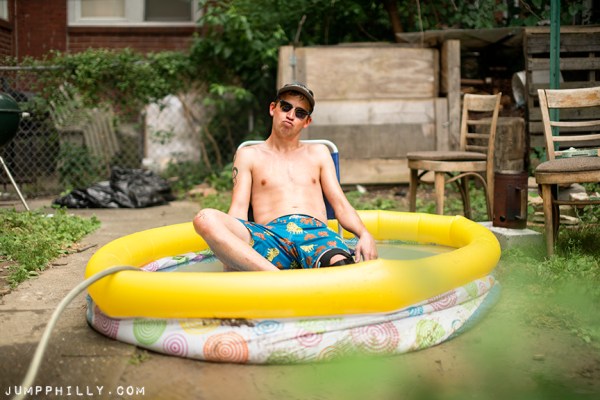
He now lives in the show house All Night Diner, which he believes has had a positive impact on him as a musician. There is no TV in the house and every resident is a musician or artist. The constant playing and creativity inspires Cooper to play and write music more.
“The priority is music in this house,” he says. “So it makes everyone want to pitch in.”


The DIY community in Philadelphia has helped Cooper grow as a musician, and he has helped introduce others, like Emmett Drueding, to the same scene. As a musician and friend of Cooper’s, Drueding’s basement was the place in which the two used to jam to Nirvana covers. Drueding has also seen Cooper evolve as a musician over the years, becoming an honest and original songwriter.
“I think Curtis plays the music that he hears in his head, and I think that’s the best way to be original,” Drueding says. “You see a lot of bands, even good ones, regurgitating sounds or saying, ‘We want to make music like so and so.’ There’s nothing wrong with that but I don’t think Curt’s approach is like that at all.”
Cooper finds a lot to love about Philadelphia. Being here makes it possible to tour up the Northeast corridor, as well as head South, without much difficulty. And he has found what he believes is a very special, inclusive and supportive music community, especially what is based in West Philly.
“That’s the best thing about West Philly. It’s an open scene,” Cooper says. “We’re in a very safe scene out here. I’m very fortunate to be playing out here.”


