The Hard Rock Cafe Goes Local.
Text by Kevin Stairiker. Image and video by G.W. Miller III.
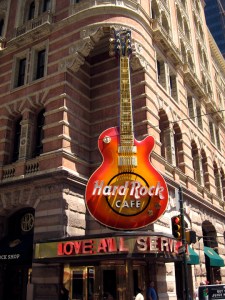 The Hard Rock Café unarguably has a pretty bad reputation: it’s generally seen more as a theme restaurant where out-of-towners come to purchase t-shirts and trinkets than as a live-music venue.
Thankfully, the local branch of the international chain, located at 1th and Market streets, is trying to do something about that.
“It’s a work in progress,” says Jacqueline Allen, the sales & marketing coordinator of the Philly Hard Rock. “We‘d rather it not be like, ‘I‘m coming from out of town so I should go to the Hard Rock.’ It should be more like, ‘I live in Philadelphia so I should go to the Hard Rock.’”
The restaurant opened in 1998 but they didn’t begin regular music events until about two years ago. They have slowly been doing more and more shows, and trying to bring local folks into the venue. In recent months, they’ve had numerous local acts perform, such as June Divided, Dave Patten, Jessi Teich, SezHu, Lydia Rene and Funk Church (in the video above).
This fall, the Hard Rock will undergo major renovations that Allen thinks will turn the building into one of the top venues in the city.
“I can’t give away too many specifics but in the next couple of months, the venue is going to get a lot bigger,” she says. “We’re getting a newer look and a bigger stage, all the while bringing in bigger bands each week.”
See the Hard Rock’s website for a complete listing of upcoming shows.
Black And Nobel: Antenna of Energy.
 Text and images by Chris Malo.
In the heart of North Philadelphia, in arguably one of the city’s most drug riddled neighborhoods, is a different type of business, one offering the opposite type of product that many of the other corners peddle.
Located at Broad Street and Erie Avenue, Black and Nobel is a community resource that slings hope, information, books and music.
Black and Nobel owner Hakim Hopkins began selling books on the sidewalk in 2003, before doing enough business to rent a location on the same block. Eventually he expanded to the current location at 1409 Erie Avenue.
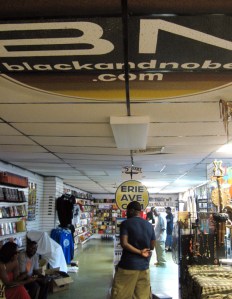 You enter the store by walking up the steps, through a poster and flier covered staircase to the second floor. You are greeted not only by the books, movies and CDs that line the walls but by Tyson Gravity, who has worked at the store for more than six years (or, as he explains, long enough to see his long black locks turn a silvery-gray).
What is striking is that there is a constant stream of people who come to Black and Nobel – not just to shop, but to engage with the community. They come to talk, trade ideas, discuss anything and everything. The guiding philosophy, Hopkins says, is to teach people. From simple manners to business concepts. On the far wall there are shelves with books dedicated to educating people about the music industry.
In addition to retail, one of the programs that has become the pride and a cornerstone of Black and Nobel is shipping to prisons. Between twenty to thirty packages per day are mailed to correctional facilities around the country, serving those who are locked down. Recognizing the possibility of hard work and entrepreneurship, Black and Nobel makes their entire inventory available for wholesale, to encourage people to find the same success they have.
Black and Nobel has become a staple to the Philadelphia hip-hop industry. A who’s who walks through the door on any given day. From Freeway and Peedi Crakk to Jakk Frost, Tone Trump, Oschino and Meek Mill. It has even attracted out-of-town legends like Raekwon, Professor Griff from Public Enemy, Styles P and Rick Ross.
There’s even a story about a cypher taking place out front, when a hooded figure strolled up, jumped in an pulled off the hood to reveal the D-Block General Jadakiss.
But what is, and will always be, important is the hometown team.
“We are hip-hop,” Tyson states. “It’s important because from the outside looking in, a lot of labels say that Philly artists are a liability. If we don’t support each other, we are showing we are a liability.”
In these difficult economic times, with bookstores filing for bankruptcy and music labels scrambling to come up with a new business plan, Black and Nobel is optimistic about what lies ahead. They know they offer what other brick and mortar or online businesses can’t: a sense of community, in their own community.
Vox Populi: Bringing Music & Art Together.
 Text by Christopher Brown. Image by Eliza Morse.
Vox Populi, the art gallery in Chinatown North, recently launched a new performance space, AUX, allowing them to intertwine art, music and dance into a multi-dimensional experience.
“We hope the new space will function as a continuous testing ground for local artists and musicians,” says Greg Rossi (above), program director at Vox. “Billing music and performance art together is part of this experimentation and we hope to generate a dialogue between these worlds that isn’t always active in other venues.”
The space was filled to capacity – around 70 people – during each of the three nights of the official opening in July. The christening included a long string of multi-disciplinary and experimental performances, including dancers, musicians and artists of various disciplines.
“Philadelphia has a thriving, vibrant performance scene,” says Becky Hunter, Vox Populi’s press officer. “There’s clearly audience demand for more crossover between art, music and dance.”
The performance area was built in part with a $30,000 Creative Industry Workforce Grant.
Vox Populi is located at 319 N 11th Street. Check Vox Populi’s website for show schedules. Most events will be free, all-ages and open to the public.
Milkboy Philly Opens!
 Text by Kevin Stairiker. Image by G.W. Miller III.
 It’s not easy finding time to talk to Tommy Joyner.
Joyner, who runs Milkboy Studios and operates three Milkboy Cafes (in Ardmore, Bryn Mawr and a new location in Center City) is in constant motion.
Even when he’s standing still, he’s on the phone, tweeting, thinking about one of his businesses or otherwise planning the success of his ever-growing, yet-humble empire.
“There have been times when I’ve had to leave a session at the recording studio to go to one of the cafes to fix a toilet, and then go straight home and spend time with my family!” Joyner says with a laugh. “It’s a never ending job.”
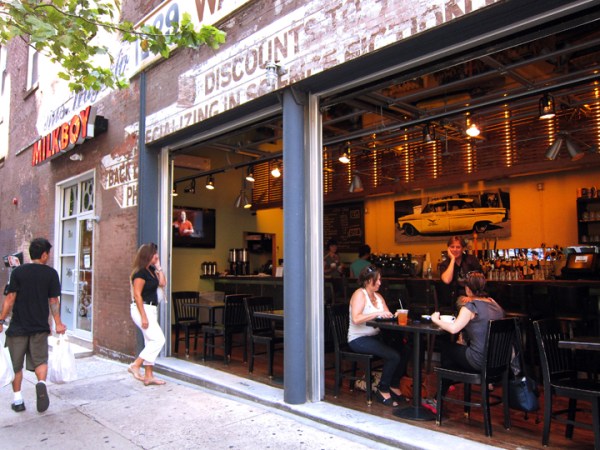
His days are about to get longer once the new Milkboy officially launches this month at 11th and Chestnut (the location quietly began operating in August). Unlike the suburban locations, the Center City spot is a full-blown bar as well as a coffee shop. It will open around 6 am for the workaday crowd and then close at 2 am, after clearing out the revelers.
The two-story corner location across the street from Jefferson Hospital, features a 200-person, standing room-only performance venue. Joyner describes the space as a “down-and-dirty, fun bar.”
The landlord of the building contacted Joyner about the location.
“He had a grant and a loan from the city of Philadelphia to improve the area,” Joyner explains. “They were looking for a business that was a coffee shop or an eatery or a music venue, something exciting. So when the landlord plugged in all those things for a search, guess what came up? They came to us and said, ‘We’ll build this place to suit if you’ll operate here.’ It was kind of an offer we couldn’t refuse.”
The first show will be on September 17 – GANG will perform with Hank & Cupcakes. Black Landlord will play on September 24. City Rain performs on 10/27. See Milkboy Philly’s website for more listings.
Eric Smith & Peter Marinari: Of Lines, Lyrics & Technology.
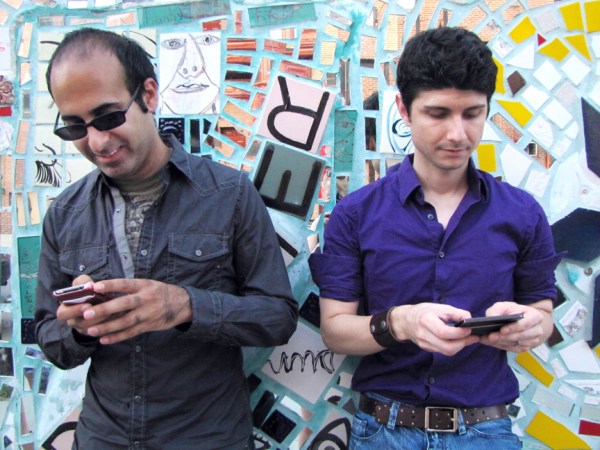 Text by Lauren Gordon. Images by Ashley Hall.
Peter Marinari and Eric Smith probably would have stumbled across each other at some point. They are both savvy with technology and obsessed with social media.
But it was music that ultimately brought them together – albeit through the Internet. Read more…
Chalk & The Beige Americans: The Fisher-Price Version of The Roots.
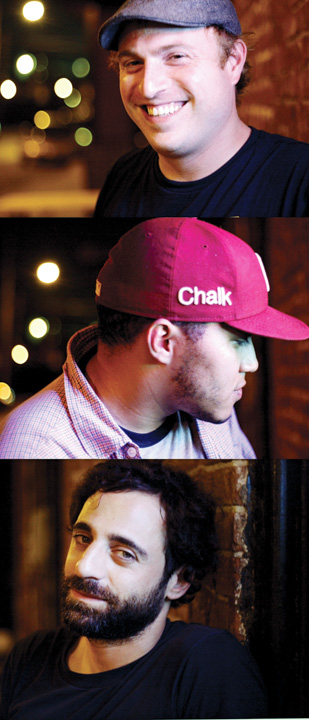 Text and images by Megan Matuzak.
Chalk & The Beige Americans were originally just named Chalk. But then lead vocalist David “Chalk” Mayers Jr. had a revelation.
“We are all variations on beige,” Mayers explains. “White people aren’t white. Black people aren’t black. We are all variations of the shade. The name is just funny. There really was no reason.”
The three-man group prides themselves on comical variations of their band’s name, including BeigeHeart, Beige Matthews Band, Beigetastic, Beige Jovi, and The Beige Mayers Trio, to name a few.
Mayers jokes about calling their first full-length album, which is due to be released in the fall, The Beige Album.
The two-year old bands’ laid-back style features smooth grooves and avant-garde lyrics.
“If you took a whole bunch of A Tribe Called Quest grooves, with some ‘50s fucking bass styling over that, with guitar over top, where the acoustics are very folksy and gospel,” begins bassist Dave Kasper, “that’s how we play. How do you really explain that to people?”
“We have been struggling with trying to find a phrase or a compound word for this genre,” says Mayers. “People have been calling us ‘soul hop.’ It’s just hard because I feel like we touch on a lot of genres. It’s overdone but I think our music is just a melting pot of genres. If I had to anchor it down, it would be more like funk.”
“Not funk,” says drummer Rich Breazzano. “It’s a groove. It’s so simple that you could drive a truck through it. It’s like a grilled cheese sandwich. You know, it’s all the cheese and bread and then you just eat it.” Read more…
Blondell Reynolds Brown: The Dancer in City Hall.
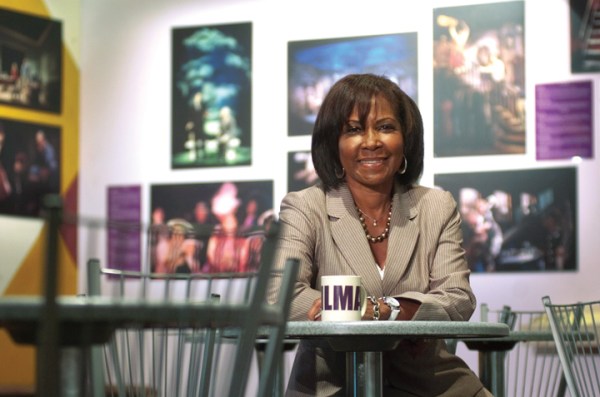 Text and interview by Cary Carr. Image by G.W. Miller III.
Democrat. Educator. Advocate for youth and women. Councilwoman at large Blondell Reynolds Brown is known as a forceful politician who isn’t afraid to take a stand for minorities in Philadelphia. But the Penn State graduate also identifies as a life-long dancer, former member of PHILADANCO and an enthusiastic fan of jazz music. That’s why her responsibility to support Philadelphia’s arts and culture fits perfectly into her life in the world of politics.
So while the city faces an uphill battle to protect the arts against a diminishing budget, Brown uses her passion for song and dance to keep the music playing as she maps out her next public policy victory. Whether it’s mastering difficult choreography or convincing council members to see her vision, Brown is determined, hopeful and unrelenting. Read more…
UPenn Glee Club: The Brotherhood of Song.

Text by Kelsey Doenges. Images courtesy of the Penn Glee Club.
“Marry Me, McCartney” signs flooded New York’s John F. Kennedy airport on February 7th, 1964. Thousands of teenaged girls didn’t notice the cold because they were too fixated on screaming until their voices disappeared, jumping until their legs fell off, and hoping to catch even a glimpse of four boys with mop-top haircuts who would soon be stepping on to American soil, starting the British invasion.
***
Similar scenes hold true whenever the University of Pennsylvania’s Penn Glee Club, a group composed of three-dozen male choral performers, touches down in a far off place.
Erik Nordgren, current director of the club, affectionately tells one tale from when he was a performer in the club.
The year was 1999 and the Penn Glee Club was on one of their overseas tours, this time in Japan. It was their last big concert of the tour, in an all-girls’ high school in Hiroshima, jammed to full capacity with around 1,500 people.
The ladies of Hiroshima became so emotional and excited that they didn’t know whether they should scream or cry. So, many just did both.
“It was literally ridiculous,” Nordgren recalls.
The Glee Club received fanfare as if they were a crazy pop sensation.
It must be something about choreographed, singing boys in Oxford button-down shirts, khaki pants, blue and red striped ties and a navy blue blazers that gets the girls going. Read more…
The Latest Wave of Philly Folk Music.
 Text by Jillian Mallon. Top images by G.W. Miller III. Bottom photo by Lisa Schaffer.
Raph Cutrufello sports jeans and a navy blue T-shirt that is torn at the seams above his left shoulder blade. He blends into the scenery of the part-convenience store, part-diner where he is eating his breakfast.
“You see on that shelf right there? That lampshade?” he asks after ordering his whitefish sandwich. “My mom has one. I think there’s one in my house.”
Cutrufello’s calm and homey style does more than just echo the style of the diner. It also has a place in his music. He is the founding member of Philadelphia-based contemporary folk act Hezekiah Jones.
The band was first picked up in 2006 by Yer Bird Records after the label discovered recordings that Cutrufello (top image) had put online under the name of his pet snail Hezekiah, claiming that these were songs that the snail wanted to bring from his home in Indonesia to the United States.
Those first songs – and many of the others that followed – were different than what Cutrufello used to play. As an adolescent his musical focus was jazz piano and instrumental songs. However, when he first picked up an acoustic guitar and began writing lyrics, the gentle folk sound of Hezekiah Jones came to be.
“I never had any real fascination with folk music,” Cutrufello says. “It was just, you know, I started playing the guitar and the guitar just kind of sounds like folk music.” Read more…
Emily Pukis & The Vagrants: We’re Not a Cult.
 Text and image by Mary Kinsley.
Emily Youcis crawls through the open window onto the roof, the tar still a little sticky from the hot, humid day. The South Philly streetlights illuminate her as she strolls over in her black skate sneakers, the cool breeze gently stirring her T-shirt and skirt.
“This is Franzia,” Youcis says, identifying the light pink liquid inside the two-liter A&W root beer bottle she then takes a swig from. Read more…


 JUMP: The Philly Music Project