WIN FREE TICKETS: Reggae In The Park with Damian Marley and More @ The Mann Center on 8/29.
The fourth installment of the annual Reggae In The Park returns to Philly next week with amazing acts like Damian “Jr. Gong” Marley, Stephen “Ragga” Marley, Morgan Heritage, Tarrus Riley, Jo Mersa, Black Am I, Skip Marley and more.
To enter to win a pair of tickets, email us at FreeJumpStuff@gmail.com (give us your name and put “reggae” in the subject line).
You can get tickets here if you don’t want to take the chance.

Text and images by Tim Mulhern.
Walla Fest made its Philadelphia debut earlier this month at PhilaMOCA with an eclectic mix of music, art and films.
After spending a few years based in Norristown at The Center Theater, Walla Fest moved to the city and settled down at the mausoleum-turned-art space that has been taking on an increasing number of shows, fests and other events to fill the void left by the closing of Golden Tea House.
Although PhilaMOCA is considerably smaller than the multi-floor Center Theater, Walla Fest made full use of the space available. Art covered the walls and hung from the ceiling, vendors lined the perimeter of the floor selling goods ranging from cassette tapes and earrings, to glassware and bucket hats, and short films were shown on the projector screen behind the stage set for bands.
Littler opened the weekend with a set of straightforward, riff-heavy punk, which contrasted with Shannen Moser’s acoustic set that followed. Moser’s subtle instrumental arrangements allowed her powerful voice to shine. Moser announced that she is the first artist to be featured on Philadelphia clothing company Thread Society’s video series Thread Sessions. A live session with Moser is up on Thread Society’s website along with a limited edition t-shirt with proceeds benefiting Girls Rock Philly.
Based out of Baltimore, Mothpuppy plays both solo and full band shows. At Walla Fest, guitarist Ryan Vieira joined guitarist and singer Morgan Murphy. The duo shared their hushed, acoustic songs filled with Murphy’s personal lyrics and Vieira’s supporting melodies. Rapper Rhetoric Wallace’s set began on a serious note after he announced that his partner, Uncle Crimson, would not perform with him after being forced to deal with personal mental health issues. The rapper took a few minutes stressed the importance of mental health advocacy to the audience. All things considered, Wallace performed a tight set with the help of PhilaMOCA’s in-house sound person queuing up the instrumentals.
A break between shows allowed attendees to appreciate the art on display and catch a short film or two. Screenings included Super Stupid!!! by Madeline Babuka, Transient Pictures’ Am I Next? and He Miss Road by Charles Cadkin and Rob Hunt.
The Districts frontman Rob Grote was a late addition to the lineup after Brandon Can’t Dance dropped unexpectedly. But Grote is no stranger to the Walla Fest stage. On stage, Grote recalled when he and his band mates played the Norristown edition of the fest in 2012. Much has changed since then, but one couldn’t guess by the way Grote performed on Saturday night. Armed with a guitar and a foot-operated synth, Grote performed highlights from The Districts’ most recent effort, A Flourish and a Spoil, as well as new, unreleased tracks. The energy and passion found in The Districts’ full band performances was not lost in Grote’s stripped down set.
Clique followed, playing a tight, noticeably louder set that featured most of their self-titled in addition to unreleased tracks. NAH and Mannequin Pussy closed out Saturday night with two high-energy sets. Armed with a drum set, synthesizers, samplers and a handful of effects pedals, NAH brought his one-man band to the floor of PhilaMOCA, setting up in the middle of the crowd earnest to experience his brand of harsh and abrasive industrial rap. Mannequin Pussy closed out Saturday’s performances with a set that prompted the first and only mosh pit of the weekend.
Sunday’s performances opened with a set from Kississippi. Guitarist Colin Kupson spent the majority of the band’s set with their back to the audience, letting their guitar playing speak for itself, while singer and bassist Zoe Reynolds anchored the band’s sound alongside drummer Alex Stolte. Rapper Buddy Leezle entertained the crowd with a performance that included a short set of Twin Peaks-themed raps – an appropriate move in a venue with a mural dedicated to David Lynch’s Eraserhead painted on an exterior wall. The Retinas and Frontyards closed out Sunday’s early show. Guitarist and singer Tom McHugh’s snarled vocals laid the foundation for the band’s reverb-heavy set. Frontyards combined surf rock-inspired lead guitar melodies with jazzy instrumentals to create an impressively tight sound to round out Sunday’s early show.
Cory McConnell’s excellent documentary on Philly transplants Girlpool, Things are O.K was featured during Sunday’s screenings alongside Eliot Bech’s Holmes Disposer, A Vicious Heart by Sophia Bennett and We’re Gonna Be Lords by Robert Lopuski.
Walla Fest paid tribute to its Norristown roots with a set from Rich Flow, a veteran of the fest. Hailing from Sea Cliff, New York, Turnip King blended shoegaze and psychedelic for a jam-heavy set. Three-piece Hello Shark took a considerably more mellow approach to their set. Guitarist and vocalist Lincoln Halloran half-spoke, half-sang his intimate, vulnerable lyrics with sparse instrumental accompaniment. Norwegian Arms (top image) wrapped the weekend with an upbeat and high energy set that drew inspiration from folk-rock and Afro-pop.
Walla Fest made its home in Philadelphia and after a successful debut, it doesn’t look like it’s leaving any time soon.


VIDEO PREMIERE: Kim Jong Ill’s “Mission Impossible.”
The guys from electro/pophip hop duo Kim Jong Ill will drop a new album, The Get Down, in the fall. They released a brand new video as a teaser and we’re premiering it here right now.
We spoke with Alvaro Lopez-Moreno (aka Blackwolf), the group’s primary lyricist, and Ron Swerdon, the primary songwriter, about their name, their music, the new video and other fun Philly stuff.
Kim Jong Ill? What’s up with the name?
Alvaro Lopez-Moreno: I had the idea that it would be funny to do a rap album called Kim Jong Ill, with 2 Ls to represent how “ill” the project was. With kind of a real world “supervillain” theme.
Ron Swerdon: Alvaro called me one day and described what was then more of a collaborative project and I committed to it immediately
ALM: Halfway into writing the third song, Ron started suggesting ideas for how hooks and bridges should go. “You should sing like this…” and I recognized immediately that Ron could bring something to the table that I was severely lacking. Ron knows how the math of music works and is incredible at recognizing what makes something good and taking it to the next level, where what was good is now great.
RS: Though a lyricist, I am not.
ALM: After finishing that song, we scrapped the first two songs and started fresh. The idea of it being a solo rap album produced by Ron was left by the wayside. The songs there ended up on our first album “Rust.”
RS: And a few years later we are a electro-rock, hip-hop, indie pop band or all/none of the above at any given moment. It’s all fun though – and the name continues to be in keeping with that.
Has the name brought about any awkward moments/experiences or feedback from North Korea?
RS: You know we aren’t actually from there right? I don’t think you’re supposed to even go there if you don’t have to.
ALM: Well the name really was a stupid joke making fun of how rappers are all trying to be “ill” and equating villainy with being cool and here we had a real person who was seen by our culture as an insane villain. In keeping with our mostly sarcastic and nonsense sense of humor, the feedback we’ve gotten has mostly just made us laugh. The only weird thing that happened is that when Kim Jong Il actually died, we got a lot of random hits and mentions on social media as capitalizing on his death.
Where did you guys come from? What other projects have you been involved with?
ALM: Ron and I are both from DelCo, but we met in college. We only really began working on music together after we both graduated. Ron had a band that I did some backup and featured vocals on, and I was primarily focusing on a college band I had. I still do solo rap stuff under the name MC Blackwolf, and have worked on that for about 12 years now. I love working with other musicians and have had a lot of short lived side projects here and there through the years, but something about Ron and my chemistry really stood out as important and somehow bigger than what I could achieve on my own or with other musicians.
RS: We had our first shows in West Chester, PA, but we’ve both been living and playing in Philly for about 2 years. When we started, my main projects were my own singer-songwriter stuff, which I’d mostly do in coffee shops and such, and something of a kinetic dance mashup project that I would have fun with, but I don’t really do that anymore and concentrate on Kim Jong Ill and producing beats and sound engineering for other artists in my home studio.
 What’s up with the new video?
ALM: Ron and I are pretty weird. It often takes people a while to warm up to our sense of humor, and our sense of what is and looks cool. Our live shows really capture that, but it’s often harder to get that across with just the songs. This video gets that side across pretty well. It’s something we brainstormed and came up with and shot over the course of a weekend. We’ve only ever done one video before, but it’s a weapon we’ve decided to add to our arsenal.
RS: The last two years have been very busy for us, so with our new album, The Get Down, finally finished, we both really wanted to get something done and out there. Obviously, for “Mission Impossible,” the timing was right.
ALM: Ron’s right. The past two years making the new Mission Impossible movie were tough. While Tom Cruise is a pleasure off set and an excellent actor, he is not an easy man to work with. His demands and time constraints were a constant companion. This video was primarily a way of linking this amazing movie we made with the even better album it is essentially a prequel to. I feel like we were successful as it really comes across to the people who see the video.
RS: I’m not sure I’m liking your tone, which I can only describe as “anti-Cruise.” I try to maintain a very “pro-Cruise” atmosphere around me. We don’t talk about that Scienceburg stuff he does.
ALM: Don’t get me wrong, I love Tom. I am in no way Anti-Cruise. I have no problem with Cruise being a Scienton. I was more talking about how exacting he could be and how much of a perfectionist he was in getting across the ideas form the album in our movie.
RS: Sorry, I feel like we went too far down a Cruise hole here.
What do you prefer – the live shows, making videos or simply just making/recording music?
RS: I’m definitely more fond of creating the music/videos and recording/editing music or video. It’s like a drug to make a thing from nothing, and then show it to someone, and get some sort of response from them. Any reaction at all.
ALM: This is our biggest divide. I am all about the live shows. If you see us live, we are both energetic, but I tend to go a bit crazy. I jump off the stage, get in people’s faces, do wall kicks, even going so far as to fake seizures in the pit during breakdowns. You don’t get to fake seizures in public very often without a heavy punishment, believe me I’ve tried. For me the shows are the reason I do this. If you are a fan of ours and you haven’t seen a show yet I feel like you are missing out on a big part of what makes us who we are.
RS: We have a show coming up!
ALM: It’s September 20th at Bourbon and Branch with Hank and Cupcakes. Come out and buy me a beer. I’m really good at drinking beers.
RS: That would be fulfilling for everyone, I think.
If you had ten minutes with the Pope when he arrives here next month, where would you take him and what would you talk to him about?
RS: I have been referring to him as “cool Pope” in casual conversation for a while now, since he seems kind of cool, and doesn’t give off the “Star Wars Emperor” vibe that the last few have. I’d probably just fist bump him and try to say something that would blow his mind – philosophically speaking.
ALM: Real talk, the Pope is coming to Philly? Didn’t he hear what happened to Hitchbot? This seems like a bad idea. Also, why haven’t I read about this in every single Philly newspaper and blog? Also why isn’t it all over my facebook page? Oh wait.
RS: Is it controversial yet to talk about the fact that Hitchbot was like 75 percent pool noodles? Lame robot design.
ALM: I guess as long as the Pope has a significantly lower pool noodle to robot parts percentage than Hitchbot he should be alright.
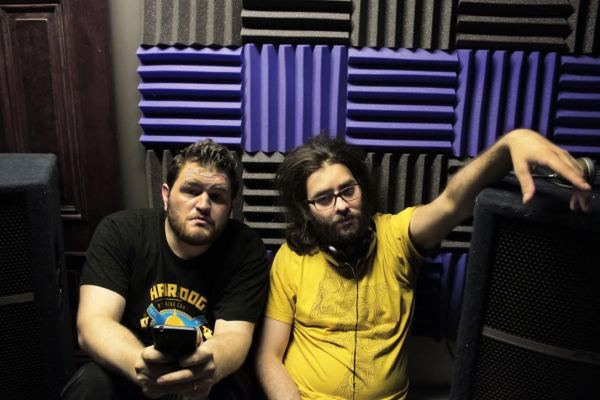
 Text and images by Chip Frenette.
The 20th Anniversary Reunion Tour of Non Phixion kicked off last Thursday night in Philadelphia.
The set started off with DJ Eclipse playing dual roles of roadie and DJ. Before he was joined by the other members of the group, he set up his laptop to work with the coded records that spin on dual Technics 1200 turntables. He also tended to the microphones for the other three members of the act – Ill Bill, Goretex and Sabac Red.
After he got the beat running to prepare the crowd for the arrival of his three cohorts, a failed microphone check called for killing the current track and using the only one functioning microphone at the DJ stand to ask for the other three to be active. He stepped to the front and quickly used the mic check opportunity to recognize the recent and unexpected death of Sean Price a.k.a Sean P. or Ruck.
King Syze, part of the Army of The Pharoahs crew, got things started on the evening with a lot of old school style rap. He mentioned that he still uses a CD book regularly rather than an iPod and still rocks stuff like Gang Starr.
Opening act Outer Space’s Crypt the War Child ended their set with a request for everyone to put their peace signs up for Sean P. and then he added, “Hip hop’s losin’ a lot of people.”
DJ Stress, a wild eyed and enthusiastic guy covered in colorful tattoos, held it down for Outer Space and King Syze.
When the remaining members of Non Phixion took the stage, the energy in the room quickly multiplied at an exponential level. There was a rush to the front of the stage to warmly greet the long awaited return of the hip hop quartet. Sabac Red was more than thankful to those in attendance letting them know how appreciative they were to be able to kick off the reunion tour in Philadelphia saying, “We’re from Brooklyn but Philly is like our second home.”


Old Head: The Case for No Vocals.
 Text by Kevin Stairiker. Images by Jessica Flynn.
It’s unlikely that the three musicians who make up Old Head will ever look the part. Despite all being students at Temple University, they each could reasonably be mistaken for any level of high school student. However, the best thing about preconceived notions is confounding them, and Old Head does just that every time they play.
For a band about to release its first album, Old Head has had the life span of several bands of a greater size. The core group of Connor Fundyga on guitar, Matt Campbell on bass and John Tarquinio on drums has existed for nearly five years. The boys played in bands with names like Sages and Bagged Lunch, traversing genres and band members in their shared hometown of Exeter, Pennsylvania. The true genesis of Old Head started with a punk band called Black Candy, which slowly but surely morphed into the entrancing and technical instrumental music that they make now.
“I think the shift in our writing was built on the separation of the band after everyone left for school three years ago,” Tarquinio explains. “As school went on, practices were split up into three month increments, leaving a lot of material up in the air for reflection.”
Nick Ambrosi, a musical and artistic collaborator of the Heads, has seen their transformation in full and refers to the three as “brothers.”
“The development from then to now is undeniably huge,” says Ambrosi, who has done artwork for Old Head, from early demos through to their newest album. “The passion was always the driving element in everything they did and I think that was very evident.”
These years allowed the band to grow in ways many bands don’t give themselves the chance to. The band originally had a vocalist who was a verbose punk screamer, leaving Fundyga to feel like the band didn’t require a steady singer.
“Having vocals always felt unnatural,” Fundyga explains. “The only reason I sang in the first place was to fill the void. I think we always knew we’d end up instrumental. It was just a matter of ensuring the transition would be smooth.”
As the punk chords gave way to a more nuanced musicality, Old Head began hitting its stride and playing in various basements of North Philly. However, drunk college students don’t usually make for the best audiences to appreciate long, instrumental feats of musical proficiency.
“People feel that if they can’t tap their feet to our songs, the music is too confusing and unengaging,” says Fundyga. “Yeah, whatever.”
Which brings us to the current day and Stained Glass Stilts, the band’s first real album. The song stems were recorded months ago.
“It was hard to express to the engineers how we wanted the songs to come together,” says Tarquinio.
“It can be hard to communicate ideas artistically,” adds Campbell. “I’d be much more comfortable if the band were in control of every stage of production.”
 So, Fundyga acquired Pro Tools and the band slowly began the process of mixing the album themselves. The do-it-yourself ethic is apparent in all facets of Old Head, right down to the art work.
“I always felt like my visual [for Old Head] needed to possess a handmade ‘DIY’ aura,” says Ambrosi. “This is something I feel is very present in their music, something with the inability to be replicated with another’s hand.”
The Heads finished the album in mid-May after a weeklong stretch behind the mixer, with each member fully entrenched in guiding the final sound. Songs like “Me-Tooism” evoke a hazy Television-esque groove early on before transitioning into a crescendo Maps & Atlases would be proud of. Half the fun of seeing Old Head live is being struck by the sudden changes in time and feel. The album lives up to the experience. Lead single “Anchors,” which has been available on their Bandcamp page since February, argues strongly for the case of a vocal-less band. The guitar melody will burrow deep in your head, and as you walk down the street humming it and trying to conjure the words, it will take a while to remember that there aren’t any.
The lads are up in the air over a release date, due to Campbell’s summer-long trip to Germany.
“[Connor and I] will write together and focus on adapting the material to other musicians for live performances,” says Tarquinio. “It would be strange to drop such a large album and not be able to play out.”
Regardless of the release date, Old Head continues to follow their own path and not settle in one musical space for too long.
“We’re always in a state of flux,” Fundgya says. “I can’t imagine ever reaching a point where I want to stay forever.”
Kenn Kweder & Richard Bush: “You Have To Risk Failure.”
 Kenn Kweder and Richard Bush have been making music in and around Philadelphia for decades and they both continue to perform regularly.
Bush, who has fronted countless bands including The A’s, now leads The Peace Creeps. Kweder, who grew up in Southwest Philadelphia, fronted Kenn Kweder & His Secret Kidds and now does shows solo and with friends.
We listened as the two discussed the Philly music scene – then and now, as well as the art of showmanship.
Kenn Kweder: If I remember correctly, I met you in 1977 at Gene’s on the Boulevard.
Richard Bush: That is absolutely correct. We opened for you and we were terrified to open for you. We’d read about you in the paper all the time.
KK: You guys were all confident, I remember. You were on your game. You had that stage-persona clothing.
RB: Yeah, we dressed for success.
KK: A lot of bands back then were still doing the ’60s thing with no effort put into what they wore. I looked at you guys and thought, “Huh. These cats are serious.”
RB: You were very gracious, I remember. I mean, we were terrified. You were like, “Oh yeah, you guys were good.”
KK: To me, that’s the only way to be. And anyone who takes themselves seriously, you know, it just makes sense. It is music, you know?
RB: It is a business.
KK: But we didn’t find that out until years later! It didn’t seem tough in the beginning. We had infinite energy back in our 20s. It didn’t seem to take any effort to make a show happen. And any effort it took didn’t seem to hurt as much as it does now.
RB: You seem to still have energy. You are playing all the time.
KK: Back then, doing everything with an original band, writing original songs, keeping the band together was an inordinate amount of work. We were doing 50 shows per year. Imagine how much work that is. It’s insane.
Going back to the early days, what were your favorite shows, your favorite venues?
RB: I always liked playing The Ripley because it was a big space on South Street. The shows I really remember are the ones that went crazily wrong. They were kind of funny, different from all the other shows. I remember playing at The Palladium in New York. We had a last minute show opening for Ritchie Blackmore’s Rainbow. It was just the wrong thing for us to do but we had another gig that night. We had to make some quick money and go. During the first song, people were booing us. Second song, they were on their feet booing us, giving us the finger. By the end of the set, they were out of stuff to throw at us so they were ripping the metal off the sides of chairs and throwing it at us. They could have decapitated us.
KK: There is nothing like that. You’re a showman and you’re giving it everything you got and these people aren’t even giving you a chance. Once, I opened up for Steven Wright, the comedian. I think he just booked me so he could use my guitar. The booing started slowly and just accelerated. It was one of the most unbelievable things I’ll remember. People throwing stuff is just insanity.
RB: We opened up for The Ramones a lot and that was a tough crowd. The Ramones are so singular. We figured out that if we just said, “You know why we’re opening for The Ramones? Because we’re their favorite band,” then people would like us. Not that it was true or anything.
KK: I played for them one time but it was really early and people didn’t have a chance to form an allegiance with them yet. The ’70s thing was pretty deep. And then the ’80s? That was pretty crazy.
RB: I kinda don’t remember the ’80s. I had The Candles.
KK: I had many bands. I don’t understand how I had the energy to book all those gigs. People don’t understand the amount of effort it takes to book gigs. There’s always the chance of rejection every time you pick up the phone. It’s almost like asking someone out for a first date. Even if it’s a club you’ve played 20 times, you could still get rejected. It’s crazy, man.
What was the best show you ever did?
RB: It was really exciting for me to open up for The Kinks at The Spectrum. They were one of my favorite bands. And at The Spectrum? That was unbelievable. It was weird because I just felt so tiny, like I was under a microscope. Luckily, we had played some larger stages. We had learned that if you set everybody up too far apart, they can’t connect with each other. So we just set up in our little area. But it made us feel so tiny.
KK: The best feeling is that 30 seconds before you hit that Spectrum stage, that 30 seconds before you hit those big stages. I haven’t done the big stages in a while but I still get that feeling. A few years ago, I was playing at Temple University. All week, I practiced “The Star Spangled Banner” and I just couldn’t get it. All of the sudden, I’m surrounded by all the people and these athletes and nothing was more frightening than being surrounded by 8,000 sober people. At a bar, people might not catch the mistakes. This was more frightening than playing The Spectrum … and I had the lyrics written on the top of my guitar. Anytime you’re still nervous about doing stuff shows that you still respect the craft.
RB: It keeps you on your toes. Keeps you in the moment. If you’re just phoning it in, what’s the point of doing it, you know? I don’t want to see that from anyone, let alone myself.
KK: Phoning in is a drag.
RB: Why give it a half-assed effort?
KK: That’s why we do this. It’s in our genes, in our DNA. How about all the guys who quit at 33 or 34. There were other circumstances that maybe prevented them from going on. But it is a tricky thing to continue on.
RB: I totally just lost my train of thought.


KK: Talking about phoning it in and stuff like that. I started in the ’70s. You probably started around the same time.
RB: I started as a kid.
KK: It takes a lot of drive to continue to do it. The amount of money that you should get paid is seemingly never there. And you’re still doing an original band. I don’t know how you do it.
RB: These guys are great. I’ve been in a lot of bands in my life but this one just feels so great. Every time we get together is so great.
KK: It’s like a clubhouse. It always starts that way. Then there’s a business plan. Then there’s no house. Then you start drifting, so you start the clubhouse back up again.
RB: I’m all for live, original music. That’s what attracted me to music, even more than recording. It’s like, “Whoa. They’re doing that right in front of me.”
KK: The other day, I was hosting a show with all these bands at a church in South Philly. There were like 20 bands and they were fucking good. It’s like they’ve never had a setback in their life. I don’t even know their names but they were fucking good. I’m just glad that someone’s carrying the torch without any sense of regret.
RB: It’s really tough. You have to plow it out and do it on your own. You don’t get much help. You’re underpaid, you’re under-appreciated. And people don’t realize how much they really need us.
KK: I think that’s really true. It’s like when you’re looking at a building and you don’t realize how it makes you feel calm because of how pleasing it looks with its symmetry and all. We’re that for your ears. If that all disappeared, there would be some quiet dissonance or something. I don’t know if that makes any sense at all but it’d be weird.
RB: We wouldn’t be people then. People need art. It’s how we evolve.
KK: Even the cats who were doing stuff on the cave walls. There was something they were trying to express, to get out.
RB: Music is here for a purpose. It wasn’t always there. We created it. The human race created music because we needed music. A recording is a record of something that lasts. It’s the blueprint of the song. When you do that song live, it’s whatever that song is at that moment. It may be kind of close to the original but they are two different things. What works during recording doesn’t necessarily work live and what works live doesn’t necessarily work during recording. You could have the greatest live show and then you listen to the record and you’re like, “I never want to listen to this again.” It’s all part of that live experience. Live shows are singular experiences. To make a performance real, it has to be in that moment and you have to be true to yourself.
KK: I grew up when The Beatles were around. Then they were gone but Paul McCartney was still doing stuff. He did Wings and other stuff and then he said he was going to do Beatle’s songs. I saw him do those and my friend was like, “Now I can die.” Even though we’ve heard those songs a million times, I got the chills. And no drugs either.
RB: I saw Iggy Pop I don’t know how many times. Every time I saw him, he was entirely different. I never knew what I was going to get from him. And even if it was not what I wanted or expected, I couldn’t be disappointed. It was always real. The frontman as a focal point, a thing of interest, comes and goes. Some generations kind of miss it. Sometimes I see a band and I think, “This band would be great if there was something to watch, if someone was connecting with me instead of staring at their shoes.”
KK: Sometimes you’re waiting for something bad to happen. You know, with Iggy, he could get injured.
RB: I saw Iggy one time at The Tower. It was Halloween night. I was standing in front of the front row. He was hanging right over me and I was thinking, “This is so great.” At the same second, I was like, “Do I really want to be this close to Iggy?” There’s that danger. You never know what’s going to happen.
KK: It’s like a mercury thing.
RB: You have to risk failure. Because otherwise, it’s too safe. If you’re not doing something new, a little risky, you start falling into habits. You have to find a new way to sing things every night or you’ll just fall asleep.
KK: Sometimes I went overboard.
RB: Yeah but that’s the only way you can achieve something you haven’t achieved before. I’ve fallen off the stage maybe five times in my life.
KK: Sometimes I give everything I have and I think I’m going to collapse.
Bear-One: Gentleman of Leisure and Sound.
 A self-described “audio engineer by craft,” Bear-One has been working with some of the biggest names in Philadelphia for more than a decade. Our Holli Stephens caught up with the producer and DJ, who has been riding a high in 2015 … and with good reason. Images by Dustin Fenstermacher.
Where does the name Bear-One stem from?
Oh man, you want to start with that one? Wow, I never really told too many people this …
As a child, I was infatuated by Winnie the Pooh. My sister would call me Pooh Bear around the house or whatever. As I got older, like 11 or 12, I was like, “Don’t call me that!” But she kept calling me that. Playing football, she would be like, “Pooh Bear, time for lunch.” People would be in the backyard like, “Who’s Pooh Bear?”
So I dropped the Pooh but I kept Bear. Then I started doing graffiti and I put the “One” on and it just stuck.
So what is your relationship to Sugar Tongue Slim [STS]?
Just MC and DJ. Like Gang Starr. I handle the majority of his production and I’m also his DJ. The whole team is called GOLD (Gentlemen of Leisure and Development). That’s me and Slim and then we have different managers. Jordan Brown, who does a lot of vocals, and I’d also put RJD2 in there. It’s a whole force.
Me and Slim moved here around 2003. That’s when Slim started rhyming. I got on board with Slim in 2010. I was working at Def Jam and Slim was signed to Def Jam. We knew of each other and had crossed paths.
We all started working together with The Roots. I was really good friends with Dice Raw and Truck North. Then Tariq Trotter (aka Black Thought from The Roots) founded Money Making Jam Boys. I was a DJ for that. Slim was also a part of that. Then we really started connecting.


What is your production process?
In general, it’s me going through records, just digging. A lot of times, it’s not really about chopping up different sounds. It’s about vinyl. That’s my biggest thing. I need the vinyl.
What makes vinyl so important?
The digital aspect is cool but I come from the vinyl aspect. I come from beat digging in the record store for four or five days. I feel like it’s a lost art. A lot of people don’t dig because there’s YouTube and Google but I come from the era of vinyl. We would go in from when the record store opened at 9 a.m. to when it closed at 9 p.m.
That might sound crazy but that’s how we used to do it. If you ain’t got the vinyl, you don’t have a hit.
How did you and Slim link up with RJD2?
When they did RJ’s record together, RJ was like, “Well I owe you a track.” Then we did one song, which is called “420.” Slim pinned it and engineered it and RJ made the beat. One song went on to five songs, five songs went to 10. Ten went to 15, 15 went to 20, 20 to 25, and at 25 we had an album, which came out May 5 (with 12 tracks).
You’ve seen a lot of big names come through your studio spaces. What is it like to have Meek Mill or Method Man come in for a session?
It’s love. I worked for Def Jam and was around all these big artists, so it got me to be in the main frame of thinking, “Oh, they’re just like me. They’re cool, they don’t really trip.”
I met Meek when he was 15. He was a kid.
Working for a major label for eight years prepared me to be with these bigger acts.
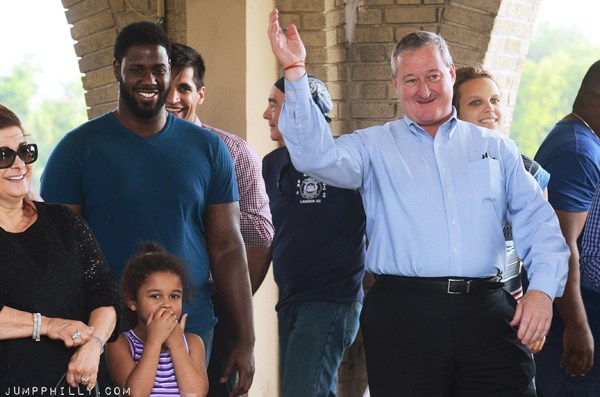 In May, former city councilman Jim Kenney won the Democratic primary to become the party’s nominee for mayor in the November general election.
In a town where registered Democratic voters outnumber registered Republicans 7-to-1, Kenney is all but guaranteed to become the next mayor of Philadelphia.
Our G.W. Miller III spoke with the candidate and former Mummer about how he’ll handle the arts and culture when he takes office.
Do music and the arts play an important role in Philadelphia?
Absolutely. From preschool to kindergarten, all the way through high school and onward, arts and culture are a tremendous part of a person’s development. It’s sad that the resources to do that in our public schools are limited. We need to try to find innovative ways of getting arts and culture back into the curriculum.
What can government do to make that happen?
Provide resources. Provide innovative ideas to bring together commercial organizations to do this kind of stuff on a non-profit basis. Work with people like the Picasso Project (a project sponsored by Public Citizens for Children + Youth that brings the arts to public schools), the Art Museum and even individual artists. Dealing with existing artists throughout the city and region who want to volunteer in our schools. We’ll try to provide some resources for them to do that. And we’ll try to get kids out of the classrooms and into music venues and art venues as much as possible. I think we should be depending upon the principals of our schools to give us some direction of what their needs are and then we’ll go out and try to find the resources – governmentally and philanthropically.
Over the past 20 years, the city has leaned upon the arts and culture for this renaissance we’ve been experiencing. Is there a way to ensure those artists can stay here or show them that they are valued?
We have to make sure we continue to improve the quality of life for everyone, including how much it costs to live here and what opportunities are available to artists. Starving artist is not necessarily a foreign term. We’ve got to figure out ways to keep them working on their craft, in their fields. I don’t have the answers to all those issues but we’re hoping the robust arts and music communities in the city can give us some direction and tell us what we can do to provide those services.
How do you do that?
Bring people together. Maintain the Office of Arts, Culture and Creative Economy. There will be an arts and culture presence. Whether that’s in the city rep’s office or if it rests in the Office of Arts and Culture remains to be seen.
Rather than see arts communities move from neighborhood to neighborhood, is there a way to maintain those creative communities that emerge, like the Frankford Avenue corridor?
I couldn’t stand here and tell you exactly what we can do right now. But again, government shouldn’t be reinventing the wheel. They should be talking to people in the industry, in the business, and learn from the folks who are doing that work.
 Has music played an important role in your life?
Music, arts, culture and sports have always been a real uniter of people of different races and different backgrounds.
Do you play any instruments?
No. I sing a little.
What do you sing?
Whatever is in the karaoke machine, usually old stuff.
So, where Mayor Nutter shows up and sings “Rapper’s Delight,” you will sing …
You’re not going to hear me sing that. One thing I can guarantee is that you will not hear “Rapper’s Delight” from me.
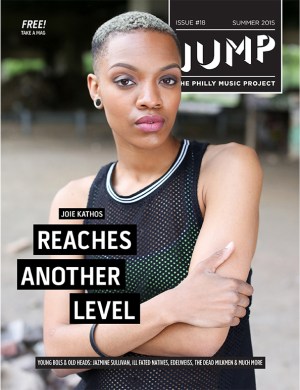
The Next Generation of Joie Kathos.
 Text by Brianna Spause. Images by Brae Howard.
Joie Kathos scheduled herself some downtime to create on a warm Wednesday afternoon in West Philadelphia.
“This used to be my sister’s room,” she says, eyeing up the fresh coat of forest green paint dressing the walls of her home studio.
A soft, April sunlight bounces in the open window upstairs in the house Kathos grew up in.
“It’s minimal but it allows me to do what I need to do,” she says with a quick glance around the room, her absorbed expression reflected in an Apple monitor.
Flanked by speakers, a cherished old Maschine MPC mixer and a keyboard all linked up and ready to go, the 23-year-old Kathos, whose given name is Jordan Shannon, transforms herself in this familiar space.
With origins in French and Greek respectively, the fierce young businesswoman’s adopted moniker translates to “With joy, I am.”
“Joie is the Beyonce for Jordan,” Kathos says, shedding light on her growing brand. “She comes in, works hard and takes no BS from anybody. She’s not afraid to speak her mind or challenge the normalities that people set in society.”
Kathos burst onto the scene a mere two years ago with a self-titled EP that landed her the title of the 2013 Philly Hip Hop Awards’ Best New Female Artist. Though in the process of establishing her young music career, Kathos has spent her entire lifetime on stage – finding her roots in dance at age 3. Through a repertoire of talents like production, songwriting, acting, choreography and teaching, she has emerged as the powerhouse behind the entrepreneurial venture Joie Kathos, LLC.
“Hold up, I’ll be down in a minute,” Kathos speaks quickly into her iPhone.
Kathos returns with Jacqueline Constance in tow, the 26-year-old singer sporting a full-faced smile and a loud sweater.
Kathos and Constance met last year on the set of The Queens Village, a monthly performance series at Voltage Lounge that celebrates sisterhood in the Philadelphia music scene. The featured artists became fast friends, bonding over what Constance calls “a really cool artistic synergy,” which is evident in their latest collaboration.
“Win or Lose,” is a socially conscious track from Kathos’ second EP, FLOATERS, which became available online for free in July. Inspired by the All Lives Matter movement, the hip-hop track illustrates a core value of Kathos’ music – a diagnoses of how individuals in today’s society treat one another. The protests in Baltimore over the death of Freddie Gray were a timely example Kathos cited. News coverage of the events had just begun to roll out that week as she spoke firmly about the deep-seated change the country needs to face.
“I let everybody know from the rip that I’m just about peace and positivity,” Kathos says. “It just comes out in my music without me even really thinking about it because I try to stay true to myself. Honestly, I’m disappointed in what I see happening in the world today.”
Kathos goes on, describing how the human race is on the cusp of a renaissance period. Her blend of alternative hip-hop is crafted with the intention to inspire positivity while retaining easy listening qualities.
“Hopefully my music will contribute to the spark of change we all seem to be crying out for as a people,” she says.
To Kathos, it’s all about balance. She aims not to produce tracks that are too heavy, but rather keep it real.
Russell Shannon, Kathos’ father and manager, views her music as a labor of passion.
“[The message] she projects in her music is how she is in real life, out with her friends,” Shannon says. “She’s of a conscious level where she wants people to think about what is going on in society. She doesn’t want the young brothers and sisters to feel like they have to go ahead with the norms of what’s going on in the neighborhood.”
A lifetime resident of West Philadelphia, Shannon cites examples of drugs, teenage pregnancy and violence as pieces of a perpetual cycle which Kathos targets lyrically.
“Her whole life is geared around making a difference and she’s showing it,” he says. “She proves it on a regular basis.”


With Logic software stretching across her monitor, Kathos runs the beat she has been playing around with for a new music video on repeat. She and Constance mindlessly sing along as they gather themselves to record, Constance pulling out a smooth harmony as she struggles with a tangled chord.
“This is an illustration of my life,” she murmurs, locking eyes with Kathos for a belly laugh.
Laying down the lyrics takes several tries as Kathos listens to the playback with eyes closed, executing subtle dance moves as if the choreography was already brewing.
“I’ll do it until I have it,” she says.
“That’s great, that’s a great trait to have,” Constance, with a background in musical training, says. “Go crazy.”
Kathos, a raw talent with no musical training, gracefully takes direction from Constance – “Be more buoyant,” “Pick up the lazy tongue,” “Think less vertically and more horizontally” – until a solid amount of progress on the track has been nailed down.
Eyes on the clock, Kathos begins to gather her things to head out into rush hour traffic.
“So this is what I do during the day,” she says, her hands up in the air, embracing the silence in the studio as the computer sleeps. “The dancing is what I do at night.
“It’s not my full focus anymore, but it’s definitely a huge part of my branding and who I am,” she adds over her shoulder as the front door clambers shut. “Dancing adds a completely different element to my stage performances and it’s something I’m very comfortable and confident in.”
Kathos begins to stretch on the hardwood floor of Studio A. It is 5:58 p.m. and the intermediate dance workshop she teaches on Mondays and Wednesdays at Millennium Dance Complex is about to begin.
Two young dancers mill in – one male, one female. A small crowd for a Wednesday, Kathos says, as she usually works with eight to 10 students for the general admission class. Though a little extra cash never hurts, Kathos teaches classes at the studio in pursuit of her lifelong passion. Instructors at Millennium can take one another’s classes for free, an opportunity Kathos utilizes to stay sharp.
“She has always had a drive to learn new things,” Shannon says.
It’s a trait he attributes to Kathos’s growing success as a performer and a quality in high demand in the field of dance, where new rhythms and techniques are consistently changing the pace.
As for her role as a teacher, Shannon added with a laugh, “Joie strives for perfection.”
The instruction is slow and thorough at first, as Kathos runs down sharp movements to Kendrick Lamar’s “Alright.” Her face lights up when she watches her two students execute the sequence perfectly for the first time, about half an hour into the hip-hop class. Almost simultaneously, they jump backwards and throw their arms out in celebration.
“Yes! Y’all are working today!” Kathos offers.
On a constant repeat, the dancers run through the routine while watching themselves intently in the mirror, their focus evident in a cool and confident manner. Long shadows race across the studio floor, visible to the public through a wall of windows. A constantly rotating crowd of onlookers strolling down South Street halt, mesmerized by the routine as it unfolds.
“It’s crazy, her work ethic,” Constance says, watching the workshop from the lobby. “I’m surprised she actually finds time to work on music with me. She does so much between teaching and gigging, sound production for dance studios and choreographing. She probably works harder than a lot of Philly artists – well, artists period. She’s really into building her brand and she’ll do whatever she needs to build it into something beautiful and positive.”
As an independent artist, Kathos funnels the majority of her time into creative outlets to promote the Joie Kathos brand. Despite a jam-packed schedule and each end of the entertainment industry pulling her in different directions, Kathos is dedicated to producing a quality product.
“I give 110 percent to everything,” Kathos says confidently. “I can’t fluff it because my name is attached to that and it’s a part of me.”
Sheer dedication to her craft is a trait that is easily noticed by those working with Kathos.
“Her work ethic is what is going to make her successful,” Shannon says. “Whatever it is that she’s trying to do, she works hard at it and she does it until she feels like it’s perfect. Eventually, that perfection comes out on stage in her performances.”
At a young age, Kathos laid her dreams out on the table and she’s been chasing them ever since.
“Growing up, I wanted to be everything,” Kathos says. “For the most part, I knew I wanted to be a rapper. I knew that since I was 9. I had dreams of touring the world doing modern dance but my body was like, ‘No, you’re not made for this.’”
Kathos had put in years of training in ballet, tap, jazz and hip-hop, taking on a specialized dance curriculum at William Meredith Middle School and the Philadelphia High School for Creative and Performing Arts (CAPA). At the ripe age of 17 – about to accept the role of dance captain going into her senior year – Kathos began to experience crippling pain in her right hip that kept her from being able to make it across the floor.
A few trips to the doctor uncovered the resounding effect of a jungle gym accident in her formative years. As a result, Kathos does not have full hip rotation on her right side, which is vital to perfecting bodylines and turnouts in a dance career.
It was time for her to make a decision. Pursuing a professional career in ballet or modern dance could have meant a lifetime of pain, Kathos remembers.
“After I got injured, my focus switched to music really heavily because I was mourning over never being able to dance again,” she says. “Music was really therapeutic and I felt really happy, like this was all I ever wanted to do.”
Equipped with a soundboard and laptop, Kathos had already begun producing music by the time her flexibility injury brought years of career planning to a halt. Shannon recalls that time as a difficult one for Kathos.
“When things go crazy for her, she really focuses on something,” he says. “Music was what she focused on. It was a smooth transition through a rough time.”
As she has grown into her music career, Kathos has found a way to incorporate her first true love with her new career path by creating a memorable stage presence.
“Dancing is a crucial part of my live performance. You get the full experience,” Kathos says while making jokes about “just standing up there, holding your pants and doing the old ‘wish-wash’ hand thing.”
“I think that Joie is a rare breed, one-of-a-kind type of artist,” says DJ Bear-One, who has been working with Kathos as a sound engineer and DJ for the past eight months.
As a partner on stage, Bear-One has been impressed with “the way she switches from MCing to singing and her dance moves.”
“That’s a move MCs used to do back in the day,” he adds. “You had to entertain, not just stand around with a bunch of people on stage. You had to rock the party. I love her energy and we’re just getting started. Wait for it!”
Thick smoke rises from Clark Park in early May and the smell of sweet, sweet free barbeque fills the air. A small crowd has formed for the 2015 May Day Rally, a celebration of “Socialization, Solidarity and Humanity,” a gathering of labor unions and members of the $15-an-hour movement, to let their voices be heard.
Kathos performed at May Day in 2014 and had been invited back to the festival this year in acknowledgement of her insightful lyrics and firm stance on equality. As 4:30 p.m. rolls around, Kathos jumps on stage with an electric disposition, captivating the audience seated below. In a commanding tone she raps, “Join us as we take back our history and continue to fight for the dignity and rights of the voters.”
In addressing the issues at hand, the audience receives her words well by nodding and clapping along.
“Say it girl,” rings out from different sides.
 As four dancers join the stage, the dynamic of the performance is transformed. Confidence is displayed in between calculated movements as Kathos performs with a gleaming smile. Three of the five performers, including Kathos, don T-shirts with an intricate “Think Nation” logo.
Think Nation is Kathos’ newest venture, a clothing line designed to inspire the wearer to promote positivity amongst young people. Shannon’s childhood friends Sean Byrd and Lamont Turner had goals for a clothing line and those goals aligned with Kathos’ mission as an artist.
Growing up, Byrd notes, Kathos was, “musically inclined and liked to dance but I never thought we would be business partners until I decided to launch a clothing line.”
After attending one of Kathos’ performances in 2014, his vision of a young girl in tap shoes was forever changed.
“She doesn’t follow the crowd, she does her own thing,” Byrd says of the quality which makes Kathos a fine leader of Think Nation. “She doesn’t care what anybody thinks. Basically, what she does is she does everything in a positive mindset. That’s what I like about her. She could be out there doing everything that everyone else is doing but she’s not. She’s going in a different direction.”
This past year, Kathos adopted the Think Nation look by repping the brand on stage as a leader of positivity and change. The line officially launched at the unofficial release party for Kathos’ new EP at the Theater of Living Arts in July.
Kathos’ music clearly defines the goals of the clothing line. Standing apart from hip-hop artists who “just talk about clothes and money and cars” has always been a goal for Kathos’ brand, she says.
Twenty-three and so long to go, Kathos has been grinding her own groove into Philly’s hip-hop scene. A seamless culmination of dance and music with a social conscious is brewing within this West Philadelphia MC, all of which came from a negative possibility.
When Kathos couldn’t pursue dance as a professional career, she refused to extinguish her creative voice.
“Never give up on anything you have the slightest idea that you can achieve,” Kathos says as a note to aspiring female artists. “Learn. Do. Be proactive and consistent. Even if other people don’t see the vision or don’t believe in it but you believe in it, it can happen. Your path is yours and your story is important in more ways than one.”
DJ Sylo Breaks Out.
 Text by Tyler Horst. Images by Charles Shan Cerrone.
In an unlit corner of Alessandro’s Pizza & Grill on North Broad Street, Brady Ettinger sets up the kind of massive speakers you would expect to find at a club. It’s early on a Saturday night and the restaurant is empty. For now.
“We’re expecting to see three to four hundred people come through tonight,” he says, unwinding an XLR cable and attaching it to a speaker.
No, three to four hundred people aren’t coming just for a bite to eat. The pizza at Alessandro’s is good but patrons who don’t already know what’s up for tonight will find a lot more than just tasty pie. Ettinger, who is better known by his DJ name SYLO, is throwing a party. Along with his friends and compatriots in STUNTLOCO, the party crew he started at Silk City, SYLO is holding the 10th installment of the Pizza Party, which is exactly what it sounds like. Starting at 10 p.m., Alessandro’s will transform from an unassuming pizza parlor to a nightclub that also serves free pizza. Though the last few installments have been garnering plenty of buzz online, SYLO says he refrained from announcing the details on this one until just a week before the date. For him, it’s all about cultivating an underground feel.
If this all sounds like many a millennial’s dream it’s because SYLO, 23, has been deeply involved in the nightlife and party scene for years and he knows his audience. He’s put in so much work that he doesn’t have to do anything else for money. DJing is his one and only occupation.
For now, SYLO has to make sure everything is right. He checks his watch and runs a hand through his platinum hair. There’s still time to grab a few things from his place that he forgot.
SYLO exits the building and walks up Ridge Avenue at a fast clip.
“Our generation is harder to trick,” he says, darting quickly across the street to avoid traffic. “Everyone is more media-literate. They know when something isn’t real.”
Being a poseur is not something that has ever been on DJ SYLO’s agenda. Though he believes his STUNTLOCO brand is on the verge of breaking out into the big-time, SYLO’s biggest hope is that it always maintains a grassroots mentality. He talks more about his goals in a collective sense, desiring success not just for himself but for the people in the STUNTLOCO “movement.” That doesn’t mean SYLO hasn’t given some thought to how he’d like his own name to be perceived.
“I’m not trying to be the best DJ,” he says, “but what I am trying to be is undeniably unique.”
Like everything else in his career, the Pizza Party concept started as a house party. SYLO asked a friend if he could throw a party at his place, bought a whole bunch of pizza, texted a few friends and the rest is history. At this point in his career, SYLO may spend plenty of time spinning at more established venues like the 700 Club but his artistic ethos was formed out of the sweaty basements and tight spaces of house parties.
SYLO grew up in Maryland, where he got his first turntable at the age of 17. He DJed his first house party while in high school. His first exposure to the Philadelphia scene was through the world of college parties.
“I feel like I moved from Maryland to Temple,” SYLO says about his migration from his home state to the city of Philadelphia.
He came to Temple University to study media studies and production and learn more about the technical aspects of audio, but fashioned himself a more personal curriculum in the DJ profession by spending most of his free time hosting or planning parties off-campus.
It didn’t take long for his roots to grow well past the college scene. In the seven years he’s been a part of the city, SYLO has woven himself into the community so much that he has started to become a landmark in his own right.


It’s approaching 11 p.m. and SYLO, as excited to be here as anyone else, dances around the faux-Renaissance architecture in the dining room of Alessandro’s with a pizza box in hand. He slides happily into the midst of some young ladies in full party attire, flips open the lid and offers up a slice. The ladies smile and dig in, some of them leaning in for a friendly hug. After the brief encounter, SYLO floats off somewhere else.
“As a local DJ in the city you came up in, you’re kind of like a community leader,” he says.
A lot of the people here tonight either know him or know of him. It’s not the 400 they were expecting but there are a lot of people.
You’d think any sane restaurant owner would be terrified by the idea of letting some kids run wild in their establishment but Alessandro’s owner George Tzinas has been smiling the entire night.
“The important thing about this is that the group has such good energy,” he says. “There are never any problems.”
To hear Tzinas tell it, the story behind the Pizza Party’s move to Alessandro’s is that SYLO simply walked in one day and pitched the idea. SYLO says he had been out skating on Broad Street and stopped in for something to eat. He found the ample space in the dining area and side room with a bar. He came up with the idea on the spot. It was too much for him to pass up.
SYLO’s set starts at midnight. With things heating up, MC for the night Fidel pops in an old VHS tape of the Michael Jordan documentary “Come Fly With Me” to display on the old TV they plugged in and propped up on a table.
“We used to play young bol shit like ‘Land Before Time’ — classic ’90s stuff,” Fidel explains over the thumping of the speakers. “Now we’re trying to make it more adult.”
Fidel, born Matthew Ford, is SYLO’s self-proclaimed “partner in crime.” Their relationship is a creative one. SYLO and Fidel refuse to define it in any concrete terms—they just kind of go together as a package deal. They throw out names like “Jay-Z and Kanye,” “Simon and Garfunkel” and “Siegfried and Roy” to describe the nature of their relationship. They’re not only friends but also huge admirers of each other’s work.
“It brings every type of person together,” Fidel says about SYLO’s parties. “SYLO brings them all together. They don’t want any drama. They just want to coexist.”


As he thinks about what music he might play tonight, SYLO says his choices change depending on the space. His forte is hip-hop but he’s been expanding his palate with more house music. For tonight, he thinks he’ll “try more weird stuff” because the event is a little more exclusive.
He’s also been working on his own original music, some of which he plans to throw in to his list for the evening. Watching a human body move to his own composition is much more telling feedback to SYLO than a comment online. He’s excited to test out his new tracks but nervous at the same time.
“I know every twist and turn in the song,” says SYLO, “but seeing people react for the first time is amazing.”
As someone whose self-appointed job is to make sure other people have the night of their life, SYLO stresses the importance of focus while standing behind a turntable.
“You have to stay smooth as a DJ,” he says. “You can’t get too excited or you’ll get distracted. You have to take all the energy and hold it in your gut.”
As SYLO finally gets behind the table, his night is just beginning. He goes right from his set to an after-hour party somewhere else, where he says he’ll keep going for as long as the people want.
When things finally do die down, the sun is already beginning to peek up on the horizon. SYLO has time for a quick nap, then another gig at the Dr. Martens store at 1 p.m. He’s tired but only because his body says he’s supposed to be.
“Yo,” he says with a smile. “Tonight was crazy.”


 JUMP: The Philly Music Project