Those People: “Paris: Live at The Fire.
Here’s the second installment of a new collaborative effort, lead by the group Those People.
The video project brings together props from Philly Aids Thrift, a stage at The Fire, recording at Fresh Produce Studios with Kyle Graham and video production by a team of volunteers lead by Dexter Gresh.
Check out the first video they produced here. And here Those People’s 2014 album Be Careful What You Wish For, which was produced by Bill Moriarty, below.
Is Music Important In Schools? “It’s critical,” says the District’s Director of Music Education.
 Philadelphia’s youth are caught up in a churning tide of financial turmoil.
The Philadelphia School District, the nation’s eighth largest public school system, is woefully underfunded and expenditures only increase every year. Basic amenities, like school nursing, sports teams and libraries, have been reduced or eliminated at many city schools. The arts are always on or near the chopping block as well.
Our Brianna Spause sat down with Frank Machos, the director of music education for the Philadelphia School District, to talk about budget woes and how the district is continuing to provide arts training.
What changes has the music department seen since Governor Corbett’s 2013 “doomsday budget?”
Two major changes have been a massive reduction to our central office staff. We have no more support positions and are tasked with a much bigger palette of responsibilities. In the schools, the biggest effect has been on our support and operating budgets.
What resources are lacking that would create a solid program?
Extra-curricular money. A lot of our after and before school programs have been cut and that’s had a large effect on overall programming. The biggest need is instrument repair. We provide all of our students in the district with instruments, so they quickly deteriorate. We are in a situation now where if a principal opens a new program or we hire a new teacher, they are at the mercy of whatever resources have been left in place. As things go and deteriorate, we don’t have funds to repair or upgrade.
 If funds were available, in what resources would the school district invest?
Music technology across the board – just innovation – is a major need that we would address. If we had the tools in place, a creative and clever teacher would get kids hooked and then introduce them to traditional music and history. Sometimes just getting that initial hook is a challenge because we don’t have the resources that the kids want to see when they walk in.
Are music classes required in all schools?
In 2004, the policy went into effect in the state that says a classroom teacher can teach a music lesson. With the minimal funding toward staffing, all of the teachers in the building are facing an overloaded schedule. It’s met with mixed reviews, obviously. Our certified teachers would prefer that we would have certified teachers teaching [music] but from a standpoint of resources, our priority is that every student has exposure and access to these programs. Our certified music teachers kick in at sixth grade. What is happening in elementary school with an uncertified teacher is more of an exposure than any in-depth curriculum. That creates a challenge in building off of that.
Are there any schools that do not offer music programs?
There are a few. It’s probably about 25 percent where no music is offered.
How have programs downsized?
It’s a mixed message in branding that we have faced. A lot of the perception outside of the district is that our programs have gone away all together, and they really haven’t. All of our high schools are required to carry music or art. Our kids are required to achieve two credits in arts and humanities prior to graduation. For the most part, it’s fairly healthy. Of course, our ideal is that every kid in the city has both. We’re reevaluating how we might be able to reallocate resources over the next few years.
What are the tangible lessons students gain from music education?
Along the way, they’re meeting folks from the Philadelphia Orchestra (like in the images above by Charles Shan Cerrone) and from the Curtis Institute. They’re getting private lessons, winning scholarships. We’re requiring them to be places on Saturday morning at a certain time. We’re giving them all of this college and career training that, for years, we forget to tell as part of the story. But when we start to do data on it, it starts to validate what we are able to do for these kids.
Why is music an important part of developmental education?
It’s the student engagement piece. Our kids are becoming increasingly overtaxed and overburdened by standardized testing with high stakes. To have an outlet within the building that lets them decompress for a period of time, allows them access to other parts of their learning abilities and emotions that the typical classroom is not designed to do. It’s critical.
 Text and photo by Diana Shalenkova.
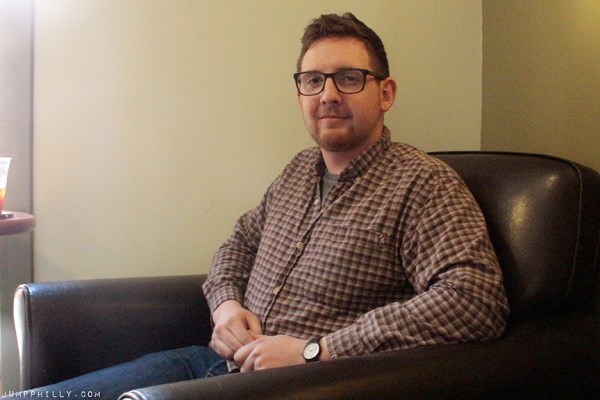
Mantua Fest began partway as an extension of Make It Work PHL, Ben Johnson’s senior project for Drexel University, partly as an idea that Johnson had been pondering when he first began booking shows at his house several years ago.
Make It Work is a DIY booking company aimed at helping new and touring bands get gigs at Philadelphia houses.
“I wanted to make an organization where bands from out of state – instead of trying to book through R5 – have a place to submit their band and tell me a date,” Johnson (pictured above) explained as he sat in the sunny back room at the Green Line Café. “Then I can bring that information to people I am working with through Make It Work who book shows at their houses.”
Now, Johnson and Make It Work are working with the Dornsife Center for Neighborhood Partnerships with plans to donate a part of the profits from Mantua Fest back to the center.
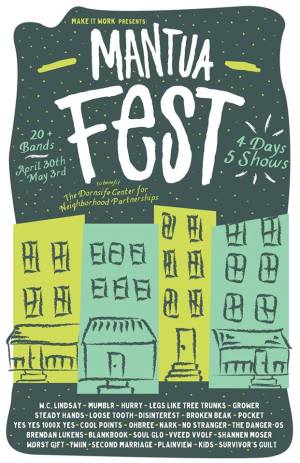 “Even though Drexel is this money-sucking university, they wanted to do something good for the community instead of filling plots of land with student housing,” Johnson said. “Dornsife is a community center where people from the community can use computer labs, get financial advising, monthly community dinners and other resources, and where students can go to learn.”
Though Mantua Fest gets its name from the geographic location of the weekend-long event, there are social implications regarding a festival named after a neighborhood that does not involve members of the community of said neighborhood. According to Johnson, a flyer for the festival has been put up in the Dornsife Center. However, with the event being planned on such short notice, Johnson says there was no time to find artists from the community and plans on doing this differently next time around, considering the first time a beta test.
“I feel that the next Mantua Fest will be better because it will include more people from the community, maybe like a block party as well,” Johnson said. “It’s definitely been a learning experience, but I am trying to do something good.”
Mantua Fest consists of five shows, with a matinee on the fourth day. The event kicks off on Thursday at Rock Bottom XX, featuring W. C. Lindsay, Mumblr, Legs Like Tree Trunks, Yes Yes A Thousand Times Yes, and Second Marriage.
Others scheduled to perform during fest include OhBree, NarK, No Stranger, Edelweiss, Hurry, Loose Tooth, Pocket, The Danger-O’s, Cool Points, Grower, Disinterest, Soul Glo, Blankbook, Steady Hands, Broken Beak, VVeed VVolf and Shannen Moser.
Each show is $5, but four day passes are available for $10. Tickets are available here.
 The Wombats returned to Philadelphia last Thursday with a packed show at Union Transfer.
It was the second stop on their 23-stop run through North America and the first in the United States in celebration of their recently released album, Glitterbug (you can download the track “Emoticons” for free here).
The three lads from Liverpool came out and immediately had the crowd bouncing along. They performed tracks from all three of their albums and for most of the night, the crowd sang along with Matthew Murphy, while watching the infectious energy of bass player Tord Øverland Knudsen and drummer Dan Haggis.
East London’s Life In Film opened, with bass player Dominic Sennett hitting the stage in a satin Sixers warm-up jacket. The band performed their jangly pop music while seemingly distracted – for much of their set, guitarist Edward Ibbotson was having technical issues.
“I’m having a fuck-load of trouble with my guitar,” he said. “I’m standing up here feeling naked.”
While the band seemed a mystery to much of the Union Transfer crowd, the band got everyone moving when they belted out their songs “Alleyway” and “Get Closer.”
Philly’s own Cheerleader kicked off the night’s festivities. Singer Joe Haller crooned along to the smooth summer-sounding tunes that left the crowd swaying.
Cheerleader, along with Life In Film, is accompanying The Wombats during the North American tour, which ends on May 20 in Vancouver.


Girls To The Stage: A Celebration of Female Artists.
 Rachel Dispenza and Lauren DeLucca are seniors at University of the Arts, studying in the new music program called Music Business, Entrepreneurship and Technology. Together for their senior project, they created Girls to the Stage, recording and producing a compilation tape that highlights female musicians in Philadelphia.
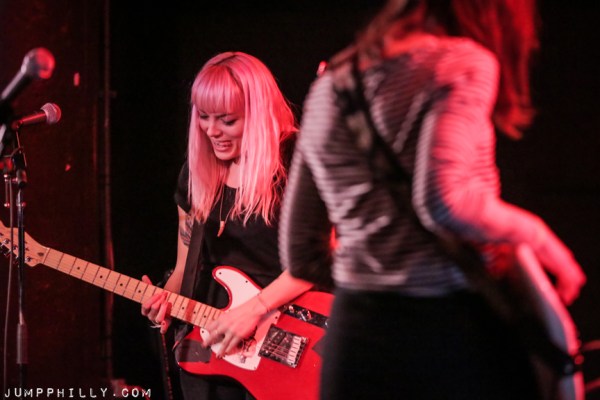
The tape release benefit show tomorrow (4/29) received so much interest, Dispenza and DeLucca decided to move the show from Creep Records to the First Unitarian Church. Proceeds will be donated to Girls Rock Philly. Artists to perform include Amanda X (pictured above in a photo by Jason Melcher), Mannequin Pussy, Fake Boyfriend, Shannen Moser, VVeed VVolf and Roya. Get tickets here.
Our Michael Bucher spoke with Dispenza and DeLucca about the project and why it was so important for them to make it a reality.
Where did the idea for this project come from?
Dispenza: In October, we were in the music office in school where I worked until about a month ago, talking to the director of the music college at UArts about senior projects. Because our major is so new, there hasn’t been a developed protocol for that yet. No one has graduated yet. We were brainstorming things we would want to do for the project that involved stuff we cared about, as well as all three aspects of the major were involved in – music business, entrepreneurship and technology.
DeLucca: So technically, this whole project is our senior project. It kinda evolved into something bigger than that. We got a lot bigger response than we anticipated, which is great.
Was there something you wanted to do beforehand for the project?
Dispenza: I’ve been booking DIY shows for the past couple years now and didn’t really get into recording until having to take it for class and then working at Headroom Studio for nine months. Lauren’s been interning at Milkboy the Studio for about two years. So, we wanted to be able to combine the things we like and trying to work really hard at into one project.
Where did the idea for the all female/heavily-female show and tape come from?
DeLucca: I think from just being involved in the Philly music scene, you kinda start to notice how male dominated it is. Even in terms of not just the bands that play but the people that come out. So, we wanted to do something that drew attention to that and showcase some of these bands that we love.
Dispenza: I feel like if you notice a problem that you want to change, you have to start with right where you’re from and work on it there before going on to do more things. Plus, because we had such a short time period, it made the project a little bit cleaner. Say the studio cancels on us that night, the band didn’t just drive from hours away to record with us and then be stuck until we could get an available slot.
What were the logistical first steps to putting it together?
Dispenza: We sat down one night and made a list of everything we needed to accomplish throughout the course of the project, whether it was short-term or long-term goals, and a list of bands based on a level we thought would respond or get back to us and be really excited. We knew we needed to pick a venue, a date. We needed to talk to the studios we worked for about when we could get in to record, if possible.
So finding the venue was the last part?
Dispenza: Well, we had worked on it for about two months. We originally had the show at Creep Records. Will Angelos, who works there, has been great about letting us do other shows there in the past. He was really excited about it. We picked a date and it was good and then after we announced the event, we noticed a very immediate positive response and came to the conclusion that that space would be too small to host the event. We didn’t want to have any limiting capabilities. We wanted to have as many people to come as possible and support the cause.
What were the steps from there?
DeLucca: We kinda thought having it at The Church was one of those things like, ‘Oh, what if we had it at The Church? Ha ha, that’d be great.’
Dispenza: But really, come on. About a week after we announced and decided we would at least try for The Church., among other things, I contacted Andy Nelson at R5 and got right back to me and was super positive about it and excited about trying to make it happen. We called him a couple days later to go over all the questions about having it there before we decided to settle. He was great about answering everything and we decided to go forward with it. They were totally willing to promote it. They just had to make sure they could get the room that day. After a week or two, it wasn’t going to happen. The Church tried to move a bunch of other stuff around for the R5 event and they just couldn’t do it.
When you reached out to bands initially to do it, what was that process like?
DeLucca: Initially we just asked friends like Shannen Moser, VVeed VVolf and Roya. We’re like, ‘Hey, do you wanna do this thing?’ Everyone was super responsive at first. Then we were brainstorming more full bands that we could put on it and cold emailed or texted people in Mannequin Pussy or Amanda X or Fake Boyfriend.
Dispenza: We were recording Mannequin Pussy at the Headroom the one day and they were giving us suggestions for bands that would be good for it and one of them was Amanda X. Kyle Pulley, who runs the Headroom with Joe, just got out his phone and started texting Kat and they were on it.
What was recording all these different bands like? Any surprises?
DeLucca: We had both taken recording classes at school and I’ve been interning at Milkboy for a long time, so I was kinda familiar with the whole process. But we had never done anything really to this scale by ourselves before.
What were your experiences at Milkboy before?
DeLucca: Mostly helping out the other engineers. Some of the engineers would record instruments themselves on other peoples stuff, so I’d help them record while they played. So, I was familiar with the process, familiar with the software, setting everything up but it was mostly just this being our project and not working on something else. There’s more pressure there but everything turned out surprisingly well.
Were there any different experiences in the studio that you weren’t used to?
Dispenza: I wasn’t used to recording anyone I wasn’t friends with first. When I was taking recording classes, I was doing demos of my friends’ bands that they wanted to use before going somewhere else to record. Meeting members of the band that I never met before at the recording session was a little unnerving.
DeLucca: Even with our friends, we wanted everyone to feel comfortable in the recording session and for everything to sound good and to see the experience as professional.
Were there things about booking DIY shows or being involved in the community that helped the process?
Dispenza: Networking, which is one of those things I hate to hear so I’m mad I even said it. But I have been booking shows with Ruben Polo for the last few years and he’s taught me a lot about that whole process. He was really helpful when it came to like bouncing ideas off for this. Knowing all these different people who can point you in a new direction or if they can’t do it, they might know someone who can. It helped get us to the next step, even when things weren’t certain.
What would you do differently if you were to do it again?
DeLucca: Because it’s our project for school, we had to get the whole thing done before we graduate and it definitely would have been a lot easier if we had more time.
Dispenza: This also being for a graduation project, we’re not just focused on this project. We’re still in class full-time. I’m working 2 or 3 jobs, another project, an internship and booking other shows. Lauren has school and her internship and job. So, balancing those two schedules and bands’ schedules was really challenging in such a short period of time.
What did you both learn from this whole experience?
DeLucca: Ask and you shall receive. We didn’t really know if any of the bands we contacted would be about it or how many bands we could fit on it or if we could get the recording time we needed or get the venue we wanted. But everyone we asked to help us has been really great and receptive.
Dispenza: I can’t say I’ve had too many bad experiences working on a show before. Even if I have, its kind of a thing I move on from and don’t hold on to.
What drew you to donating the proceeds to Girls Rock Philly?
Dispenza: Seemed like a no-brainer. We haven’t worked with them in the past but considering one of the overarching goals of the project is not only to promote women who are already playing music in Philadelphia but to encourage women to start doing so as well. Sending the money to an organization that teaches young girls not only music skills but leadership and creativity? It just fit.
How did you both get involved in music?
Dispenza: I started going to shows with my friend when I was 15 or so. From there, I started selling these T-shirts I designed at friends’ shows within northeast PA and southern New York. Sponsoring friends bands and booking shows a movie theater. From there I wanted to work in music in general, whatever I could do to be around it.
Did you learn anything from the bands you worked with that inspired you?
Dispenza: I just love how unafraid they all are. They got in the studio and started playing their songs. They were confident about it and that’s a point I’d like to get to. So, it’s really great to work with people who love what they do and are comfortable with what they do.
What are you going to do from here?
Dispenza: I’m gonna book more women on shows. Lack of representation was something I noticed before we started the project, otherwise there would have been no need. I don’t think I noticed it on such an individual basis before I started the project as I do now. Whenever a tour manager hits me up to put on a show they want in Philly, I now look at every single one and ask how many women are playing this? Are any women playing this? How many women do I think are even going to go to this? I make sure I’m doing my part to provide more representation.
DeLucca: Within the bands that play the shows but also with the people that attend the shows. Making it so the environment is comfortable for everyone who wants to come out.
 Text by Holli Stephens. Images by Holli Stephens and Eddie Durkin.
A hubub of noise. Palettes of paint. A plethora of flow.
The Beaver Dam.
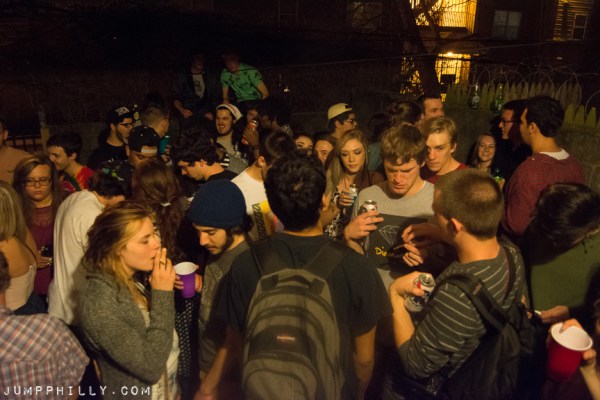
Houses throw concerts in basements frequently in Philadelphia. But it’s a rare occurrence that a showgoer can watch live painting, groove to the beat of a DJ, hear their favorite band and watch a flow artist all in the same night, under the same roof.
“The Special Green Weekend” event held at The Beaver Dam last Friday consisted of musical artists Tie-Dyed Dave, Flower Garden, Mercury Retrograde and Broadened Horizons, with DJs Patrick Richards and Kyle Ryan.
“We switched to the house show stuff in November and that’s when it started to kick off,” says “Kyle,” who lives in the house (we’ve changed his name changed for safety purposes).
Kyle cautiously waits at the door, scanning the sidewalk for any passersby. Previously, his house shows solely catered to DJs. But after watching the success of different houses over the years – and with a little encouragement from his peers – a community of different artists now inhabit his parties.


Two painters settle in the living room of The Beaver Dam, a batch of finished paintings on each side of the room and paint brushes in their hands. Michelle Smith (aka Sugar Cadavers) preps her station, crouching over to pour paint onto her palette.
“Music is very much about art,” she says. “It’s just very nice to have it actually there. People forget about it a lot.”
Ellis Rosenberg’s face is pressed against the canvas. His painting is a very abstract portrait outlined in a bright pink.
“It’s great,” Rosenberg says, “that there are like-minded people that get together and enjoy these things and start their own movement and future.”
A pile of amps and guitars find a home in the utmost corner of the immense basement.The stage is set. Strobe lights cast shades of blue, green and red on those beginning to filter in. Only the silhouettes of bands can be seen in front of all the commotion.
Patrick Richards does not see the individuals gathered to watch him spin. His head is furiously bobbing to the beat of Claude VonStroke and his view is nothing but his CDJ.
“DJs used to be known as tastemakers,” he says. “People would trust them to show them the new hot records. As someone who digs for new tracks rather then playing a set filled with bangers, I think it’s refreshing to hear someone say that my choice of music is receptive to more the one crowd.”


Tie-Dyed Dave, lead by singer/songwriter and lead guitarist David Durdaller set the tone for the night. His soulful voice resonates above the upbeat roll cast by his drummer. It surprises him to see art being sold upon arrival but in a good sense.
“It’s nice,” Durdaller says. “It makes it classier. All the art around encourages different types of artists to be here.”
Steven Haas’ straw hat encompasses the vibe of his band, Flower Garden, the only crew on the list not based in Philadelphia. The crowd has evened out nicely by this point and can be seen openly grooving to the funky pop riffs of Haas’ guitar.
“It’s a pretty cool thing,” Haas says. “We’re all here and we’re playing together.”
Mercury Retrograde, formerly known as The Wanderers, includes two members who had the original idea to bring the artist community to The Beaver Dam – Smith and Dan Snyder. Snyder is also the frontman of the band’s experimental jam style.
“It’s eclectic,” Snyder says. “It brings out a lot of people’s talents. It’s not just about music. When you add other arts to music, I think that helps direct the focus to towards the art and community of putting on a show. I feel like college students, especially, forget that sometimes. “
Ending the night was a joint collaboration of bands Broadened Horizons and Brain, lead by Andres Gallegos, who won over the crowd by covering Grateful Dead and Bob Marley.
“This is just a fusion of art,” says Gallegos. “This venue expresses it the most out of all of them. They’re really good at gathering people here and expressing the DIY in Philly.”
The Beaver Dam is in the process of staging an all-day music event in early May.
 Text and images by Evan Kaucher.
Cartel hit the stage at the TLA Friday for a sold out show and took their fans back 10 years with an entire set dedicated to their classic album Chroma.
Not only one of the most influential pop-punk albums, Chroma is also Cartel’s first full-length, which released in 2005. As a celebration to its 10-year anniversary, the group set out on a U.S. tour (with one show in U.K.), playing the entire album from front to back. This would be a first for the band.
With a majority of the fans reminiscing about their teenage love and heartbreaks, Cartel’s lead singer Will Pugh reminded everyone of the last time they played at the TLA in 2007.
“The last time we played here it was St. Patrick’s Day and we were trashed along with audience,” he said. “It was a show to remember.”
The crowd roared with approval, throwing up hands and sloshing beers as if they all remembered the epic event 8 years ago.
Starting from the top of the album, they opened with “Say Anything (Else),” which was a featured song in Madden 07. They then followed with their hit single “Honestly,” which they performed on MTV’s TRL (Total Request Live for the younger generation) in 2006. As of this year, “Honestly” has since been certified gold by Recording Industry Association of America.
For most of the fans, the concert brought them back to their youth, whether it was to when their parents drove them to their first Cartel show or when they first ripped butts after school blasting Chroma from their car stereo.
Accompanying them on tour was Hit The Lights, who recently came back from Japan (Skip School Start Fight Tour) and the U.K. (Pure Noise Tour). Their full length Summer Bones has also recently been released.
TEAM* and Driver Friendly also opened giving a more alternative rock vibe.


LAVA: Radical City Music Hall.
 Text by Jared Whalen. Images by Michael Bucher.
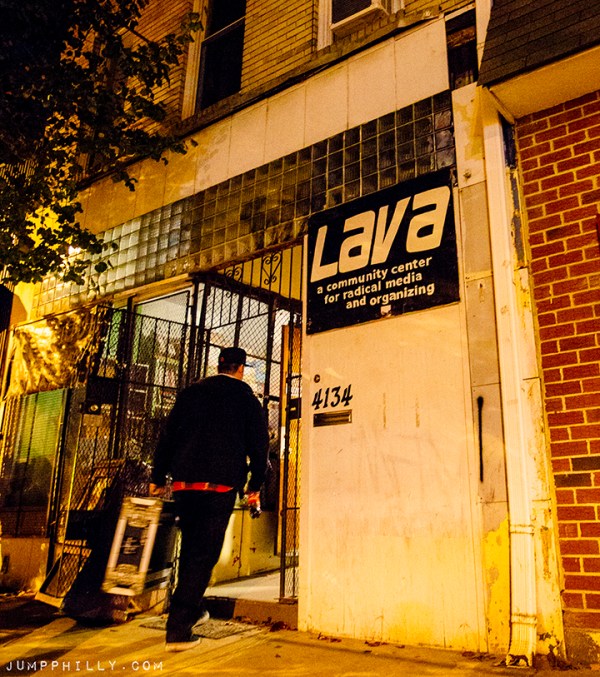
Three floors of poster-cluttered walls, stacked bookshelves and various workshop areas make up LAVA, the Lancaster Avenue Autonomous space in West Philadelphia. The three-story building is a community center and activism hub, and has become home base for several activist groups as well as a shared space for community events.
Located at 4134 Lancaster Ave., LAVA currently houses six organizations and has been home to many more over the years. Launched in the early 2000s, the space was founded by groups such as Food Not Bombs, an international social activism group, and the former radio station Volta Radio. Since then, more than a dozen groups have operated from within its doors.
“The whole thing with LAVA is that they want to cross-pollinate so that activist groups support each other,” says Mahdi El, founder of Young Broadcasters of America, which operates out of LAVA. “It took a whole decade for that to happen. Groups used to not mingle. Everyone was in their corner, just doing their own work. But in the last three years, it’s been very healthy.”
Active LAVA groups include Human Rights Coalition, Food Not Bombs, Defenestrator newspaper, Young Broadcaster of America and the LAVA Library. All these groups are either dedicated to community engagement and empowerment or toward regional activism.
 Outside of housing organization offices, LAVA space acts as a public art and music venue, often hosting shows featuring local and touring bands. A frequent stage for punk and alternative bands, shows often combine an element of philanthropy and activism, such as nonperishable food donations and social issue awareness. Artists having performed at LAVA include Radiator Hospital, Reign Supreme and Boroughs (above).
The Human Rights Coalition is committed to empowering prisoners and bringing to light injustices in the prison and judicial system. The group is predominantly prisoners’ families, ex-prisoners and supporters. They host meetings and service projects out of LAVA space. HRC also holds letter writing nights where they go through prisoners’ letters, mostly from those in solitary confinement, that report abuse and inhumane treatment.
“We bring in volunteers and catalogue the abuse that people are reporting,” says Andy Switzer, an HRC member. “When we have resources we try to step in.”
Several groups actively engage the local community. These groups include Food Not Bombs, which holds regular free meals for the community protesting the United States’ military budget, and the LAVA Library, which offers a wide array of educational literature on activism and social issues.
Young Broadcasters of America actively works with youth to give them experience and exposure in the field of broadcasting.
“We mainly do broadcasting for children,” says El. “We actually train them and put them on TV. We work with a lot of after school programs, summer camps, that kind of stuff.”
LAVA space is heavily volunteer based, typically having 25 non-group members volunteering for various jobs and events.
“We constantly have parties here, and we constantly have workshops and we need volunteers,” says El. “There’s a lot of members from LAVA from over the years. People will float in ‘cause they’re back in from like, Oakland or Cali or Seattle.”
Fueled by its forward thinking environment, LAVA’s reputation has developed among activist and fringe circles.
“LAVA has a huge constituency across the country. That’s why I think bands come here a lot,” says El. “They heard about the LAVA over the years because there are these radical spaces, or liberated spaces. So people will hear on the West Coast, ‘When you go to Philly, go to LAVA.’”
WIN FREE TICKETS! See Madeon @ The Troc on Thursday.
French teenage pop phenom Madeon will perform at The Troc on Thursday and we’re giving away tickets to the show. His debut album reached the top of the Billboard chart for for eletronic/dance music.
If you want a pair of tickets to see the show (it’s 18 and over), like us on facebook and email us at FreeJumpStuff@gmail.com (give us your name and put “Madeon” in the subject line).
If you want to play it safe, you can purchase tickets here.
 Rakim hit the stage at Underground Arts last Thursday in full ’90s swagger. In a pair of baggy jeans, new Timberlands, over-sized Carhart jacket and a Yankees cap tilted slightly to the side, the legend stood before the crowd and just let the cheers envelope him.
After nearly a solid minute of posing, the 47-year old, who made such classic albums as Paid in Full and Follow the Leader, then burst into an attitude-filled set.
At some shows, you’ll find the true fans singing along to every word at the front of the crowd. While Rakim was performing, it seemed that everyone in the packed house knew every word to all his tracks. It made for a pretty special evening.
Dyme-A-Duzin opened the night, which was a Red Bull Sound Select show curated by Veteran Freshman. Chill Moody followed and then presented a parade of Philly rap talent, including Freeway, Reef the Lost Cauze, Jakk Frost and more.


 JUMP: The Philly Music Project