Soohan @ Kung Fu Necktie with Cheatcode, Honeycomb and More.
 Text and images by Chip Frenette.
Soohan kicked off his Made in Baltimore Tour last Thursday at Kung Fu Necktie.
Why is Made in Baltimore kicking off in Philly? Well, as it so happens, Soohan is a Philadelphian who has found himself in Baltimore recently. He produced the album – with the same name as the tour – in Baltimore.
Soohan is not your typical DJ playing a bunch of tracks produced by others with big build ups and heavy bass drops. Soohan’s first tour will be small, just a few dates in the Northeast. But it will expose listeners to what he describes as a heady mix of hip-hop and world beats, with the nostalgic sounds of the ’90s sampled to add familiarity to his grooves.
Since the album was released in mid December, it has had nearly 250,000 plays and downloads.
The tour will also feature artists from beyond the world of electronic music. The sets in all locations will also include other artists – Raf Mvta from Connecticut and Philadelphian Elle Paisley live-painted at the Kung Fu Necktie show.
The evening also featured producer Cheatcode, who modestly stated, “The mix may not be tight but the sound is right.”
He was also joined by beatboxer Honeycomb. Together, they performed through the night with Cheatcode’s all original track productions.


State Rep. Jordan Harris: “Music is Oftentimes the Soundtrack of What is Happening in the World.”
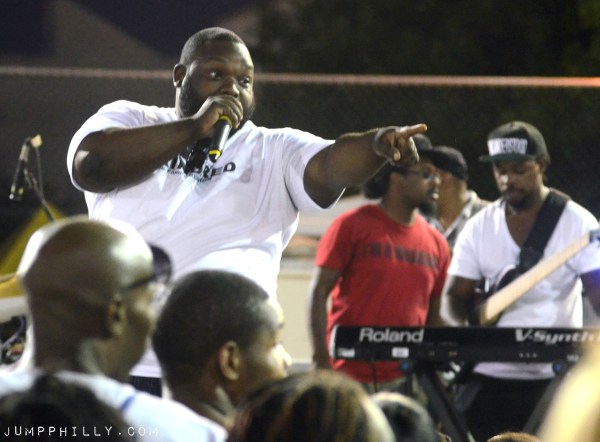 At 30, State Representative Jordan Harris is the youngest elected official in Philadelphia County. The South Philly native was elected in 2012 to represent District 186, which includes parts of South Philly west of Broad Street and pockets in Southwest Philly, like Kingsessing.
He’s currently planning his annual summer block party/music festival. His last event drew more than 5,000 people to Chew Park on Washington Avenue to hear Jazmine Sullivan, Jaguar Wright, Kindred The Family Soul, Suzann Christine and many more local artists.
Our G.W. Miller III spoke with the representative about why he sees music as a necessity for society, especially in schools.
You’re not a career politician, right? What is your background?
Before running for office, I was a school teacher. I taught middle school social studies. I also worked for the city. I was the executive director of the city’s youth commission for about two years after being in the classroom.
What made you decide to get into politics?
I’ve always had a desire to be involved in government. My undergraduate degree is in government and political affairs. My masters degree is in education. Going off to college, I had a desire to learn how government affects our lives and how to be involved in using government to benefit the community that I grew up in.
I was in high school at Bartram Motivational. The school district at that time wanted to move my high school into the main building. I was president of the student government and I thought that was a bad idea. So we organized parents, students and teachers to advocate to keep the school open.
I ran into Senator Anthony Williams, who helped us through that process. He showed me how, if you use government the right way, if you organize, you can see your will imposed upon a situation.
You don’t seem like a politician.
I take that as a good thing!
I saw you on stage at the festival last summer (above). I thought you were the hype man.
Every year, I do a street festival. Last year I partnered with Kindred The Family Soul and called it Kindred The Family Reunion. It was a part of my street festival, part of my summer series.
The points of the festival and series are one, there are children and families in my community that I represent, who can’t afford $60 per person to take their kids to Great Adventure or Dorney Park or anywhere like that. If only for a day, if only for a few hours, those kids get the opportunity to jump on a moon bounce or eat cotton candy or experience some sort of amusement park feel in the summer.
In addition to that, it’s an opportunity to use that to bring out a large number of people and get them valuable city and state service information. There were more than 40 different agencies that were out there giving out information and talking to people.
We also want to invite people into the neighborhood. There’s the hope that they’ll want to open up a business there or they’ll think, “Maybe I could live in this neighborhood.”
Is music a draw to bring people together?
Music is oftentimes the soundtrack of what is happening in the world. When Sam Cooke said, “A change is gonna come,” he was talking about the era in which he lived. When Marvin Gaye asked, “What’s going on?” It wasn’t just a song. It was an actual question about what was happening in the world. When James Brown said, “I’m black and I’m proud,” it was an anthem about being proud of who you are.
It also is something that unifies us – black, white, brown, yellow, Christian, Muslim, Jew, gentile, gay, straight, questioning, whatever. Music unites everybody.
That’s why we like to focus this event around good music.
Do you think you’re able to make an impact on the arts as a legislator?
I think government does play a role in fostering music. On a nice summer day, you can walk down Broad Street and hear performers showcasing their craft. There are some places where government would want to shut that action down. But that’s part of what makes Philadelphia the beautiful city that it is.
Additionally, government has the ability to fund musical programs. Governor Wolf just gave his budget address. It is a bold statement that educating our children should be a state priority. My hope is that school districts will continue and reinvest their money in music programs. I tell people all the time: you don’t understand how music can affect people’s lives. It’s been shown that, from a therapeutic perspective, music is helpful.
Another thing that state government can do is partner with philanthropic organizations. I serve on the advisory committee for the Knight Foundation and over the last couple of years, the Knight Foundation has made millions of dollars worth of investments in the arts here in the city of Philadelphia.
Does it get frustrating being in government?
Yeah, it does get frustrating. There seems to be this mindset that Philadelphia is a black hole of funding from the state. What a lot of people don’t understand is that Philadelphia and the five county region, we are the economic engine of this state. When you look across the commonwealth at all the counties that have bridges, state police, highways … a lot of them have that because of Philadelphia and the five county region’s economic engine. We need to do a better job making that known.
It’s also frustrating because I don’t think people view the importance of music and art in our culture. Music and art is transformational. It’s frustrating to get funding. But it’s encouraging to go around and see the places where it’s working.
Cory Wade’s Next Reality …
 Interview by Beth Ann Downey. Images by Jared Gruenwald.
Just a few weeks before walking for House of Byfield and Dom Streeter during New York Fashion Week, Cory Wade is looking relaxed in sweatpants, grabbing a sandwich and soup for dinner at Queen Village’s Café Fulya. Fans who know Wade from “America’s Next Top Model,” the reality show on which he came in third place in its 20th cycle, might not recognize him as he is now.
But the truth is that Wade has ambitions outside of the modeling world – one of the biggest is making it as a soul musician.
Describe your music background and your modeling background.
My experience was very limited [before “ANTM”] and I feel like I’ve been thrown into this fashion world without really knowing that much about it. Trying to navigate that industry has been so crazy. I’ve had highs and lows. There have been struggles at times but I’ve also had great successes. So that in itself is a very weird place to be – living in Philly and being in the fashion world – because you don’t really think about fashion when you think about Philly, which is something that I hope changes very soon.
As far as music goes, that’s just something that I’ve always done. I always used to write songs as a kid. I had a little journal that I would write in and a lot of the time, I would turn what I was writing into music. Now, even though everyone knows me as this model or this reality television personality or whatever, I have to make room for the music side of me or I feel like I will lose myself in the end. It’s such a genuine part of who I am and I love it so much and it comes to me so easy.
What was the greatest life or career lesson that you learned by competing on “America’s Next Top Model?”
I say it all the time and it has become a mantra of mine: rise above and radiate love. When you’re in a setting where tensions are high and you’re living with people you’re competing against and there is drama – a lot of it, it’s very easy to lose yourself and sort of overdo it for the sake of TV and to get into your competitors’ heads. It was very easy to be nasty. I had a lot of opportunities to be nasty, like mean, and trash talk other people. I learned a lot about myself there because I was making the conscious decision not to.


Do you get recognized on the street now?
Oh yeah, absolutely. It’s pretty cool to be recognized for that, but the trouble with it is, it becomes really all people know you for. So the challenge is, I feel like I have to keep on doing things to reestablish the way that people see me because I don’t want to just be known for that one thing I did, as awesome as it was.
During your time on the show as well as with your current following, it seems as if you get a lot of support from the LGBT community. What is that like and what do you like most or think is most unique about the local LGBT community in Philly?
I used to be a drag queen and being immersed in that world, I learned so much about what it means to be fearless. It’s something that I’ve integrated into everything that I do now. It’s something I feel has catapulted me to achieving all of these crazy goals that I’ve set for myself. It’s that fearlessness. It’s the relentless confidence. I love the LGBT scene in Philly for that.
How do you describe yourself as a musician? And how has modeling affected your stage persona?
By nature, I am a soul artist. I love soul music. I love India.Arie, Corrine Bailey Rae. That was my first entry into the music world. When I released my first two singles – one is called “I’m Sorry,” the other is called “Stay True” – it was just me and my guitar. That’s the real me, when I’m playing music. I realized that the “Top Model” following wasn’t so responsive to them. People appreciated them because, I feel like, they sounded good. They were great songs. But people were expecting me to put out something very clubby and dancey. I guess that’s the audience I have.
Because I still really wanted to do music, I decided to release a dance track with a music video. It’s very flashy. It’s “Pose Down.” I think it is important that I reach out to that fan base, sort of, because they’ve given me so much and they’ve uplifted me so much. So I have to sort of cater to them. I don’t love that song. I think it’s funny. I think it’s stupid. It’s a complete parody. But it’s important that you cater to your fan base, for sure. I think, going forward, I’m going to do more soul. I’ll find a way to sort of mesh the two genres. I really want to do soul-funk, something that is still going to make you move and want to dance, but that’s still soul at heart. “Pose Down” is not me. I love soul music.
You used to do musical theater and you’re known for being a wedding singer before “ANTM.” What’s your writing process now? How do you feel putting your original music out there?
Writing comes very naturally to me. I write based off of how I’m feeling in that given moment. You hear about actors and “method acting” where they really draw from real-life experience in order to convey whatever emotion they’re trying to convey. I feel like the same principles apply to writing music because music makes people feel. That’s its ultimate purpose. So I think you have to go somewhere in order to evoke some kind of emotion from someone else. You have to draw from some sort of life experience.
What’s your biggest piece of advice for any aspiring musicians or models out there?
My advice is to do what you want to do and don’t let anyone else’s idea of you – and what they think you are – deter you from doing something that you just feel like doing. Everybody says to me, “Oh Cory, it’s so important that you brand yourself. Branding is everything in this industry.” Yeah, but this is still my life and I still have to enjoy my life. I still have to be happy. So, put that before anything else and you’ll be fine.
Chris McElroy: The Party Crasher.
 Interview by Eric Fitzsimmons. Images by Evan Kaucher.
Chris McElroy has been around the Philly music scene since middle school and the whole time he has been bending, breaking, creatively interpreting and ignoring the rules to see his favorite bands in person.
It’s not all slight of hand though. McElroy, 29, of Fishtown, is a talented web and graphic designer at SEDSO Designs. He worked with Trent Reznor as a teen and he has designed websites for many local bands and venues, which means he now gets backstage with an official pass … usually.
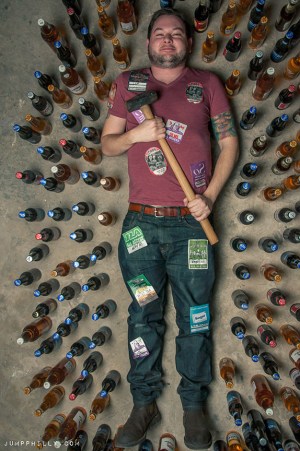 How did you start going backstage for concerts?
The very, very first time there was a band called KMFDM from Hamburg, Germany. I was a huge fan of theirs. I emailed back and forth with the band and did some website stuff with them. I was either 14 or 15. They were playing at the Trocadero and it was a 21-and-over show only. I really wanted to see the show because I’d never seen them live before so I emailed the band and they said, “Get to the venue early and meet us by the tour bus.” As soon as I met them, they gave me a guitar and they had me carrying the guitar cases and all the gear so that I wouldn’t get IDed. The lead singer told security he was my uncle. So, that’s how I got in. It was just carrying a guitar case.
Why is getting backstage a big deal for you? What draws you to the backstage scene?
It isn’t too much anymore since I’ve done it so many times now. But sometimes, it’s just going back there ’cause you know you can get a free beer and don’t have to pay super high prices at the bar.
I like hanging out with some of my favorite musicians, seeing them in their natural habitat, so to speak. You get to see another side of them. If it’s backstage, before they go onstage, you know they’re nervous. They’re warming up on a drum pad or something like that. Then, if you’re backstage after their set, they’re all cracking beers and having a good time and they’re your best friends for the night.
 What act had the coolest backstage scene?
I would have to say Nine Inch Nails in Las Vegas for my 21st birthday. I had done work with the band before and they invited me backstage. Trent Reznor, he’s my musical hero. It was really cool just talking with him one-on-one, you know? We ended up getting to trash his dressing room. Most times backstage, it’s not what it looks like in the movies or whatever. But this was one of those nights where it was a lot like the movies.
How do you find working with bands?
I love it. The cool thing, since doing Nine Inch Nails’ website when I was a teenager, is that’s a great selling point to bands. “Hey! I did Nine Inch Nails’ website.” Bands automatically want to work with me. Plus, just being connected in the Philly music scene, I know the industry. I know all the key players, so to speak, and I have good suggestions for bands besides the regular web and graphic design work that I do.
What’s your big secret to getting backstage without a pass?
Rule number one: make friends with the security guards. Ask them their names, make sure they know your name. Tell them a funny joke so they remember you and just don’t piss them off.
Good Old War @ The Church with You Won’t and Pete Hill.
 Text and images by Emily Scott.
There is something heartwarming about seeing your hometown, Philadelphia suburban band play a sold out performance at the First Unitarian Church. After a two-year hiatus, acoustic folk band Good Old War did just that on Sunday.
The three-piece band brought out newcomers to the church, noted by their unfamiliarity with the basement stairs entrance.
The evening was kicked off by another Bucks County native, Pete Hill. The one-man band took on a fresh-faced American indie rock sound that had the crowds swaying to his bluesy rock riffs. Hill played a few tracks off his latest work, The Bullet Tree, including “It’s A Shame.” Backed by a folk bassline, Hill’s soulful voice does the rest of the work.
Good Old War drummer Tim Arnold accompanied Hill on “Soaking,” which featured surf rock riffs and rim clicks that felt just right for the warmer evening,
The theme for the night seemed to be small, multi-instrumental bands. Next to take the stage was Massachusetts’ duo, You Won’t. At first glance, they appear to be a simple drum-and-guitar indie rock group but add in a tambourine pedal, synthesizer and a whirly tube, and you have the multi-genre band. Their stage presence was incredible and had its fair share of jokes as guitarist Josh Arnoudse sang “Can’t Help Falling In Love” falsetto through the whirly tube.
A woman came to the stage to welcome “the best band in the world” and the trio couldn’t stop laughing as they walked onto the stage. The band opened with their catchy folk rock track “Coney Island” and the church basement was overwhelmed by loud sing-alongs.
On tracks like, “Looking For Shelter,” harmonies played an integral role in capturing the audience’s attention. The trio’s working harmonies were still spot on even after some time off as a band. During “Weak Man,” the crowd independently belted Anthony Green of Circa Survive’s refrain.
The band didn’t stray from crowd participation. The group asked two girls to come up and sing Keith Goodwin’s verse on the track.


Good Old War opened with two new tracks off their upcoming album, Broken Into Better Shape, one of which has yet to be released. “Tell Me What You Want From Me,” which was released earlier this month, features more rock ‘n roll riffs from the band. The foot-tapping drum patterns from Arnold turned this track into an anthem.
After playing their hit “Amazing Eyes,” the band came out for an encore to play three more songs. As Arnold’s accordion riffs cascaded the room, the crowd let out a cheer for the track “My Own Sinking Ship.”
The band seemed to feel right at home, as the whole crowd was singing along to nearly all the tracks, including the latest one.


Nightwish @ The Electric Factory.
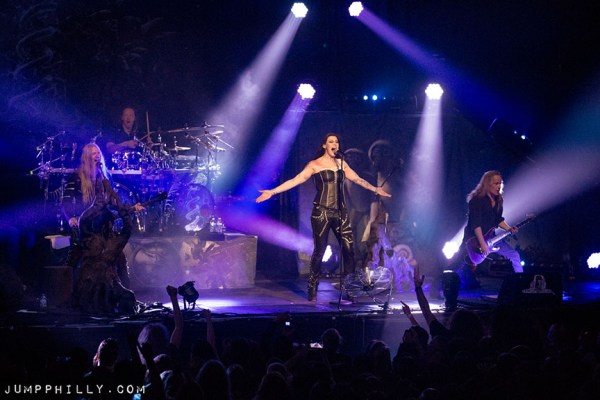 Text and images by Lee Miller.
Philadelphia was the second stop on Nightwish‘s latest world tour in support of their latest album, Endless Forms Most Beautiful, which was released on March 31st.
This marks a new era for the band from Finland. Just shy of their 20th year, it is their first album with their latest vocalist, Floor Jansen. It’s also the first album to feature multi-instrumentalist Troy Donockley as a full member and the first without drummer Jukka Nevalainen, who is temporarily away from the band for health reasons.
Opening for the tour are both Delain, who hail from the Netherlands, and Sabaton from Sweden.
Delain took the stage first and while they are they newest band on the tour, they’ve still be active for 13 years. Delain has a long history with Nightwish. Nightwish’s bassist, Marco Hietala, has appeared on their albums dating back to 2006.
Their seven-song set featured simpler symphonic metal than the headliners – and more peppy and upbeat. It might not be a stretch to call it pop-ish.
The packed in crowd showed their support but really erupted for Sabaton. The audience chanted the heavy metal unit’s name. The band featured lyrics about battle and warfare and, suitable to their northern homeland, were decked out in matching snow-camo pants and guitars.
Lead vocalist Joakim Brodén brought an impressive amount of charisma to the stage, cracking jokes and working up the crowd by telling them they were louder than NYC (to which the crowd responded with a “F*** New York” chant.)
Doing heavy metal with a smile, Brodén expounded on how he believed metal was for everyone and pointed out the diverse crowd jammed into Electric Factory for the evening. To drive his point home, he singled out a 12-year old girl from the audience and had her brought to the stage to rock out with the band during their final song.
Their 10-song set was a hard one to follow but Nightwish is a band that brings showmanship in spades. They packed a stage set that could put anyone’s to shame with instrument stands crafted to look as though they were carved out of Ents (the tree creatures from Lord of the Rings).
Or you might say that they looked like Groot from Marvel’s “Guardians of the Galaxy.” In fact, a fan in the front row brought a large Rocket Raccoon stuffed animal to wave around.
Combined with the battery of lights, when Nightwish finally took the stage with “Shudder Before the Beautiful” (also the first song on the new album) it was quite a visual spectacle for a venue of Electric Factory’s size.
There are many bands that delve into symphonic elements in their music but Nightwish has a really deep repertoire of backing tracks that go beyond simply adding in some strings sections and some chanting.
The occasional addition of brass really adds a layer that takes them into a different level of complexity. It is almost a cinematic sound.
After opening with two new songs, they dipped back to 2007’s hit “Amaranth,” which is a more conventional soaring symphonic metal track. From there they went even further back to “She is my Sin” from 2000’s Wishmaster album.
After jumping back to the present with the Endless Forms Most Beautiful title track, an uptempo genre bending experience, Troy Donockley finally took to the stage with his Uilleann pipes for “My Walden.”
Fittingly, this led to “The Islander,” which is a Celtic rock inspired acoustic number sung by bassist Hietala that really lets Donockley’s work stand out.
They rolled on for seven more songs after that before reaching “The Greatest Show on Earth,” their 24-minute multi-part epic from the recent album. Much like how 90s metalers X Japan generally only play half of their 29 minute epic, Nightwish played only the middle sections of the song.
After that epic performance, which was their 15th song of the night (but really more like their 15th, 16th and 17th), they took a moment to run off stage for a break and wait to be called for their encore.
They didn’t linger off stage for too long but when they returned to the stage it was roughly four hours from the beginning of the show and most of the fans still had plenty of energy to give.
Nightwish closed out the night with “Ghost Love Score” and the appropriately titled “Last Ride of the Day” before thanking the packed house and sending them on their way.
It wasn’t necessarily the end of the night though. If four hours of metal wasn’t enough, next door at Voltage was still rocking their grindcore show.


 Text and images by Grace Dickinson.
Young Fathers played Boot and Saddle on Saturday, bringing an assault of energy to the stage.
The three men – a Liberian, a Nigerian and a Scotsman – took turns not only soloing on the mic, but also breaking out into dance solos that made it impossible not to bounce along with them. They had moves. And individual talent that enabled each to stand alone, yet also create seamless harmonies with the childhood friends that stood beside them.


The multiracial trio met when they were just 14-years old at an under-16 hip-hop night in Edinburgh. The more than decade-long period they’ve spent with one another since is made evident when the three get up on stage. Together, they are able to sustain a continuous and building blend of rap and gospel-like lyricism, which itself often carries both a heavy political and emotional tone. This synthesized singing gets paired with poppy percussion-recorded tracks and a drummer that they bring along on tour. In fact, the drummer should not be forgotten. He, too, delivered an equally energetic performance, flailing his arms, and at times, dramatically plopping himself to the floor during pauses in his set.
On tour for their latest, White Men Are Black Men Too, Young Fathers recently won a slightly controversial Mercury award in 2014 for “Best New Album.” Still somewhat of an unknown name to many, it came largely as a surprise, and even still, it’s clear that the band remains in the process of making their recognition wider. While they played to a sold-out show the night before in Brooklyn, Boot and Saddle remained half-empty through until the end of their show. Although, also clear, the audience certainly didn’t leave night feeling half-satisfied. From their piercing stares to their constant hip-shaking, Young Fathers is a band to see live. Get enough people to their on-stage performances, and likely it won’t take much longer until their name becomes established.
Opening for Young Fathers was Mas Ysa, delivering intense, space-like electro jams and equally intense, emotional facial expressions. Yikes the Zero with Radio Ghost also opened up, a fun, Philadelphia-based rap collaboration.


New Sound Brass: The Instant Party.
 Text by Tyler Horst. Images by Mina Lee.
Upstairs at the Stone House Pub in South Philly, in an empty billiard room with the blinds drawn against the midday sun, Mike Strickland Jr. hums a line to himself before trying to replicate it on a baritone horn. He and some of the other members of New Sound Brass are in the middle of arranging some Bob Marley tunes for their 10-piece ensemble. There’s no sheet music, no talk of music theory, just Strickland’s animated instructions about how to capture the vibe of the reggae standards and make them their own.
“We can play whatever you want to hear,” says Dan Demmy, who plays trombone. “We put it in our brass machine and turn those words into sounds. It changes everything.”
All told, Strickland, Demmy, Bruce Swinton Jr., Jimmy Carras, Patrick Renzi, Thomas Hagglock, Larissa Hall and three members of the Windless family – Curtis, Perry and Sharif – fill out the New Sound Brass line-up.
It’s a small wonder to find 10 people who enjoy playing together, especially when considering the diverse array of backgrounds the members represent. Some started off playing in gospel bands. Others cut their teeth with brass bands in the Mummers Parade. A church may be a far cry from the bacchanalia of the wench brigades but the band thrives on its attempts to marry these and other influences together into their own voice.
“We don’t know what the sound is,” admits Strickland about the band’s style.
“The common factor is we’re all from Philly,” says Demmy. “It’s a Philly sound.”


Strickland is the de facto leader, though he’s uncomfortable with the notion of being the man in charge.
“I thought we could be something different than any other brass band,” says Strickland. “In my opinion, we were only going to accomplish that if we were accountable to each other.”
“They’ve been together for such a short time but it’s really evident that they have a strong bond with one another,” says Amy Johnston from the Mural Arts Program. Mural Arts first hired New Sound to perform at a fundraiser in May of 2014 and then a mural dedication last June.
“They have the ability to connect with a crowd and create energy,” says Johnston about the lively dedication ceremony. “They kind of took us to church.”
Demmy believes part of the success of the band comes from the fact that they are sort of a novelty around here. Few other brass bands in Philadelphia commit full-time in the same way New Sound does. It also helps that there are few restrictions on where New Sound can bring their effusive brand of entertainment.
“We can play anywhere,” says Renzi, who handles the snare drum. “We don’t need electricity.”
And even in a packed bar or other indoor venue, Demmy says the band’s goal is to make people feel like they’re in the thick of a parade or dancing at a party.
“It blurs the lines between performer and audience,” he says about the band’s connection with the crowd. “We’re all a part of it.”
“I’m a fan of NSB,” says Strickland. “Just because I’m in the band doesn’t mean I can’t be a fan.”
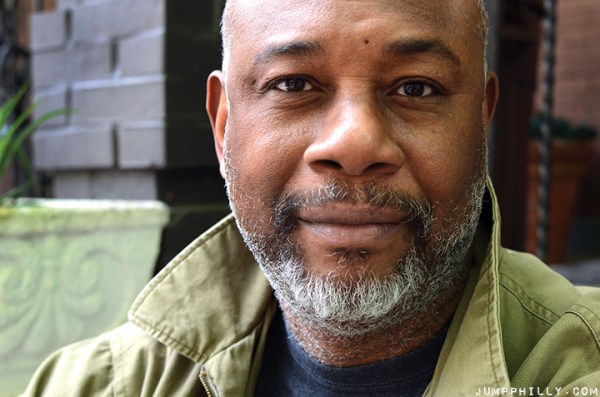 Interview by Matthew Leister. Image by G.W. Miller III.
The Philadelphia Jazz Project, WRTI, WXPN and NPR’s Jazz Night in America teamed up to bring more than 20 area jazz musicians to the World Cafe Live in March to pay tribute to three of Philly’s most renowned jazz organists: Charles Earland, Shirley Scott and Jimmy Smith.
The show, “Home Cooking: Philadelphia Jazz Organ Tradition,” was sold out.
The event, however, was recorded and will begin airing online next Wednesday (April 15th) at 9pm ET at npr.org/jazznight. The radio version will beginning airing on WRTI April 16th.
We caught up with Homer Jackson, the director of the Philadelphia Jazz Project and the curator of the event, to talk about the show and the state of jazz today.
First of all, as a lover of music, I must ask, what’s your favorite music out today? What new stuff is exciting you?
Because I’ve been working on the Sun Ra Mixtape, I’ve been listening to Sun Ra and Sun Ra related people for the last two months. I’ve been listening to Thundercat and Flying Lotus and Shabazz Palaces because we’ve been looking at developing a project, hopefully for next year, where we’ll be bringing in some artists to actually celebrate Sun Ra with us and we are interested in all three of those groups.
Where will you be holding this event?
We don’t know just yet. It’s a money thing. If we’re funded for that project then… we’re working with a couple other organizations to do this. So, if it falls into place, we’ll be celebrating Sun Ra with elders and young performers.
Are there any up and coming local jazz acts you have been excited about in Philly?
Oh my God. There’s so many. There are so many people here in Philadelphia, elders and young people.
For instance, we have been doing this series in collaboration with the producer’s guild at the Free Library through a librarian by the name of Adam Feldman and the series is called Mysterious Traveler. It’s an incredible opportunity for us to be able to check out artists who should be known and should be much more popular in the community, but they just haven’t had the kind of exposure that they really are due. Some of those musicians are Nimrod Speaks, Anwar Marshall, Dan Hanrahan, Wayne Smith, Jr., Michael Cemprola, Matthew Clayton, Vince Turnbull, Brian Howell, Jason Fraticelli; these are some amazing, amazing young musicians. These are free concerts at the library, we started in September, and the last one will be coming up on the 9th of April at the library. These young people exemplify and sense of the past merged with what is yet to be the future. So they’re not replaying old music, they’re revisiting old ideas and bringing a contemporary thought to it. So, when elder jazz fans come to see these folks their minds are blown because the music feels based in the tradition but very fresh too. Those are really some talented people and I’ve been very excited about working with them.
We also spent nine months last year working with a group of female vocalists called Diva Nation. They are really some talented folks and they are about to be doing some salons soon and they will be presenting their work. Some of the singers in that group are Ella Gahnt, Barbara Montgomery, Carol Harris, Liz Filantes, Gretchen Elise, and I’m missing someone else but there have been eleven people that have been a part of Diva Nation and it’s been a pleasure working with them and supporting the sense of community amongst female vocalists who work in jazz in Philadelphia. So, that’s just some of what we’ve been working on. We’ve been crazy.
How do you and the Philadelphia Jazz Project find these people?
Read more…
Jeff Zeigler: The Soundman Takes the Spotlight.
 Text by Chris Brown. Images by Jeff Fusco.
It’s a tired saying but sometimes success really is just a matter of being in the right place at the right time. For producer/multi-instrumentalist Jeff Zeigler, that right place turned out to be here, in Philadelphia.
After finishing school in 2000, Zeigler left Boston with the intention of working in music in some capacity. He had recorded albums for bands in Boston but he says that Philly offered a lower overhead, where you could spend more time focusing on what you really wanted to do, as opposed to just working to survive.
“This city, I’ve found, has – and it still exists – a lot more of a communal music vibe than there was where I’ve been before,” he says while sitting in Uniform Recording, his Eraserhood studio. “In Boston, everyone was more on their own and it was almost competitive. Here, I think people were just excited to have some new blood in the city.”
However, this isn’t to say that any of what would follow is chance or luck.
“It definitely took a while,” he says about getting started in Philly.
Without the outright specific goal of working as a producer in mind, Zeigler ended up forming Relay, a band that later would come to be known as Arc In Round. Not only was this the first project that Zeigler would tackle here in the city, it was also his first ever band.
“I didn’t even really start working on music until college,” he says. “I played guitar when I was younger but never really went anywhere with it.”
While in school, Zeigler took a recording class that afforded him the opportunity to borrow gear, if he needed it. Having picked up the guitar for a second time, he used the opportunity to start writing and recording.
“After awhile,” he says, “I was just like, ‘I should probably start a band, I guess. That seems like a logical move.’”
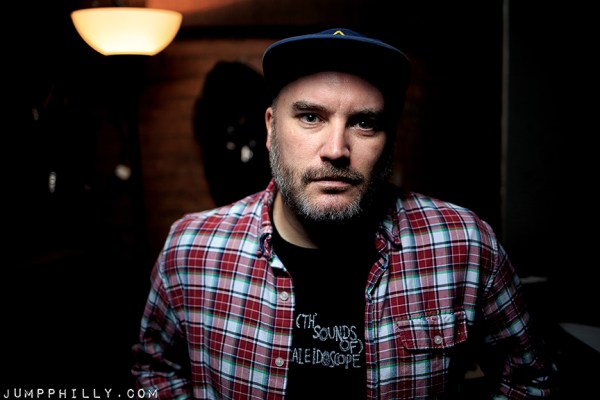 The idea of logical moves comes up often when talking with Zeigler. It’s a thought process that has roots in nearly everything that he’s touched in the last decade. The first bands that he started working with were friends or their friends.
“It grew at a reasonable, organic pace,” he says. “Being in a band and dealing with other like-minded bands who were all kind of into the same stuff, it just sort of made sense.”
As his recording commitments increased, Zeigler continued to make music with Relay. He also took on tour managing and soundboard duties with bands such as Frightened Rabbit and Twilight Sad. Somewhere in between working on his own music and overseeing tours, Zeigler worked on albums for both The War on Drugs and Kurt Vile.
“I would work on records for half the year and then tour manage and do touring sound the other half,” he says. “So, it was like constantly working on the road and then coming back and having to start recording records right away.”
Eventually, Zeigler decided to take a break from the road.
“It just made sense to me to try and do the studio stuff full-time,” he says.
In the time that has passed, he’s recorded, produced, mixed or engineered a slew of albums by local acts such as Purling Hiss, Lantern, Nothing, Amanda X, Steve Gunn and, of course, The War on Drugs. While that range of artists may seem varied to most sets of ears, in each instance Zeigler always finds a thread. While he describes it as mostly just keeping things “true to what makes sense for a given band,” those who have worked with Zeigler find that there’s more.
“Jeff has great ears and an uncanny ability to utilize and create space in his mixes,” says Christopher Smith, from the record label Paradise of Bachelors, who worked with Zeigler on Steve Gunn‘s 2014 release Way Out Weather. “He gets the material right away and absorbs and processes it as his own art. That care and ability is rare.”
Smith wasn’t the only person who was quick to offer praise.
“What it comes to down is Jeff really knows his shit and he has a great personality,” says Josh Agran of post-punk outfit Cassavetes, whose 2014 record Oh So Long was mixed and recorded by Zeigler. “The whole process ended up feeling like we were just hanging out and making a record.”


These days, Zeigler is back to the juggling act, balancing his time on the road with the time in the studio. In September, he and harpist Mary Lattimore released an album together, Slant of Light, and then headed out on tour in support of the record.
While both have been highly visible members of the city’s scene for years, the pair didn’t really know each other until they both found themselves on the same touring bill. Zeigler was doing sound and tour managing for Kurt Vile and Lattimore was playing in Thurston Moore’s band.
Shortly thereafter, Lattimore came to Uniform Recording to work on her 2012 solo album, The Withdrawing Room.
“She’s pretty open to collaborations and had wanted me to help with processing and tweaking out what she was playing as she was playing,” Zeigler says. “I had stuff set up for that and I also had a synth set up. She asked if I wanted to play on a piece and I was like, ‘Alright. Let’s try it.’ We improvised for a half hour or so.”
That initial exploratory jam would end up becoming the first half of The Withdrawing Room.
“I completely trust Jeff’s musical aesthetic and ears and didn’t want my harp record to be too same-y,” Lattimore says. “I trusted that Jeff would add something interesting texturally to enhance the piece.”
Following those sessions, the duo began playing shows together.
“After the solo record, I wanted to keep playing music with Jeff, so we started playing improvised shows,” Lattimore continues. “It was natural to make a record after that, so we recorded some ideas in early 2014.”
With everything going on – a full recording schedule and a new album out, Zeigler sounds like a guy in need of a vacation. He recently traveled to Amsterdam but that was for a few weeks of recording. He’s now planning a more proper European vacation.
At some point, a solo album will see the light of day, Zeigler says. He describes it as coming from the world of “early New Order” and influenced by Krautrock. The album will include contributions from former Arc in Round bandmates Mikele Edwards and Matt Ricchini, as well as drumming from Chris Ward of Pattern is Movement. Zeigler anticipates having a band together by spring for live shows.
Looking even further down the road, Zeigler also has plans to pursue a hip-hop-based beat project.
“Part of me feels like I’ll just end up doing that for the rest of my life,” he says with a laugh. “It’s so fucking fun.”
For someone, who has spent so many years behind the scenes of much of the city’s most celebrated music, it just might be time for Jeff Zeigler to step out and spend a little time in the spotlight himself.


 JUMP: The Philly Music Project