Phil Nicolo: The Butcher Goes to China?
 Text by Kyle Bagenstose. Images by Rachel Del Sordo.
Phil Nicolo‘s doing what he does best. He’s tinkering.
Hunched over a small desk, his eyes are excitedly scanning a computer screen. He seems to be almost trembling with anticipation. Surrounding him is a control room filled with all kinds of boards and buttons, dials and wires, faders and switches.
On screen is The Beatles’ “Don’t Let Me Down,” laid out neatly in tracks. It’s the original studio recordings, all in a row – Paul McCartney’s bass, Ringo Starr’s drums and studio musician Billy Preston’s keyboards among them. But Phil has one particular track in mind.
“Let’s listen to John Lennon and Paul McCartney sing by themselves and get goosebumps,” he says.
He selects the track and hits play. A hush falls over the room for several seconds, with only a slight white static noise emanating from the speakers. And then…
“Don’t let me down!” Lennon screams passionately from out of the silence.
The hush is back for several seconds. Phil closes his eyes and bobs his head to a nonexistent beat, his brow furrowed emotionally.
“Don’t let me down!” he mouths, perfectly timed with a second scream from Lennon. The goosebumps come.
“Then you get Paul coming in on the harmony,” Phil says.
Now two voices are screaming in unison, punctuating the eerie silence in between. Phil begins to shuffle his feet and move around. He’s in the groove.
“Don’t let me down!” they bellow.
“And they’re just looking at each other while they’re doing this, man,” Phil exclaims. “Come on!”
Nobody ever loved me like she do me
Ooh she do me
Yeah, she does
Then Phil moves back to the mouse and begins clicking away. Lennon and McCartney’s vocals grow quieter, like they’ve gone underwater. He highlights a few other tracks — the bass and drums — and hits play.
The bass line rumbles the floor. It starts and stops, almost bumbling.
“Fucking Paul McCartney’s bass playing,” Phil says with admiration, as his eyes close again and he plucks an invisible bass. “I mean, one of the greatest melody makers on the fucking planet, right?”
Phil would know. At 58, he’s been around a lot of melody makers. As an award-winning engineer, producer and mixer who has worked with countless stars, it almost seems unreal that he’s working out of a basement space, dubbed Studio 4, below a bar on Conshohocken’s main strip.
Kwesi K’s Farewell Show @ Boot & Saddle.
 Text and images by Darragh Dandurand.
Kwesi K ran around the venue space of Boot and Saddle in the minutes before his last show in Philadelphia on Saturday. He plans to leave in a month with hopes of making it in Los Angeles. He was shaking hands, giving hugs and getting ready to say goodbye.
After performances by Cookie Rabinowitz and Elegant Animals, Kwesi bound up to the stage and cupped the microphone in his hands and thanked everyone who came out for the performance. An uproar of applause met his remark as he set into songs from Pronouns, Lovely and Ran Away From Me.
Work Drugs Album Release Party @ Spice House Sound with New Myths.
 Text and images by Darragh Dandurand.
If you happen to walk down the quaint and sleepy Fishtown alley that Spice House Sound is nestled into, you might, once in and while, hear faint bass lines rattling the windows and muted drum beats trying to break through the walls.
Last Friday night, the little street seemed peaceful and cold, that is unless you knew which doorway to walk through to attend the secret show Work Drugs and New Myths was playing in the wood paneled studio for a few dozen hipsters. The intimate concert was a release party for Work Drugs’ Runaways album.
By around 9 pm, the sound booth started filling up with friends, fellow musicians and some usual suspects from Philadelphia’s local art scene.
New Myths, a trio from New York City, opened up the show with a few appreciate remarks before diving into a heavy-hitting and stripped live sound. They played several selections from recent album, Give Me Noise, including “Howl.” Brit Boras crooned lyrics behind her guitar while Marina Ross, on bass, and Rosie Slater, on drums, backed her with vocals and undeniably catchy rhythms.
Right before Work Drugs was about to start their set, each member slid on a pair of Wayfarers as a nod to their smooth and silly vibe. Outside of live shows, the band consists of guitarist Tom Crystal and pianist Ben Louisiana, but on Friday they had Jonas O on drums and Mr. Kansas City backing on bass. Jennifer Pague of the Philadelphia duo, Vita and the Woolf, also stepped in for a song or two.
Crystal and Louisiana shared turns on the mic, but more often than not, complemented each other’s vocals with paired melodies. In between songs, Louisiana made a few jokes and talked about their excitement for Runaways release. Sipping on Beck’s, the audience would began to sway after only a few bars of each song.
As Spice House Sound filled with music and studio owner, Alex Santilli, recorded every moment of the night, the party lasted well into the early hours of Saturday morning.


The Wonder Years Go Back To The Burbs.
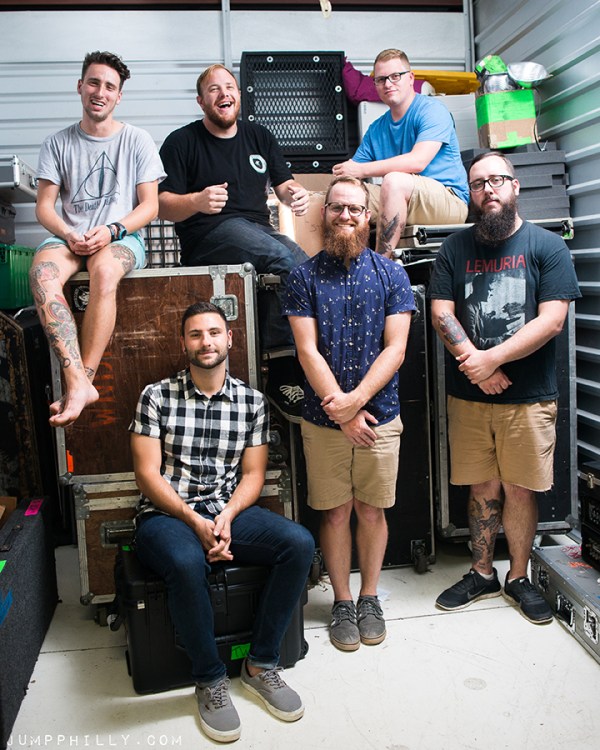 Text by Beth Ann Downey. Images by Jessica Flynn.
Of the patronage in Michael’s Family Restaurant tonight, it is doubtful you’d be able to find one person under the age of 50.
Taylor Swift and other comparable pop tunes play overhead at the Montgomeryville joint. The crowd, dispersed amongst seafoam green vinyl booths, enjoys the traditional diner faire, stocked salad bar and treats from the artfully organized pastry display.
It’s the kind of suburban spot where older customers can eat alone without feeling out-of-place. It’s a place where strangers can easily talk to each other over the wall between booths, or where the friendly waitstaff will greet you by name and listen attentively to your best new news.
This is the place about which Lansdale-based pop punk titans The Wonder Years wrote the song “Coffee Eyes,” off their 2012 release Suburbia I’ve Given You All and Now I’m Nothing. While many of the same characteristics described in the song are apparent tonight, the diner seems different for frontman Dan Campbell, who would often hang out here with friends in their high school days. The waitress he references in the song, named Patty, now works at a diner down the street.
But as what proves true for most of us about relics of our childhood, some things about Michael’s haven’t changed for Campbell at all.
“Every time I eat the fries here I get really sick,” says Campbell, more commonly known as Soupy to friends and fans alike, upon seeing his order. “So what’s going to happen is I really want them and I’m going to eat them. But then, when I have to literally run for a while, it’s because of the fries. You didn’t need to know about my bowel movements but now you do.”
 Text by Michele Zipkin. Image courtesy of Steve Gulllick.
Al Spx, writing songs under the moniker Cold Specks, has taken a stylistic and emotional one-eighty through her latest album, Neuroplasticity. The twenty-six year-old Canadian songwriter has branched out compared to her instrumentally scant first record, as a young songwriter ought to do from album to album.
“I wanted to have a kind of live show that I could play day in and day out, that takes the audience members on a journey,” says Spx.
And she will take listeners on the journey of her raucous, dissonant, haunting and melodic musical world at Johnny Brenda’s tomorrow night as part of her tour to celebrate the album. She shares a bill with Brooklyn-based songwriter Eddi Front.
Satellite Hearts: The Classic Rock Foundation.
 Text by Morgan James. Images by Charles Shan Cerrone.
Some herald Philadelphia as the city of soul, singer-songwriter vibes, gritty punk and/or unsullied rap. But others question if that is all the city has to offer.
“I thought this city forgot what rock ‘n’ roll was,” says Justin Pellecchia of New Hope’s Satellite Hearts. “I felt Philadelphia forgot how to rock.”
Pellecchia is the front man and lead guitarist of the tight-knit rock trio, which includes bassist Lucas Rinz of Lambertville, New Jersey and percussionist Keaton Thandi of Flemington, New Jersey.
Pellecchia dons wispy shoulder length hair and an arresting yet comforting disposition. In fact, there’s a captivating sincerity present in all three members – whether it’s Rinz’s fetching stoicism or Thandi’s wide-eyed enthusiasm.
It’s their unassuming off-stage presence that renders their onstage performance downright disarming.
Rich Quick: The Entertainer.
 Text by Christopher Malo. Image by Sean Kane.
“Never in my life will I tell someone that I’m a rapper,” says Woodbury, New Jersey resident Rich Quick. “Get the fuck outta here with that. You might as well jump off a bridge because they are going to slay you.”
Clearly, the occupational label strikes a nerve.
“For me personally, my job is to entertain people,” he continues. “I’m an entertainer. Educate people. Give people a sense of culture, a point of view. Tell a story. My story.”
On a recent Tuesday night, Quick sits at the end of the W XYZ Bar in the lobby of the boutique Aloft Hotel in Mount Laurel. While the buzz builds around him – people of all ages and backgrounds have come out for the monthly showcase held here, Quick sips a drink and keeps his focus on his phone.
He is dressed in his trademark skully, chunky Knarley Chains necklace and wedding ring. Not that he is married in the traditional sense. It is symbolic and intentionally ambiguous. Listening to his rhymes, one would know he does not have a wife.
“I’m not married. But I am married to a lot of things and one of them is hip-hop music,” Quick says in attempt to clarify his marital status. “It’s an unbreakable bond. And, I even hate it. But I have devoted my entire life to it. I wear this ring because it reminds me of all my sacrifices.”
Communion: A Spiritual Gathering at Underground Arts.
 Communion is the sharing or exchange of intimate thoughts or feelings, especially when the exchange is on a mental or spiritual level. That was Ben Lovett’s ethos in the summer of 2006 when the founding member of Mumford and Sons started his Communion Club Night at London’s Notting Hill Arts Center.
Since then, the idea has evolved into an internationally recognized record label and concert tour. Over the last year, the event has become a monthly, two-room concert at Underground Arts. Featuring an eclectic mix of local (like Tutlie, above) and international talent, the event has become a staple for music lovers on the first Thursday of every month.
Our Peter Milos spoke with Communion’s national coordinator, Hillary Sprecher, who is in charge of booking and overseeing Communion Club Nights in the nine US cities they currently hold the event.
What is Communion and what was its original intention?
Communion is an artist-led organization that combines live promotion with a label. I work on the live side of our company, Communion Presents, which allows me to be involved with developing the smaller artists that might not have the proper promotion behind them. It’s an amazing platform for artists, even if they’re not involved with our label. Our passion and drive lies in helping to develop artists that we really believe in.
How did it start?
Ben started the company in 2006 with Kevin Jones and Ian Grimble. It essentially started as the same thing as what you see now in the U.K. and in the U.S., just on a much smaller scale. A tastemaker’s night full of great music and collaborative artistic creation.
What can Philadelphia expect in upcoming shows?
People can expect an amazing quality of music every single Club Night. I work to bring in the larger touring acts and our promoter partner, Bonfire, curates the lineup of locals. The chance to see who the new up-and-coming local and national artists are on a night like this is very exciting in itself.
Beyond that we’re working on record store partners, local business partners and sponsors. We want to create a night that’s more than just a typical show. We want our guests to have a bigger experience than that. Pairing with Philadelphia-based business and sponsors are what make these nights extra special. It benefits the city too, and that’s important to us.
The Burgeoning: Growing and Flourishing.
 Text by Donte Kirby. Images by Jessica Flynn.
Logan Thierjung sits on a couch in the basement of the Levittown home that doubles as a practice space and studio. His house/bandmates stand with their instruments. Behind them, a mural made by friend Pierina Medina depicts a forest and mountains with the band’s name, The Burgeoning, in bold letters across the sky.
“The name was a 10th grade vocab word and I thought it was amazing,” explains Thierjung. “It means to grow and flourish.”
The Burgeoning consists of Thierjung, the lead vocalist and rhythm guitarist (described by his bandmates as “the guy you pay to see”), his brother Alex Thierjung on bass, Mark Menkevich on lead guitar, keyboard and synth, and drummer Brandon Bradley. The band went through a few lineup changes to get to their current formation.
“Every time we would have a big show, someone would quit,” says Bradley.
The member who Menkevich replaced quit after a 2013 show at the TLA, the biggest show they had done up to that point. The drummer before Bradley left to follow a more professional career path.
 Bradley pats Menkevich on the back and refers to him as the missing piece of the puzzle that finally makes the indie pop rock band whole.
Although the Thierjung brothers – the founding members of the band – are from Bensalem, they consider Philadelphia their home music scene. The other two current members are from the city.
“All of our shows are in Philly,” says Alex.
To broaden their fan base, the band is planning to embark on their first official tour this fall.
“Normally how Philly shows go is: people come to see their bands,” explains Bradley. “Then they leave.”
With all the competition from great bands coming out of Philadelphia, Logan wants The Burgeoning’s live performance to have a lasting impression. He wants to engage the audience so much that the relationship between the band and fans is familiar, like family.
“Our music is real strict with placement,” says Bradley. “That’s why Nirvana was good. Everything was there for a reason. That’s what we’re looking for.”
“Alex has this really fine ear that catches the slightest things when we’re playing,” adds Menkevich. “Then we fine tune it until we get it right.”
The Burgeoning’s most recent release was their EP Love Alchemy, Life Algorithm back in 2012.
“We’ve changed our sound three times since then,” says Alex.
The band has been working on a new single and debating what to do with the 54 gigabytes of stored up music from their practice sessions. They have at least 16 full songs written by Logan at the ready, although not yet recorded properly.
Whatever they decide, the band is confident that their next move will be major.
“We’re at, like, the last piece of the engine before we drive that shit,” says Logan.
Jimmy DaSaint: Speaking From The Streets.
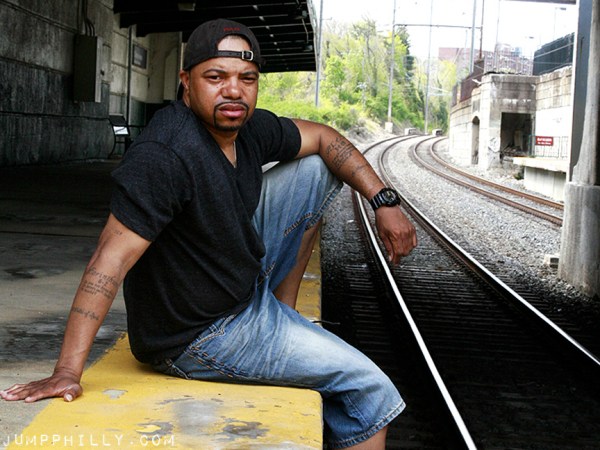 Text by Jared Whalen. Image by Marie Alyse Rodriguez.
“I’m from the streets,” says former federal inmate Jimmy DaSaint, a man of many titles. “I’ve been through it all and I’ve seen it all. The music industry, the streets, the drug dealing, prison. I’ve been shot and I’m saying, ‘I’ve been through it.’”
DaSaint is a multitalented artist with a colorful past. His persistent work ethic has launched him into the spotlight as an urban novelist and icon in the Philadelphia rap community.
But as often is the case, ambitious minds have dark motivators.
As a youth, DaSaint was introduced to the harsh realities of the West Philadelphia streets. By the time he was 15, he says he was arrested multiple times for burglary, trespassing and fighting.
DaSaint managed to pull his life together and graduate from high school. In the early ’90s, he fronted the rap group Inner City Hustlers and began making a name for himself in Philadelphia.
In 1995, tragedy struck when four members of the I.C.H. family were murdered in a small Philadelphia row home. The horrors of violence continued in 1997, DaSaint recounts, when he was shot multiple times, leaving him in a coma for a month.
Upon his recovery, the members of I.C.H. regrouped and attempted to rebuild their legacy. These ambitions, however, were short-lived.
In 2000, DaSaint was arrested for the distribution of narcotics. At the time, he was in his late 20s. He was sentenced to spend the next decade of his life in a federal prison.
Making the best of a bad situation, DaSaint made the conscientious decision to start fresh. Rather than dwelling on what would happen after his release, he used his incarceration to create something from his experiences.
While in prison, DaSaint began writing novels. Drawing from his life, his writings became relatable stories of street life and gang violence.
“I just had so much to talk about,” DaSaint says.


 JUMP: The Philly Music Project