Text and images by Rick Kauffman.
It was uncomfortable sweat, the kind that burns the eyes that you can’t whip clean. Clothes were drenched, walls condensing, and everyone squinted at the seizure-inducing strobes pulsing to the wild and unfettered rhythms of The Dillinger Escape Plan.
The nucleus of the crowd, crammed front and center at Kung Fu Necktie on Thursday night, had people pushed so tight forward they were falling over the lip of the stage the entirety of the set. No mercy. Spread to the back, the 150-cap venue had people hanging from the walls, standing on ledges that were never meant as bleachers, but were necessary if you wanted a piece of the action.
Starting off with the first track off their most recent release, One of Us is the Killer, released in 2013, the song ‘Prancer’ has become ubiquitous as their opener as of late. One of the last times around in their ongoing sold-out (or near it) streak at Union Transfer, singer Greg Puciato said after they closed out the previous UT show with a mob on stage, calling everyone up for the ruckus finisher, they’d begin that show the way the last one ended. From then on, ‘Prancer’ became the high-energy opener fitting of the tech metal pioneers.
The second song, ‘Limerent Death,’ is a banger off their forthcoming album Disassociation, dropping October 14, 2016. Guitarist Ben Weinman said recently via Noisey and a subsequent Instagram post that after the tour cycle of their upcoming sixth full-length the band will go on indefinite hiatus after nearly 20 years as a band.
To be clear, they aren’t finished yet.
On a short tour that hit spots on the east and west coasts, and not very many stops in between, the band was joined by another just returned from hiatus, The Number 12 Looks Like You, who split in 2010 before recently returning under the guise of The Devil’s Dick Disaster, the first track from their 2005 album, Nuclear. Sad. Nuclear.
Down from the previous six members that once spewed havoc and organized dissonance, two members returned, vocalist Jesse Korman and drummer Alexis Pareja. Renewed as a four-piece, they needed help from the crowd to scream the parts of the second vocalist they once enjoyed. However, a tighter group may be best for #12 as they potentially plan a comeback. They sounded clean, tight and as heavy as they ever did.
The drenched bodies surfing on each other’s heads and blindly shouting along was only the warm up before the pummeling that DEP put on those in attendance.


Halfway through the DEP set, Weinman walked on heads before grabbing onto the ceiling fan twelve people deep into the mass. He bent and twisted the blades, which left KFN ownership shaking their heads after the masses spilled onto the streets.
Fans came from as far as Michigan to catch a glimpse of DEP on the smallest stage they’ve played in years, probably since the time they tore the Barbary to pieces. One guy had caught the shows in Baltimore and New York City. He arrived in Philly with a gash on his head caused by Weinman, whose patented trick is violently spinning his axe from one arm.
Dillinger will soon travel to the United Kingdom the Reading Festival before prepping for their final tour in the fall, much more likely to be held in a full-size venues after selling out the show at KFN in seconds.


Vita and The Woolf: “You Can Totally Lose Your Shit Over Some Stupid Music, But It’s Cool.”
 Text by Emily Scott. Images by Rachel Del Sordo.
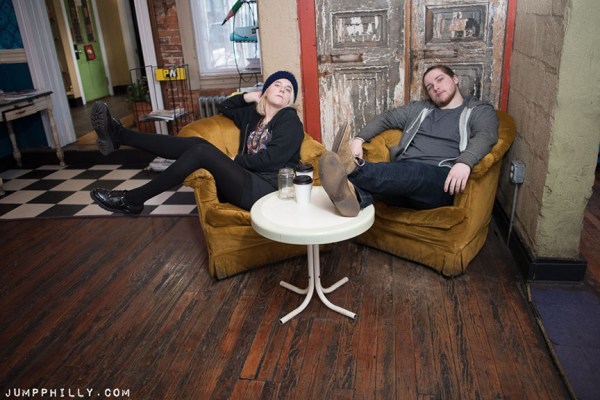
Jennifer Pague wears a red Victory Brewing beanie and jokes about being sponsored by them. She counts the goals of 2016 for her band, Vita and the Woolf, on her fingers.
“Get a booking agent, go on tour a lot, get some publishing, get a lot more fans and get closer to traveling the world and getting paid to do it,” Pague says.
Pague has always been the mastermind of Vita and the Woolf. She started recording songs in her Kensington neighborhood and played her first show with friends in West Chester, Pennsylvania, when she was 21. The band has gone through several lineup changes because Pague says it was difficult to keep people together.
“Eventually, I was just scared from having so many people and trying to schedule rehearsals that I decided to keep it at two people,” she says.
Over the next two years, 24-year-old Pague had an ever-changing lineup of bassists and drummers. It wasn’t until she was introduced to Adam Shumski through a mutual friend that she found someone with the same work ethic as her. There is something about the two that has kept them together and led to their quick success in Philadelphia and beyond.
“I think that we are both really driven people at our core,” Shumski says. “We have the same goal, which is to be in a really good band, and I think that is what keeps us together.”
The way the two recent Temple graduates gaze at each other after their responses in comforting silence, it’s apparent they work off each other like balancing weights. Pague is the driving, passionate bullet and Shumski is her reinforcement and right-hand man along the way.
When Pague first started playing the synthesizer, she listened to Of Montreal, Bat For Lashes, James Blake and other artists that somehow fall under the large electronic music umbrella. She would watch live video performances to see the type of equipment they would use on stage.
“It’s so hard to translate electronic music into a live setting because you don’t want to come off as you just press the spacebar and then, ‘Here you go, that is my music,’” Pague says.
After Pague graduated from Temple with an audio production degree in 2013, she said it was time to take Vita and the Woolf to the next point.
Pague released her debut album, Fang Song, as a solo artist in September 2014, which was followed by her first tour with Shumski as her drummer. Shumski graduated from Temple in 2015 with a degree in music performance.


The electronic indie pop record features a long list of musicians, including a bassoonist and accordionist. The album, which was recorded in her family sitting room, feels like a large orchestral piece accompanied by an abundance of harmonization.
But Pague’s latest music venture, Tunnels, shows that she has grown, lyrically and musically. Pague says she isn’t as concerned with harmonies anymore.
“Now it is more about, ‘Does this work in the melody?’” Pague says, adding that she was more inspired by R&B music for the upcoming album. “I do a lot with octaves, so I’ll do a melody singing an octave low and then an octave higher and then you get that R&B type thing going.”
Shumski says that much of his inspiration as the Vita and the Woolf drummer comes from his educational focus in jazz music. The 22-year-old also often plays with a drum sample pad, which complements Pague’s synthesizer.
“It has been exciting for me being able to explore that side of percussion and electronic music in general, because I haven’t really experienced it prior because jazz music is all acoustic,” Shumski says.
Singer and guitarist Matt Holden of Legs Like Tree Trunks believes a lot of Vita and the Woolf’s success is their comfort in working together, along with their determination.
“They do tour a lot,” says Holden, who has played on the same bill as the duo. “They go out on a limb, meet people and hustle. That is why they are doing well.”
Pague says she is excited to release Tunnels – a more “cohesive sound” – as her next step in music after Fang Song. The production process has been long but Pague made it clear that this latest project was handled with care.
“It’s always difficult if you are working on something that is your thing that you care so much about it,” Pague says. “Anyone would be crazy about it. It is just intense and you can totally lose your shit over some stupid music, but it’s cool.”
Skratch Bastid Shares DJing Tips Before Red Bull’s Thre3Style Championships @ Union Transfer.
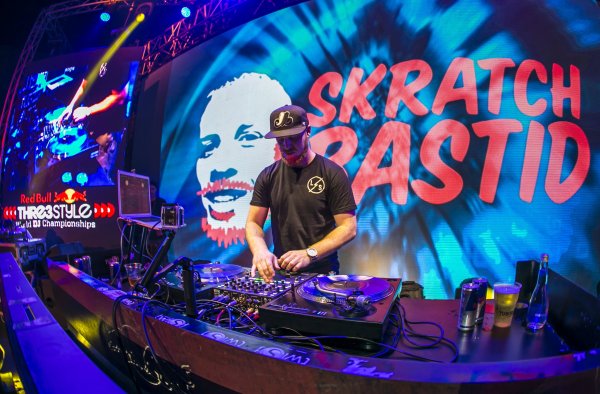
The North American Finals of Red Bull’s Thre3Style competition to find the world’s best DJ is this Thursday, August 11, at Union Transfer. Our Donte Kirby had a chance to chat with one of the world’s premier battle DJs, three-time Scribble Jam champion Skratch Bastid (Paul Murphy) who is one of this year’s Red Bull Thre3Style judges, along with DJ Jazzy Jeff and last year’s champion, DJ Byte. We talked about what it takes to be a battle DJ champion, his best and worst show and the importance of versatility as a DJ.
What does events like the Red Bull Thre3 Style and competitions like it do for the craft of DJing?
Skratch Bastid: I’m a DJ that grew up watching battle videos. So I come from a battle background. What I’ve always loved about battles is that it creates an event for DJs to work towards. It pushes people to be their best. While I do think competition and music can sometimes be a dangerous thing, I think that with Thre3Style we’ve created a healthy environment to showcase their skills of party rocking, being creative and showing what they got as DJs. I think we’re all better from that. It pushes DJs to be better and give the crowd the best show they can have. It’s healthy for DJs to have something to work towards instead of just all working towards their own individual goals.

As a world class DJ who’s won competitions like Scribble Jam repeatedly, what does it take to consistently perform at such a high level?
SB: A lot of practice. Good support around you. Practice is number one, you gotta be working on your craft. If you’re not putting the time in, then you won’t improve. So you gotta put the time in, that’s number one. That time isn’t necessarily always skill. You gotta be studying. Being aware of what’s going on around you in the DJ world, what has gone on in the DJ past and what’s going to happen in the DJ future. Then you gotta figure out where you fit in and how you can contribute. The number one way to do that is focus on it and practice.
One of the key elements of the Thre3Style is that DJs have to play three different genres. As a DJ how important is versatility and how do you incorporate that in your music?
SB: It becomes more and more important as the world becomes more and more connected. With streaming sites like Spotify and Apple Music, music has never been more accessible than it is now. Because it’s so easy to access we’re not limited by distribution as much. People can dabble in whatever taste of music they want. I find we have more casual fans than ever. I should say that listeners have a wider musical pallet than ever. As a DJ it’s up to you to satisfy that. I don’t think that every gig is going to be a multi-genre gig, but I think the average person is more open to hearing different genres of music. I think it’s important to be versatile as a DJ not only to play all different types of stuff in one night but to be able to play many different types of situations. As a DJ I never want to see a room that I can’t play.
How do you take people on a journey through sound when you perform?
SB: As far as building up my career, my name, a lot of it has to do with videos of my routine. People see the videos and want to see me live. What I’ve learned is that you can prepare people for your set by showcasing your skill and getting your talents out there through videos and mixtapes. Then you deliver when they arrive. Even before people get to the party you can start to direct the traffic. More to the point, when I see a crowd I try to read the area. I look at who’s at the party. Then I think to myself, what other parties have I played that are similar to this? What do I see out there? What are the indicators? Do I see a young crowd, an older crowd, do I see a mix, from the country, city, international? And I take all the research that I’ve done through my traveling and studying of DJ culture and I apply it. If I play a party that feels like a situation I’ve felt before I’m like, oh let me try this because it worked at the last one. If it works well, then I go deeper into that. If it doesn’t work so well then I say, maybe I should try something different. That’s why experience and practicing is so important to a DJ. You have to stay in touch with what’s going on in the party environment and in the musical world.
Can you talk about what has been your best show, your worst show and what you learned from both experiences?
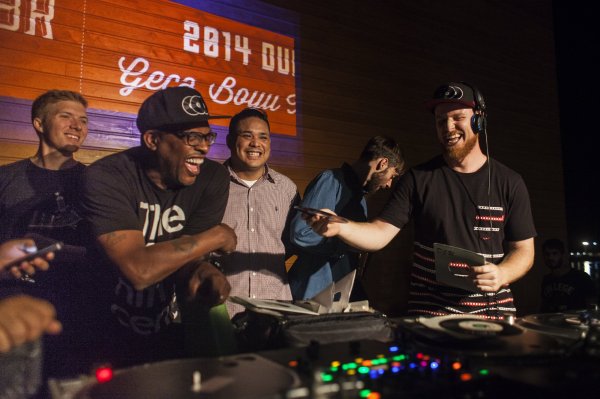
SB: Damn. I don’t think there has really been one specific show that’s been the absolute best. I run an event called Bastid’s BBQ. I’m really proud of that event. I’ve been doing it in Toronto for six years now and I’ve had some of my DJ heroes come to play it. Ali Shaheed Muhammed, Jazzy Jeff of course, DJ Just Blaze. What I’ve created with [Bastid’s BBQ] is an environment where I can literally play whatever I want. That to me is better than any show because it’s something that I’ve created. I made it out of my passion for DJing and now it’s become a thing that people want to go and see.
And can you talk about a show that you’ve bombed in and what you learned from that?
SB: I’ve never been thrown of stage, I’m thankful for that. Some gigs go better than you think and some gigs go not as good as you think. If you’re able to learn from the gigs that you don’t do as well as you thought you were, it’s still a win overall. DJing is learning. You can always learn from experience, go home, practice, get new music, come back and rock it harder. In all honesty, I’ve never bombed so hard that I didn’t know what to do.
Do you have any advice for up and coming artist and DJs?
SB: Yeah. Follow what your passionate about musically. Play records you like. Find mentors. Follow DJs that you like and practice.
If you want tickets, find details for the show here.
Like us on Facebook and email us at FreeJumpStuff@gmail.com to enter to win a free pair of tickets (give us your name and put “Thre3style” in the subject line).
Howling Fantods: “There Might Be Literally No Ambition.”
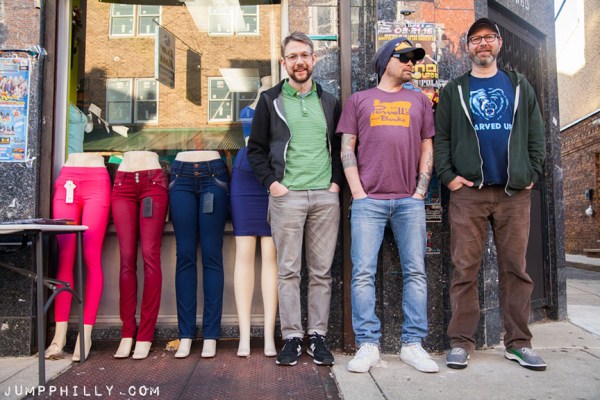
Text by Tim Mulhern. Images by Bonnie Saporetti.
The members of Howling Fantods are gathered around a table in bassist Joe Paone’s South Philly home. It is a quintessential Sunday morning scene: coffee is brewing and Paone’s cat sits curled on the staircase nearby.
In recent years, the band has grown accustomed to a quieter lifestyle, both as musicians and people.
Guitarist and vocalist Doug Wright has been at the center of Howling Fantods, performing with a rotating cast of musicians since the band’s inception. Most recently, Paone and drummer Lance Crow joined to form what Wright says is the eighth iteration of Howling Fantods.
“What I love about this band is it’s the only band I’ve ever been in where there’s no ambition that drowns out the music,” Paone says.
“There might be literally no ambition,” Wright says.
What Howling Fantods might lack in ambition, they make up for in pure enthusiasm for playing music. The musicians are more focused on enjoying their time together rather than making a name for themselves in the Philadelphia scene.
“For me, and I think Joe too, we spent a lot of our youth touring around and doing that kind of stuff,” Crow says. “In this band, it’s like, we know what that’s about. Do we really want to get involved with that?”
Although the members are not as active with Howling Fantods as they were with projects in the past, they admire the younger acts that give Philadelphia its reputation as a destination city for music. Paone says house-show staple Mumblr is the best band in Philly “bar none,” while Crow is partial to Lithuania, the collaborative project of Dr. Dog’s Eric Slick and DRGN King’s Dom Angelella.
The members agree that their age puts them in an interesting place in the youthful DIY scene in Philadelphia. Wright says the band is “totally removed” but still grateful to contribute to the thriving music community.
“My friends don’t live in houses where they have punk shows in the basement,” Wright says. “My friends are all 35.”


The band faced a major loss in February of 2014, when the South Philly practice space used by them and other Philly-based acts, like JJL, burnt down. Most of the group’s gear, including Crow’s prized drum set, was lost in the fire.
Though Paone calls the dilapidated space a “death trap,” the band shares fond memories of their time spent practicing there.
“We were like, the greatest rock band in the world when we were up in that little room,” Wright says.
After the fire, Peter Santa Maria of Philly-based punk band Jukebox Zeros offered the band gear and a place to practice, providing the push the members needed to continue making music together.
“I’ve known Joe at least 16 years,” Santa Maria says. “I played in a band [The Thirteen] with Lance for a couple years. These people are our friends. We’ve known them for years and we just wanted to help them out.”
The fire allowed Wright to refocus the subject matter of the band’s most recent effort, Forever. Wright, Paone and Crow did not let the tragedy interfere with the experiences they share playing music together.
“That might be the joy about being in a rock band,” Wright says. “It’s so over the top that you get swept up in it,”
For now, Howling Fantods will continue to practice when they can and play shows when they are offered.
“It’s a good feeling to create,” Paone says. “Knowing these guys gives me so much energy. It’s really awesome.”
G-Eazy and Logic @ Festival Pier with YG and Yo Gotti.
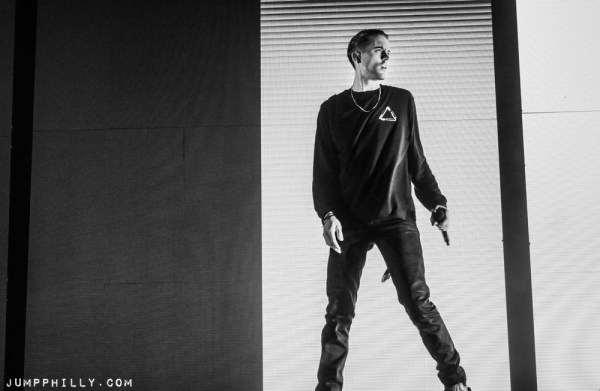 Text by Cameron Robinson. Images by Ashley Gellman.
The sky was clear, with a light breeze blowing as the sun set in the background – a scene almost too perfect for rappers G-Eazy (Gerald Earl Gillum) and Logic (Sir Robert Bryson Hall II), on their Philadelphia stop at Festival Pier on The Endless Summer Tour.
The crowd was filled with fans sporting the looks of the rappers they came to see – the ’50s greaser look with a modern Bay area spin for G-Eazy fans and NASA jackets and full on orange NASA jumpsuits for the RattPack, Logic’s affectionately named fans, who paid homage to Logic’s Space Opera themed, The Incredible True Story.
It was not hard to see why G-Eazy, from Caligfornia, and Logic, from Maryland, joined forces for this tour. They both draw inspiration from the ’50s.
Aria Nicole, 21, has been listening to G-Eazy since before his rise to fame.
“A lot of people here didn’t listen to his MySpace music,” she said. “It had the ’50s, run-around summer feel. It was different but it worked!”
As with G-Eazy, Logic’s early mixtapes were also ’50s inspired, most notably by Frank Sinatra. Logic even went so far as to adopt the moniker Young Sinatra. He calls his group of friends and his fans the RattPack, a nod to the 1950s super group led by Sinatra. Logic has stated his positivity comes from growing up with Sinatra.
Liz Ayers, 36, couldn’t have agreed more.
“‘Incredible True Story’ is my favorite song from [The Incredible True Story],” she explained. “When my son showed him to me, I had no idea who he was but his message, it’s just what I need to hear in my life. What he says is real but it’s uplifting.”
Her son, Ryan Ayers, 16, wearing a NASA jacket, added, “My friends were playing his song, ‘All I Do’ and it was really good. After that, I looked up his music. I’ve enjoyed everything he’s made since.”
Both rappers don’t rap about what is usually heard on the radio.
“They talk about their lives,” Ashley Marie, 21, pointed out. “They’re authentic and relatable. They rap about more than just money and girls.”
“They have real emotion behind their lyrics,” Nancy Thatch, 22, said.
Both women shared that some of G-Eazy’s lyrics are so relatable it brought them to tears.
YG and Yo Gotti hyped up the crowd as the opening acts. YG’s song “Fuck Donald Trump” got the crowd so engaged that chanting of the hook continued long after the song was over.


After a slight lull, the on-stage screen came to life as Logic’s song “Contact” began to play. With no one on stage, images of space started to flow through the boom box shaped screen. As the song ended, Logic’s name was chanted throughout the sold-out crowd. As if summoned by their collective voices, Logic appeared on stage wearing a cap and a FILA shirt. The chants only grew louder.
After confessing that he was sick with a fever earlier in the day, Logic jumped head first into entertaining the crowd. Throwing nothing less than his heart and soul into his performance, he gave the crowd what they were asking for and more.
Keeping things fresh, Logic began to play music from his recent mixtape, Bobby Tarantino, choosing to play the well-received track “Super Mario World.” At one point, he even took a moment to teach everyone how to produce a proper beat. From defining and giving an example of metronome, to actually freestyling over a self-produced beat on the spot.
Logic ended his set with “Gang Related.” Finishing strong, he began rapping in his usual rapid-fire pace, then he abruptly stopped the music, calling out a fan in the front row for her impressive memory of his lyrics.
“Let’s see if you can keep up!” he taunted her, smiling.
As Logic began swiftly rapping a verse from the song, an equally amazing sight took place. On the screen, a young girl kept up with Logic – word for word, line for line, syllable for syllable. Stopping, he looked at her again and challenged her with a different set of lyrics. Without out missing a beat, she stayed right there with him, looking him dead in his eyes.
“What’s your name?” Logic asked.
“Shea,” the girl in the horn-rimmed glasses beaming with confidence shouted.
“Hey Shea, how old are you?” Logic continued, smiling.
“I’m 14,” she said as a low rumble of cheers began to spread.
“Damn, girl,” Logic continued. “You’re about to put me out of a job. All right, this is the last one and we’re going to do it in one breath! You ready?”
Nodding in agreement, they begin rapping.
Logic, rapped at a pace that was so rapid it made indelible impressions on any listeners ears. Yet, the whole time, Shea was rapping right along with him.
Logic, satisfied with the girl’s talent, congratulated her and resumed his last song.
“Like I said, I’m here to promote peace, love and positivity,” Logic reminded the crowd. “You are all capable of anything you put your mind to!”
Leaving with that message, it was clear that even those who weren’t there to see Logic appreciated the truth in his logic.


After the sun set, a short intermission took places. Murmurs could be heard all around. Among the calmness, a countdown clock appeared on the screen, everyone sprinted back towards the stage. At five seconds, the crowd finished the rest of the countdown.
With every light on stage burning red, G-Eazy walked through the screen illuminated by the bright neon glow, a pure silhouette.
He opened with “Random,” from the album When It’s Dark Out. After a few songs, G-Eazy addressed the crowd, walking with a swagger he began to talk about his love for Philadelphia,
“I remember first coming here and selling out shows with 200 people at The Barbary. And now here I am,” he continued, bending down to pick up a bra. He paused and grinned at the crowd while everyone went wild. “Some cities are whatever. But Philly is close to my heart!”
He threw the bra and began his next song, “I Might,” which seemed fitting after the given scene.
Midway through his set, G-Eazy took a moment to introduce and thank the people on stage with him, from his drummer to his DJ. Soon after, he invited the opening acts back to the stage. First YG, performed the remixed version of “Fuck Donald Trump” featuring G-Eazy himself. Yo Gotti was next up, hyping the crowd with his song “Down in the DM.”
Taking a moment to slow the mood, G-Eazy played some of his more sensual songs. With the screen going black, G-Eazy reappeared under a white light with a mic and a stand. Shouting out the next few songs to the ladies in the crowd, he began to perform the song “Some Kind of Drug.” By the end of the song, a few more garments ended up on the stage, much to G-Eazy’s delight.
After closing the concert with his radio hit “Me, Myself & I,” G-Eazy reminded the crowd that in truth, without them he wouldn’t be here.


Evening Reporting Center: A Second Chance Through Music.
 Text and images by Brianna Spause.
The young boys at the Evening Reporting Center are writing their own soundtrack in the juvenile justice system.
“At ERC we be learning/ getting some jobs in return,” rings out through the speakers in the sound booth in the recording studio, which sets up Lee’s verse. “Here they teach us about real life/ not ‘x to the two’/ they should come to my school/ teach a lesson or two.”
Just hours ago, Lee was released from house arrest. At 4 p.m., he promptly arrived at the Northeast Treatment Center at Second and Norris streets – this time, on his own accord.
For the past six months, Lee has been one of the adjudicated delinquent youths under the community-based supervision of the Evening Reporting Center. He’s been working with his peers to put together a theme song for the ERC and voluntarily came to the music program today to use the third-floor recording studio.
The kids at ERC are all given a second chance. Instead of being sent away to a juvenile detention center, they are placed under supervision in their communities.
After school lets out, youths arrive to the court-mandated, alternative placement program. They are supervised between peak crime hours, 4-8 p.m., then return home – their GPS ankle monitors make sure of it.
Here, they learn to cook meals for one another, to plan finances and to develop social connections through music, art and sports. The creative alternative to juvenile detention “works to view the whole child,” says Adam Serlin, ERC program director and former musician.
“It’s not always what the child did. It’s what has been done to the child,” Serlin says. At the ERC, he says they first ask, “What are the ways we can address the deeper causes for behavior?”
In other words, the program pays special attention to rehabilitation instead of punishment.


Through the juvenile justice system, the ERC works with the Department of Human Services and Philadelphia Family Courts to provide community supervision during the length of house arrest. To provide music programming as a form of creative expression, the ERC is partnered with the nonprofit Limelight Arts.
“We give them interests they can connect to so moving forward, they’ll have some new passions that can prevent issues or recidivation in the future,” Serlin says.
Co-founders Frank Machos and Avery Coffee provide ongoing opportunities for the at-risk youths to build tangible skills in music. Machos utilizes his role as the director of music education for the Philadelphia School District to help secure equipment for the ERC and place kids who complete the program into school music programs after the end of their sentence.
His partner, Coffee, visits the program every Wednesday to provide hands-on music instruction. For Coffee, watching kids engage with unfamiliar instruments as an act of creative expression is what makes this program special.
“They get to have a voice,” Coffee says. “In this system, you’re getting talked down to constantly. You’re constantly surrounded by adults who don’t understand your situation. They aren’t looking you in the eye. They’re writing stuff down and you’re getting passed down the line. In here, you get to say what’s on your mind. This is your outlet. You’re not just a number.”
It was Serlin’s goal to create pro-social programs that would allow his kids to feel heard and find a productive way to let off steam.
“Our kids are not different than any other kid,” Serlin says. “A lot of times they just have fewer programs to go to and fewer things to do. That typically leads to trouble.”
Serlin identified music as a transferrable skill that can be carried anywhere and used as a coping mechanism if the child has issues at home.
“Music helps me express myself because I can get stuff off my chest,” Lee says. “If I’m having an issue with something, I can rap it and it will relieve it a little bit.”
The measurable successes of the Evening Reporting Center in its pilot year have allowed the branch to expand from a pre-adjudicatory program that supervised youths awaiting trial, into a six month post-adjudicatory program that serves as a true alternative to juvenile detention.
According to the DHS, in 2014, 82 percent of youths placed in Philadelphia ERCs were successful in exiting the juvenile justice system.
Fajr, a 17-year-old alumnus from West Philadelphia, was one of them. The skills he learned in the music program landed him internships with Jr. Music Executives and PhillyCAM before being hired to measure data by the ERC.
“If you’re interested, everything is in your reach,” Fajr says as he sits behind a keyboard in the live music room, mindlessly pressing keys as he speaks. “They’re not asking you to do anything except play music. I was blind to everything when I came in here. They presented me with ideas that worked in my own head.”
The ultimate goal of the Evening Reporting Center is to provide at-risk youths with skills for rehabilitation. They aren’t looking to make a star of every kid that walks in the studio. Instead, they are focused on the healing power of music and the potential of a second chance.
“Even if it’s just making the process a little more palatable throughout, making their journey through the juvenile justice system something that is a little less terrifying, that’s a success,” Serlin says.
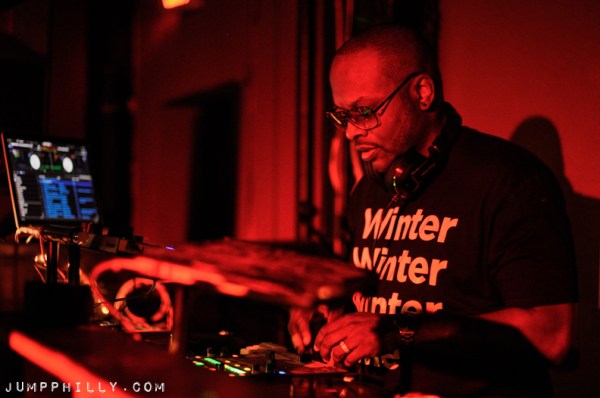
On Thursday, August 11, the national finals of the Red Bull Thre3style competition will be held at Union Transfer. Top talent from around the country will perform, with the winner going to the international finals in Chile in December. The overall winner will be crowned the World DJ Champion.
DJ Jazzy Jeff will be one of the judges at the competition at Union Transfer. It will be a night of wild music and lots of dancing, and we have tickets to give away.
Like us on facebook and email us at FreeJumpStuff@gmail.com to enter to win a free pair of tickets (give us your name and put “Thre3style” in the subject line).
If you want to play it safe and get your own tickets, find details for the show here.
Vicky Speedboat: Something Simple.
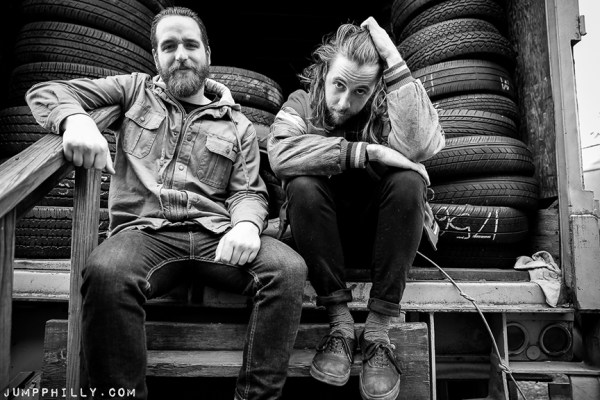 Text by Brendan Menapace. Images by Magdalena Papaioannou
The first glimpse the world got of Vicky Speedboat was when members Sean Huber and Will Lindsay played at Philadelphia’s graffiti pier, while shotgunning Hamm’s and setting off fireworks. This was in the release of the band’s first video for “Passing Through Wales,” off of its debut EP, Two Years No Basement.
The world had seen Huber and Lindsay before—Huber as the drummer of Modern Baseball, Lindsay as vocalist and guitarist in W.C. Lindsay, and both playing together in Steady Hands.
But this new project is their way of doing something simple, just the two of them—and doing it a little more dangerously.
“We’ve been planning on doing this for a long time,” says Huber, 24, of Brewerytown, with a handful of tattoos peeking out from under his shirt as he describes how the project came to fruition when the two were on a Steady Hands run in the U.K. “It was just the two of us and we had a rental car, just, like, crashing at venues.”
Huber and Lindsay had done their fair share of tours before but not like this. This was a stripped-down Steady Hands tour, featuring only Huber and Lindsay, as opposed to all seven members of the band. It was just two friends on a road trip abroad—no vans or trailers full of gear. They crashed at venues, drank a lot and borrowed equipment.
“Just the experience of touring with just the two of us, having nothing but guitars – and just kind of having so little to carry around, was really exciting and freeing,” Huber says. “We talked about other opportunities where we could travel and pack really lightly and see what we got into. We thought the best way to do that was form a rock band.”
“We did that Steady Hands tour and we were like, ‘Shit, we could do this anywhere,’” says Lindsay, 24, also of Brewerytown. He has long, blondish hair pulled back, and his voice is low and relaxed. “We really only need a guitar and a pedal board. Anything else we can borrow.”


They decided that this wouldn’t be a project that involved painstaking writing individually. Much like their tours, it needed to be two friends having a beer-soaked jam session in a basement, writing fun punk rock music.
“I would describe both of those projects as maximalist,” Lindsay says of both Steady Hands, due to the huge sound created by seven players, and W.C. Lindsay, due to the amount of electronics and production.
He adds that many of the songs he and Huber write together for Vicky Speedboat wouldn’t work for these other projects.
“So this is all the rock songs that we’ve been writing for years but never had a place to put them,” he says.
They also didn’t have a place to play them. After one successful jam session in Huber’s basement, Huber moved, leaving them basement-less for two years (hence the EP’s name).
Luckily, a friend had a basement to loan, and the two went back to work.
They recorded together at Kennedy Studios in Burlington, Massachusetts, a place run by friends of theirs. True to the band’s ethos, it was just a fun three days of cranking out songs together and sleeping in the studio. Lindsay did the guitars and bass, Huber did the drums and they shared vocal duty.
“They just recorded everything themselves,” says Steve Aliperta, a co-owner of Kennedy Studios. “They were down to treat it like a record—big parts that needed to be big. It was really effortless and we didn’t put a lot of frills on it.”
Due to their minimal size and equipment, the idea was to tour places that are inaccessible for a lot of other bands.
“We could start going to places bands don’t go,” Lindsay says. “I had this super crazy time last year in El Salvador and Guatemala, hanging out with these punk kids, going to these DIY shows down there. They were just so stoked on every band because bands just don’t go there.”
Lindsay and Huber named regions like Central America, the Middle East and Russia as their dream tour destinations.
“I’ve heard there’s a super awesome hardcore scene in Baghdad,” Lindsay says. His voice starts to show a little more excitement. “I’ve got a friend who lives in Kuwait. There’s a big hardcore scene in Saudi Arabia too, and it’s entirely against the law by, like, every metric. They have these crazy DIY shows that sometimes get broken up by the cops and the cops beat the shit out of people. I want to play one of those shows. Oh my god, so badly.”
Huber is quick to note that they aren’t going because of the danger itself, or to get beaten and sent to the gulag.
“We’re not trying to write a book,” he says of just wanting to play music in interesting places. They’d rather bring the same music, and have the same amount of fun doing so, as they would on any other tour.
“You can find these pockets and these amazing scenes,” Huber expands. “So many people are like, ‘No, don’t go to that place,’ and we we’re like, ‘No, the reason that no one is going to those places is because of you.’”
The Headroom Studio: Music Mentors.
Text by Beth Ann Downey. Images by Rachel Del Sordo.
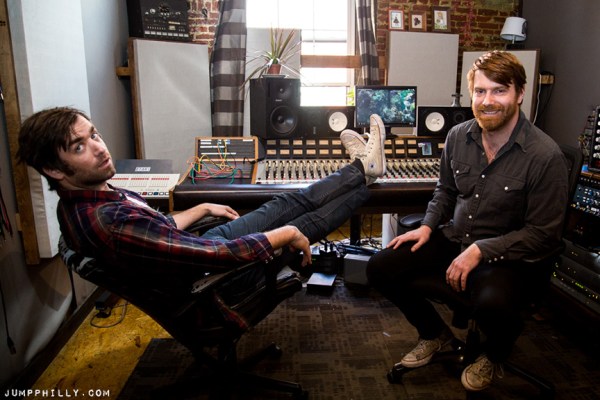
Kyle Pulley sits at the console in The Headroom Studio, his head flanked by speakers resting underneath two new plants that he’s quick to point out upon entering his workspace.
One hears lots of loud, fast clicks as Pulley expertly isolates instrument or vocal tracks, playing with the volume in the mix or fixing some end of a musical phrase. As the gears in his head turn, he’s seemingly unaware of a few mutters of “that sounds weird” and “hmmm” that he lets slip out.
Pulley has been focusing on this one track for the past six hours. It’s for the upcoming LP of Jersey-based rock band Pine Barons on which Pulley has been working on and off for months. He’s been at it for slightly less time today than the band. After playing a show at The Foundry the night before, they returned to the studio to work and ended up sleeping over.
Working hard and with what time and resources you have has been a mantra of The Headroom since the time Pulley and partner Joe Reinhart started in Big Mama’s Warehouse, a space where they lived and worked recording bands with a few mics and a laptop and sometimes for the payment of $20 and a case of beer.
“We knew a bunch of people who were willing to live like crazy people,” Pulley says. “It was a great space to start, because you could take a lot of risk on bands and work for no money for something you really believed in.”


Pulley and Reinhart moved their studio work into the current space on Coral Street in Kensington in July of 2014 and are now a go-to team for dozens of local bands for a quality recording experience, as well as sought after by out-of-town acts searching for the same thing. Reinhart says he believes they’re valued because of the input they provide during the recording process and the fact that they enjoy being as creatively involved as possible or required.
“We know where bands are coming from; we’ve been in bands our whole lives,” he says by phone while on tour with Hop Along, for which he plays guitar.
Reinhart says this experience in bands also means he and Pulley understand not having a ton of money to record. That’s why they try to keep prices reasonable, bridging the gap between expensive studios and bedroom recording.
“We talk about raising our rates but always come to the conclusion that, right now, we’d still rather be affordable for younger bands and bands who are still starting out,” Pulley says. “I’d rather work on a cool record for less money any day.”
There are plenty of cool bands coming into Headroom and cool records coming out. From well-known local acts like Lithuania and Modern Baseball, to out-of-towners like Joyce Manor, Headroom is gaining ground by word of mouth.
Zoë Allaire Reynolds, vocalist of buzzworthy indie folk band Kississippi, says the band decided to record with Pulley as fans of his current band Thin Lips and previous band Dangerous Ponies, as well as having heard about good experiences from multiple peers.
“Kyle had a hand in motivation and gave us a friendly push to take risks,” she says. “Through this, I discovered things I didn’t know I could do with my voice before. It definitely paid off in the end, not only on the recordings, but at shows, too.”
Pulley and Reinhart are understandably happy with Headroom’s headway. They both admit it’s hard to be so active in the studio and on the road with their respective bands. There have even been instances when Pulley or Reinhart have started a project but a tour opportunity popped up and the other person had to step in to see it through.
“It’s a lot because the people in your band are counting on you,” Reinhart says. “That’s something they take super seriously. It’s their band and it’s how they make a living and you’ve gotta be there for them. Then there’s these other bands, a ton of bands that I’m working with, and they’re counting on you. Their baby is in your hands. That’s a huge responsibility. I take that super seriously.”
Being absent or busy also allows the many assistants and interns at Headroom to get valuable hands-on experience, or even book their own time in the studio. Acting as mentors and working on projects based on passion as opposed to necessity are what keep these two engineers content.
“Every day, every morning I wake up and walk to the studio and I’m, like, pumped to work on what I’m working on,” Reinhart says.
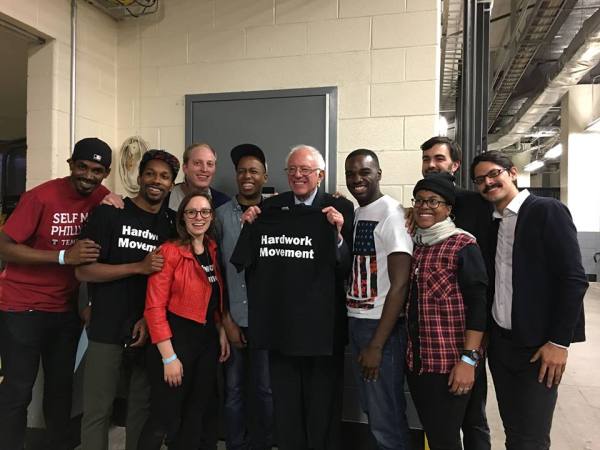
Hardwork Movement: Vicious, Driven and Nice.
 Text by Chris Malo. Images by Sean Kane.
The day after Sterling Duns’ 28th birthday, all four members of Hardwork Movement saunter up the staircase to Duns’ second floor apartment following a full band practice for upcoming shows. Blue streamers still hang from the ceiling, colorful balloons litter the floor of the living room, half eaten birthday cakes sit on kitchen counters and a suspicious gift bag perches on the edge of an end table.
Dwight Dunston (Sterling Duns) along with Rob Ricketts (RB Ricks), Keenan Willis (Rick Banks) and Jeremy Keys (Keys) grab some cake before settling into chairs. All the while, the room teems with a mixture of banter and laughter. A small space filled with people and packed with contagious energy becomes a reoccurring theme when these four MCs get together.
Early incarnations of the group began in 2012 with the Leftovers mixtape. The next several years would see more releases before a hiatus that included temporarily kicking out Keys, then a refocusing of the vision and bringing Keys back into the fold.
Trying to define Hardwork Movement or discern their sound by asking each member of the group who their favorite artist is, or who they listen to, yields eclectic responses.
“But if you ask us to rhyme on a beat, you’ll probably have a similar flow. I think that’s what makes us interesting,” explains Ricks, an easy grin splayed across his face.
Every member offers a series of skill sets to the group. While each holds his own on the mic and several can play guitar, the reserved Banks frequently handles production duties, the jovial Keys provides vocals as well as occasional cello playing and the laid-back Ricks mans the turntables.
And that’s even before bringing in the band: Rebecca Graham and Martin Gottlieb-Hollis on trumpet, Angel Ocana on drums, Jeremy Prouty on bass and Dani Gershkoff on flute and vocals.
“We also take some pride in having some versatility as well,” Keys says, dressed in a salmon button-down, grey skully and wide smile. “Just the fact that we have this live band with us really gives us the potential to push some limits where we see fit and create our own brand of hip-hop that is more modern and something that is a bit more our style, but also celebrating where we came from and where hip-hop originated.”
It may be unfair to compare their sound with another hip-hop band that hailed from Philadelphia, but not entirely inaccurate. Imagine Illadelph Halflife mixed with ATL flow and touches of D’Angelo, voices reminiscent of the cadence of ‘90s West Coast artists (Living Legends, Pharcyde, Hiero, Dilated, Lyrics Born, Planet Asia) combined with early ’90s East Coast, an old school hip-hop vibe and a Millennial’s perspective.
“I think what really appeals to me about them is the way they bridge generations,” says WXPN’s John Vettese, who recorded them for The Key Studio Sessions. “Even though they’re all young dudes, there’s a throwback element. The smooth melodic production and the ways the beats are crafted definitely brings me back to the best of ’90s hip-hop – Nas, Tribe, De La, even vocal hooks that sound like something out of Philly’s neo-soul scene. But the music also has one foot firmly in the now.”
“A lot of people use rap and hip-hop synonymously,” says Banks, peering through his glasses with the studious look of a scholar. “We rap but the hip-hop culture on a macro-level is more of taking bits and pieces and repurposing things and putting your own spin on it. So I think we do a lot of that, filling in all sorts of different experiences and influences.”
Those influences include Broken Bells, Marvin Gaye, Fleet Foxes and Led Zepplin. Those experiences woven throughout their lyrics range from sports and women to traveling. While some artists braggadociously attempt to convince the listener of their mastery of these topics, the MCs of Hardwork Movement relate their experience around these topics, how they impact and affect their lives and dreams. How to be satisfied, but still want more. How to be satiated, but still hungry. How to know who you are, but still explore. The dichotomy of good problems.
Blending talented musicians with skilled MCs rarely results in each element complimenting the other without outshining, and therefore highlighting, the underwhelming inabilities of the other. On “Living Legends,” off the group’s Good Problems album from earlier this year, Duns holds down the second verse with the line:
“Prescription: Keep giving them images of what it is/ To be young, black, ambitious and vicious, and well wishing and mission driven/ I be avoiding the sentence/ Yo, I been dodging the symptoms/ To the whites and blacks listening/ Keep it 150/ With yourself holmes…”
“That’s the American dream, re-envisioned,” explains Duns, sitting on a stool. From the boatshoes on his feet to his tan pants and grey athletic hoodie, Duns straddles a serious thoughtfulness with youthful energy. “All of us have done work in figuring out how we want to live our life and what success means to us. What it means to be happy and figure all that out and not be fed this message from history or our parents or TV or media. To blow all that up and figure out what’s really important to you.”
To take the information you’re given, both from valid and invalid sources, to define oneself, to deconstruct the projected narrative and pick up those pieces to find the ones that fit is to establish one’s own true identity.
“To be both vicious and driven, it’s kind of seen as you have to be one or the other and they really don’t have to be mutually exclusive,” Banks points out. “You can be both. You can present a mission-driven front while being kind of nice.”
“We’re all living legends,” Duns continues. “But to believe that you have to blow up other people’s perspective of you, of what it means to be successful and recreate your own. Then all you have to do is believe.”
A week prior, just doors away from the Girard Station El stop, the group meets in Hardwork Movement’s practice space. Tucked inside an autobody shop on the second floor is a large, cavernous room. In the far corner, a green and white tent shelters the four members of the group as well as the five members of their band prepping for an upcoming spate of shows. The practice comes to an end as the nine members huddle in an embrace and sing “Happy Birthday” to no one in particular.
“When we get in the room together, there’s no ego,” Gottlieb-Hollis points out. “Everybody has a voice and we listen to each other. It’s a rare thing.”
Those strengths shine weeks later at a near-capacity show at Boot & Saddle. They’ve come a long way from 2012, selling out a Haitian restaurant in Washington D.C. The four MCs take the stage to a crowd of more than 100 people packed into the venue. Rihanna’s “Work” pours out of the speakers as the MCs replace Rih’s lyrics in the chorus with their own, chanting “Hardwork, work, work, work, work, work.”
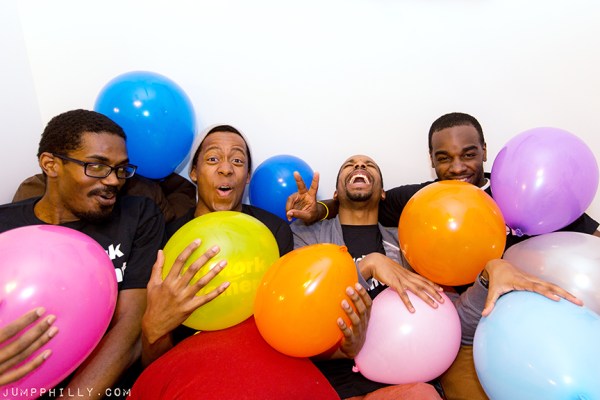
As the night proceeds, the band’s horn section pops up a third of the way through the set in the middle of the crowd, pumping their brass sounds into the atmosphere as they march to the stage and replace songs back by produced tracks. The show swells from the inside out, and once again the energy notches up.
“It’s a journey that we take together with the audience,” Gottlieb-Hollis says.
Hardwork Movement’s live performance is gaining its own reputation. Vettese attended a show at the end of 2015 at Kung Fu Necktie, leaving with a distinct impression.
“They absolutely crush it as a live band,” says Vettese. “That’s another unique approach, since I feel like most of the time live hip-hop is either a rapper with a DJ, or it’s a rapper with a band. Rarely is it both.”
“Whether we are using words or an instrument to tell our stories, we want to be very intentional about every note we play, every single word we write,” says Duns about coming together with the live instrumentation on stage.
The energetic atmosphere is visceral. The full, rich, crisp-but-not-sterile sounds feed the crowd as a setlist rehearsed at practice, complete with an interpretation of Drake’s “Hotline Bling,” takes shape on stage.
The only time the night is punctuates with pause is when Hardwork Movement tells the crowd it is Graham’s mother’s birthday. They ask the audience to serenade her, which the show-goers do with enthusiasm as the band records it on a cellphone, to be delivered later.
It may have temporarily stopped the momentum of the night but to be a reemerging act on stage, with nearly a full house of fans into your show, to stop the gig to show love to a band member’s loved one and risk losing the crowd or moment?
These are good problems.