 Text by Jennifer Granato. Images by Josh Campbell.
The crowd at the Electric Factory on Saturday April 4th talked about the DJ Shpongle, Simon Posford, like an illusive, revered presence before he even walked on stage.
“I told everyone I was going to church this weekend because I’m seeing Simon,” a woman in the crowd said, her face painted like the ‘Shpongle Mask,’ a mascot with wavy, tentacle-like extremities and three sets of eye balls.
“I drove seven hours to see Simon,” the man next to her said in response.
After being hyped up by opener Schlang and even more hyped up by the second opening act, Phutureprimitive, everyone was restless.
“SHPONGLE, SHPONGLE, SHPONGLE” the packed Electric Factory chanted and then burst into a roar when Posford finally stepped out on stage. He’s tall with a goatee and he wore a feathered hat and a smile on his face as he greeted the crowd.
“This is the last night of the tour,” he said from behind a giant DJ booth, otherwise knows as the Shpongletron 3.1, which in fact was so much more than a simple DJ booth that even referring to it as that just feels wrong. “Thank you all so much for coming out to watch our weary asses. Let’s get Shpongled!”
He played for more than two hours to a more than willing crowd, mixing new and old tracks live on stage. Putting Shpongle in a musical category is difficult – it’s very psychedelic, not quite trance, definitely electronic. It’s loaded with samples (most of which he records himself with various musicians) and crosses over a huge range of world music genres, from Latin American to Indian.
The Shpongletron 3.1, the massive white structure that housed Posford and his equipment, came to life through out the set as complex visuals that synched with the music were projected onto it.
“I can’t think of a better place to end the tour than Philadelphia,” Posford said before ending the set with crowd favorite “Around the World in a Tea Daze.” “You’ve been so good to us. We really love you guys. You are me and I am you. Philadelphia, you touch the bottom of my heart.”


 Text by Justin Dowdall. Images by Rachel Del Sordo.
With the logic of capital devouring the subculture bike market (to the point that fixed-gear bikes have become a punch line to the trust funders who buy their personality at “that store” in Rittenhouse), there is a new way of thinking about bike culture that is both meaningful and exciting, and that recycles and refurbishes bikes, not ideas.
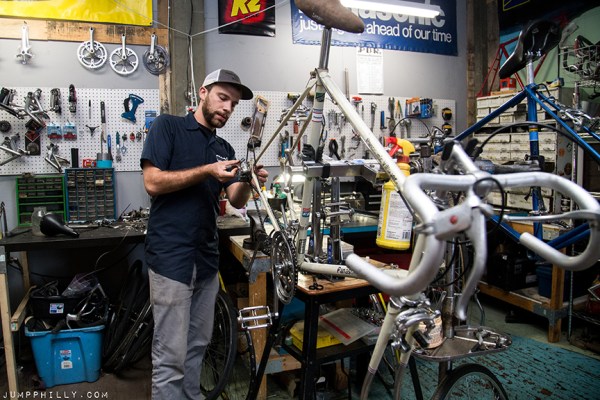
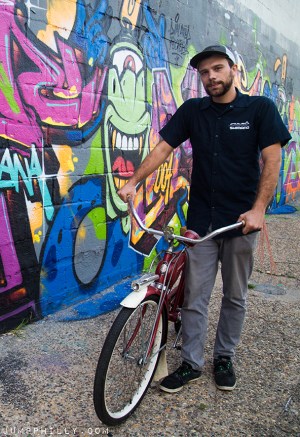
At center stage of this new way of thinking sits the Philadelphia Bike Rescue and its owner Dave Kazarov. The shop is gaining momentum as it emerges as an authentic voice in Philadelphia cycling and, as of recently, a strong supporter of the underground music scene.
 This small shop located in East Kensington’s Viking Mill building is the perfect place for a bike rescuer/music promoter to operate. The space that the shop occupies is as much a reflection of the ideology of the shop as of its business model.
To visit the space, you to have to take either an old freight elevator or an old set of wooden stairs to the third floor, all the while passing exposed brick, drywall and random artistic residue throughout the halls. Surrounding you on all sides are non-descript doors that house intellectuals and artists in residence. There is even a recording studio down the hall, hammering out new artists and ambient noises. In truth, the environment is quite electric. When you find your way into the shop, you confront a hand-picked collection of old bikes that hang from the ceilings, a beautiful sight for any bike enthusiast to behold.
Last summer, the shop made a splash in the music scene when it started its collaboration with local bands by hosting shows in an undisclosed warehouse down the road. The frequent shows were the result of a partnership with the recording label Magic Death Sounds. These events included bands such as Banned Books, Exar Kun, Tygerstrype and Son Step, among others.
“Dave just has a community-oriented mindset,” says Tony Montagnaro, co-founder of Magic Death Sounds. “I know for Dave, this is about fostering the incubation of community.”
This has been a fruitful partnership for the shop and Kazarov plans to continue to cross promote with more local bands, artists and of course local brewers, year round.
Unlike what some have critiqued as “exclusive” house shows, what is important to Kazarov is how the music engages the community as a whole and brings a diverse group of people together. When chatting about why music and community has been so important to his vision, Kazarov spoke directly to the scene in Kensington.
 “It’s different in Kensington compared to the other neighborhoods in the city,” Kazarov says. “It has been a mind-opening experience. I still have a place in my heart for say South Philly but what’s happening down there is what I would call dry gentrification, or a kind of soulless gentrification. It just seems hermetically sealed in that area. We are a little off the beaten path – maybe even a little more dangerous. It may be that it’s that feeling that attracts young people and artists who are more accepting of the existing community.”
What has emerged from his vision is apparent. Kazarov is redefining boundaries of what owning a bike shop means, while creating a soundtrack that speaks directly to the positive aspects of the scene building in Kensington as a whole.
One leaves the shop with an understanding that the bikes are not just used objects and events here are not just shows.
For Kazarov, they are two sides of an ideological move toward community building that stand against the stale hegemonic mainstream consumer culture.
Marietta: From the Basement to the Big Stage.
 Text by Jenny Kerrigan. Images by Jessica Flynn.
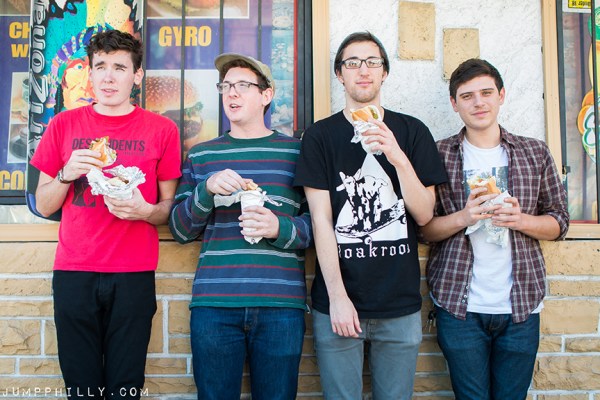
Despite the overcast weather and their killer hangovers, the members of local emo band Marietta remain cheery and upbeat while sitting beneath the mounted deer head hanging in the living room of frontman Evan Lescallette. The guys have been friends for a long time now. In fact, bassist Ben Johnson and drummer Andrew Weigel were bandmates before the formation of Marietta in their high school pop-punk band, The Putdown.
“We were pretty bad ass. Check us out on Bandcamp,” laughs Weigel in a jokingly cocky tone, followed by chorus of “Oh mans” from the rest of the group.
Marietta started as a three piece until Johnson came out to see Weigel’s new band with Lescallette and guitarist Ethan Willard, fell in love and “snuck his way in.” Now, they call Johnson “band dad” and swear he’s the one who keeps them on track. Like many Philly bands, they got their start in sweaty, packed basements that reek of old beer. Now, they’re playing larger venues with green rooms and free alcohol, alongside big-name bands like Braid and A Great Big Pile of Leaves.
“We had to actually think of what to say on stage,” jokes Johnson, referring to the most intimidating aspect of tour.
They all agree that it is definitely a different environment than playing house shows.
“There’s just a different mentality about the band,” says Lescallette. “If you’re watching a band on a stage you’re like, ‘This is the band.’ If you’re in a basement, you’re on the same level and you’re like, ‘Here’s that guys who’s going to be upstairs drinking a beer later.’”
Through these experiences, the band has made various connections within the Philly music scene. They recorded their first full-length album, Summer Death, partially in Michael Jordan House and partially in a place they call “Ron’s House.” Michael Crino of Soft Speak Records liked their album so much that he personally contacted them and asked if he could press it on vinyl. In October, they pressed Summer Death for a third time. Marietta is finishing up recording their new album at Sleepless Sounds Studio in Germantown. The album will be released early next year.
“Marietta wouldn’t be where we are today had we not started in Philly,” says Lescallette.
 Marietta records its music by tracking the individual instruments first and leaving the vocals for later, as opposed to recording live. They write the lyrics at the very end of the process and record vocal as the last step. Johnson and Weigel don’t know what their songs actually sound like until they’re mastered. When they listen to a new album, it’s almost like hearing new music to them too. It is a process where the bandmates joke that they are “Marietta’s biggest fans.”
Lescallette says he feels confident that the new record will reveal a more realized Marietta.
“I think we’ve really settled into our writing styles,” adds Willard.
The guys describe their new sound as more “party rock” and less progressive and “twinkly” than Summer Death. “I just hope we get big enough so that I don’t have to have a real job,” Lescallette jokes.
Marietta has come a long way in the last four years. They swear, despite Summer Death’s popularity, that they had no idea what they were doing in the beginning. Now, they’re planning a national tour, releasing a new album and settling into their individual styles.
“I just like playing music with these guys so if I could base my life around this band that’d be so awesome,” says Johnson. If it doesn’t work out however, the guys have a back up plan.
“We have a bunch of stand-up on Netflix,” Willard says with a shrug.
FTS: Five Terrible Scumbags.
 Interview by Elias Morris. Images by Michael Bucher.
Leading a never-faltering hardcore punk sound into the future are South Philly punk band FTS, which the band jokingly says can mean anything from “Financially Tight Situation” to “Five Terrible Scumbags.”
This powerful group of self-proclaimed social wastoids have been gaining praise from under the radar for three years now. FTS commands a loyal legion of super fans who regularly turn the mosh pit into a warzone within the first note of their set. Senior members Will “Scabiez” Moran (guitarist) and Zaya “Distraught” DeNut (vocalist) describe what it’s like being a part of the ever-changing Philadelphia punk scene.
What kind of themes do you touch upon in your lyrics?
Distraught: There’s a theme?
Scabiez: There’s a fuckin’ theme. The theme is misery. Lots of misery, but surviving through that misery and ways to have a different mindset. You just worked a shitty job, you walked home through shitty fuckin’ weather, you’ve got holes in your shoes and you’re fuckin’ freezing. I dunno. Fuckin’ life sucks.
Do you feel like you represent Philadelphia?
Scabiez: Absolutely. Philly has always had a lot of great punk rock bands in it and it’s never ever gotten acknowledged. So I feel like now is the time to really actually say, “We’re from Philly. Philly has a great fucking music scene.” That’s what we’re really trying to get out there.
Distraught: Philly has always had one of the hardest working scenes. It just sucks – there’s so many amazing bands that never made it past those first couple of tours from Philly and they just die off. Every year, you can go through a list of amazing bands who were around and alive and then just done.
Do you believe that there is a rift in Philly punk between the different scenes?
Distraught: There’s always been something between everyone in Philly because everyone likes different things and everyone always has a different thought. That’s also one of the cool things about Philly. You have so many different people with overlapping ideas. That’s one of the cool things, there’s always different ideas hitting each other. Without any kind of conflict, none of us could ever find a real way to grow.
Scabiez: Yeah, of course. But even with people that come here who aren’t from here, when they see the amount of things they can go to, they kind of realize, like, “Holy shit. I’ve just really dived into a city where, A). it’s already cheap to fuckin’ live here, and B). there’s so many great things happening in my fucking back yard.”
Do you see a younger group of kids coming in trying to change things?
Distraught: It’s cool, I’ve been around for a little over a decade now in the street punk/hardcore/DIY punk scene, and there’s always the different trends that come through. Like right now, you see a little more of the Oi and street punk coming through at the same time with D-beat style hitting really hard.
Scabiez: I’ve only been in the Philly scene for like what, four years? Five years? I got started up with Kryovax and shit and that’s how I got introduced into the whole entire Philly punk scene. I completely missed the Halfway House days. But there was still a huge street punk scene. Then I don’t know. From what I saw, things started getting not like, darker, just, like, more heavy. A lot of the bands started getting just more of a heavier sound. It was almost like they just had more anger and wanted to have more aggression in their music. Things got a lot more rougher, at least in South Philly. Things got a lot more intense.


The West Kensingtons: A Big Pool of Reggae Talent.
 Text by Jennifer Granato. Images by Jason Melcher.
Down a ramp into Bill McKinney’s cold garage in Kensington is what looks like a giant wall of black boxes, roughly eight feet tall, stacked on top of each other and open in the front. Upon closer inspection, they’re massive speakers.
This is The West Kensingtons’ sound system, something they’ve been driving all over the country to collect. The act of building a sound system grew out of reggae music from the Jamaican DIY scene. It gives anyone a way to share new music with the community.
“There isn’t a solid club scene for reggae in Philly” says McKinney, guitarist for The West Kensingtons. “Why should that stop us from doing what we do? We’ll just throw our own party! That’s how things get done, not being dependent on something being made for you.”
McKinney, back from the garage, sits on a couch in his living room and checks his phone for messages from the rest of the crew. He’s wearing a red T-shirt from the Stax Museum of American Soul Music. While waiting for other members to surface, he starts explaining The West Kensingtons.
“We consider our music to be in the reggae-soul world,” McKinney says. “We work with that moment in time when soul music was influencing reggae musicians. Reggae and soul were melding.”
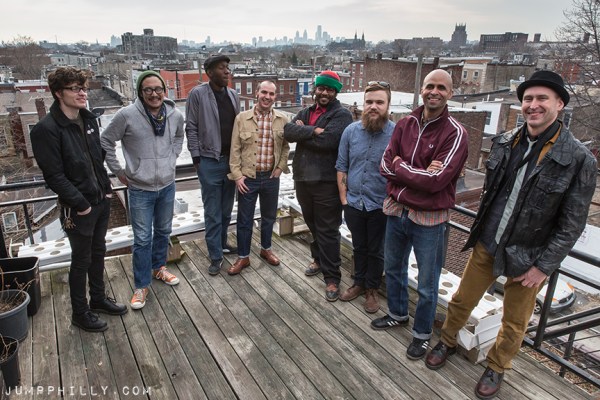
The West Kensingtons came together when three longtime friends, each accomplished musicians, found themselves living within a few blocks of each other in Philadelphia. The group then formed what they call the Reggae Club, a concept that stems from their love of music, desire to support the local reggae scene and showcase the talent within it.
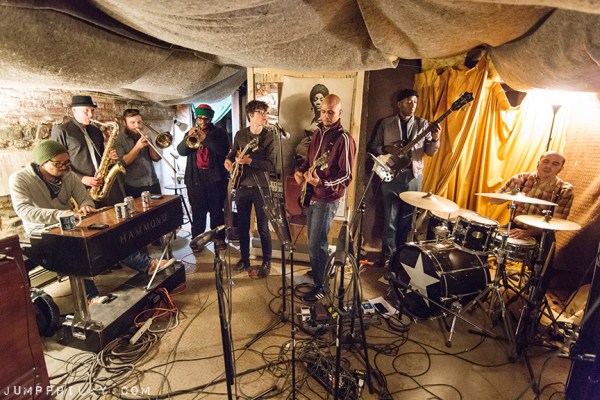 Organist for the band Sean Hur shows up, wearing ripped jeans and a long denim coat. He reaches for a box of Sweet Tarts on the coffee table and pops some in his mouth as he sits on the couch.
“We all come from different paths and different styles,” says Hur. “I played a lot of ska and punk in the ’90s.”
The members all bring pieces of their musical pasts with them to the group, some having spent time playing stoner and hardcore rock and others even producing hip-hop beats. In the present, they are united by their love of reggae and soul music.
“When we were getting started, we thought, ‘What if we lock ourselves in as a rhythm section and provide the foundation for other things to happen on top?’” McKinney recalls.
Originally consisting of McKinney, bassist Quincy Bright and drummer Michael McDermott, they quickly added Hur. Drummer Julio Apollo XII stepped in when McDermott left the group. In addition to the steady line-up, they also invite musicians into the Reggae Club and feature them on different tracks interchangeably. Members of the Reggae Club range from horn players to vocalists.
“It’s frustrating if you always have to write in one direction to work the strengths of the band,” McKinney explains. “But with a big pool to draw from, it allows us to showcase musicians’ strongest points. We can expand or contract as needed based on the music that’s being made.”
There’s a unique quality about their band in that they’re always considering what they can give back to the community.
“You have to build systems that allow people to work together while maintaining their own identity,” McKinney says. “This is the musical version of that. We want to use this as a vehicle to create other things. We might be the shittiest band in Philly in two years and that would be awesome because that’d mean that people created other things out of it.”
Father John Misty @ Union Transfer.
 Text by Kevin Stairiker. File photo by Grace Dickinson.
Philly loves Father John Misty, but it has strange ways of showing it.
Tickets for the bands’ April 1st show at Union Transfer sold out nearly two and a half months early. But when it came time for the show to start, the crowd simply could not help bringing to life every Philadelphia audience cliche. People yelling incoherently, ironically raising lighters and generally “Woo!”-ing the life out of place at times was not a good look by any means.
Misty, the erstwhile Josh Tillman, put up with more than a few boisterous drunk fans who wanted nothing more than to be a part of the show.
Regardless, Tillman and his fancy new six-piece band (multi-instrumentalists in black suit jackets, a far cry from the low-key look of the band at his first U.T. show) managed to rip through almost the entirety of their two-album catalogue. Father John Misty’s I Love You, Honeybear came out in February to nearly unanimous praise, so it was right that the audience was treated to every song but one. Tillman was his usual dancing, shamanistic self. Standing squarely at the corner of Jim Morrison and Sam Beam of Iron & Wine, Tillman had the audience in his hands from the moment he walked onstage.
The band’s donation to the April Fools’ Concert Jokes Foundation involved starting the concert with the title track from Honeybear and then bringing up the house lights and exiting the stage. They left for two or three minutes to the amusement of the crowd and then came back on to deliver the show.
Tillman later deadpanned that he wished he could have kept the joke going for “25 more minutes.”
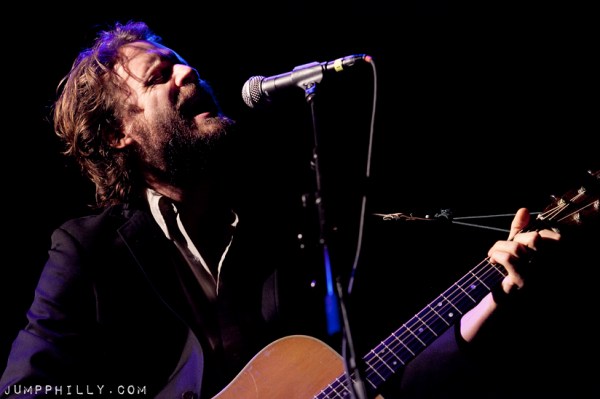 Unlike Tillman’s last show at Union Transfer (photo by Kate McCann), a solo-Misty affair which showed him workshopping the songs that would appear nearly two years later(!) in finished form, the banter was kept to a minimum to deliver the full impact. Performing 19 of his 23 total recorded works is a fairly ballsy statement to make, one that abolishes the notion of album tracks being any lesser to the songs that get featured in live form on late night talk shows.
Then again, it could be hubris.
But playing to both of those sides has been a constant feature of Tillman’s persona since the birth of Misty three years ago. He knows people would much prefer a multi-faceted conflicted performer than a straightforward bearded guy with an acoustic guitar singing about his woes.
So when Misty danced and gyrated in front of a neon heart sign that said “No Photography,” singing about true affection and every man needing a companion, the crowd was right there with him. And despite some drunken assholes yelling things out (some questions from the impromptu Q&A included “Are you my dad?” and “Snarky?”), it seemed to be at least partly out of a real appreciation for the craft and musicianship on display.
When the show ended (for real this time), the band left as the lights came up but Tillman stuck back to shake the hands of everyone in the first row. The bit of goodwill harkened back to the band’s first show at Union Transfer when Tillman stayed behind to hand back coats at coat check.
Father John Misty loves Philly despite our shortcomings and he made it known for sure on Wednesday night.
Broadzilla: “What the Hell Did We Get Ourselves Into?”
 Interview by Lissa Alicia. Images by Darragh Dandurand.
Broadzilla has been throwing down some of the most unique and body-rocking jams for nearly a decade. Thom Roland, Michael Kassler-Taub and James Weissinger started their DJ careers with humble beginnings – in illegal venues and not actually knowing how to DJ.
After spinning at a couple embarrassing gigs, the crew learned how to finesse both the turntables and partygoers. Broadzilla has now opened up for the likes of Horse Meat Disco, M.I.A. and Diplo. You can hear the amalgamation of funk, disco, pop and dance that is Broadzilla every month at The Dolphin Tavern.


How did you guys get your start DJing?
Kassler-Taub: I guess our first party was formally in 2006, so we are coming up on 10 years of doing this. It was four of us – James, Thom, myself and our friend Sarah [Jacoby]. We knew each other from college and things like that. We got a gig before any of us knew how to DJ. We basically told people that we were DJs and through a friend got a random night at this illegal venue at 12th and Walnut. It was like an upstairs venue that didn’t exist basically.
Roland: KT called me that night and I was like, “I gotta go buy some records.”
Weissinger: I borrowed all of mine.
When did you realize that DJing wasn’t as easy as just playing a few records?
Roland: The first night. The second song into the first night, we were thinking, “What the hell did we get ourselves into?”
Kassler-Taub: It’s probably worth noting that we were terrible DJs for the first five years. People who are our friends now would show up at this illegal venue and we could just see them pissed at us. “What the hell is going on? These kids are terrible. They are playing garbage records.” But back then we didn’t know. But we made friends. We consider ourselves very lucky.
Are any of you working on any side projects?
Weissinger: I am working on a new project. It’s called One Hundred Years Of Solid Dudes. I realized that everyone we know is a musician in one way or another. Some are active, some played the clarinet and stopped in 5th grade and have it somewhere up there in their head. So I thought it would be really fun to get them in a studio and make music and see what happens. I’ve been doing that for the past few years.
Who are some of your musical influences?
Roland: The dudes from London, Horse Meat Disco, they are definitely a big influence of ours. It was Optimo, 2ManyDJs initially, for sure. In the the later years, Horse Meat, mostly for the joy they bring. They have fun every time they play. They play the best disco that you never heard and it’s not like the same as [Donna Summer’s] “I Feel Love.”
Kassler-Taub: One thing that we see sometimes that drives us crazy is when DJs are not having fun. The Horse Meat dudes? If you are opening for them, they will come and dance through your set.
What does Broadzilla have in the works for 2015?
Kassler-Taub: I think we want to try some new things this year. Trying things that are not in a nightclub is definitely of interest to us. Especially since we are getting older and crotchetier, it’s sometimes a little harder to stay up that late. In the last year or two we have been very fortunate to have Brad “Zilla” [Kalinowski] help us out. Brad is our intern. We are going to think of some really cool stuff for him to do this year. We are thinking of having him DJ with us. Brad helps with some of the graphic design ideas. He had been doing a lot of guerilla marketing and facebook events.
Brad Zilla: I would love to. I need to practice though. Is that okay? I am at the level you guys were at 10 years ago.
Crash Bang Boom: The Last Punks on South Street.
 Interview by Elias Morris. Images by Chris Fascenelli.
Few people stick it out in the long run without succumbing to the pressures of “growing up” and abandoning your passions. Rob Windfelder is one of the few.
Windfelder is co-owner of Crash Bang Boom, where he began working when it was still called Zipperhead, a name immortalized in the song “Punk Rock Girl” by Philadelphia’s celebrated punk band, The Dead Milkmen. He is also the guitarists of local dark punk outfit Live Not On Evil, who have been gracing listeners with grit and gloom since 2000.
From behind his counter full of enough leather and metal to make Rob Halford squeal, Windfelder speaks of his reign as the South Street area’s single remaining punk liaison.
Give us a quick history of Zipperhead and Crash Bang Boom, if you know anything from before your employment until now.
The store opened originally in 1980 as Zipperhead on South Street. My business partner Stephanie Jolles (pictured above) and I had both worked there for quite some time. I was the general manager.
Then the original owner was looking to sell the business and it eventually got to the point where he was willing to sell to us if we could come up with the funding. So we had to jump through a million different hoops to finally get an SBA loan and purchased the place in 2000.
At that point, when our first five year lease was up, we moved around the corner here. Since it was a fresh start and something new and something that we were building for ourselves, we, at the same time, changed the name to Crash Bang Boom. It seems crazy but as of this summer, we’ve been at this location as Crash Bang Boom for 10 years already.
Do you know why the original owner quit or had you guys take over? How did you get hired?
He was more of an entrepreneur than somebody who was actually involved with the scene. It wasn’t where his passion was, so to speak. One of the main selling features to the job was that almost everybody else who worked at Zipperhead at the time were also in bands and understood it was like the “code of the West.” If you had a show and you were going to take off, someone was going to fill in – no matter how inconvenient it was – because it was going to come back at you someday.


Do you realize now that Crash Bang Boom is pretty much the sole punk distributor on South Street. Have you seen a steady decline of punk stores around here?
Yes, I do realize that. And yes there is a decline.
The face of South Street is always changing and as it stands now, that is based more on the economy and rents than anything else, just like with us moving to Fourth Street.
It seems like there’s still a lot of reasons to come to the South Street area and a lot of them are on the side streets and surrounding areas. There are so many great independent shops condensed in this area. But not a whole lot of them can afford to be on the main street. That has changed the face of things a little bit.
When did you decide to form Live Not On Evil? And what’s going on with the band currently?
Its inception started out as a concept that was a pact between two friends, Eric Bower and myself. It was my birthday and we were talking. Neither one of us was in a band at the time and we both had an idea of what we wanted to do and already had material, but it wasn’t the same band. We weren’t actually starting a band together. We were discussing starting two bands together, both playing a role in each other’s band until they both got off the ground.
So Live Not on Evil and Dead City Psychos were born on the same night, which is kind of neat. Eric was in the band for a few years for the first album and as things tightened up for him and for us… We’re still really close friends. We have a record out currently that we’re working on promoting. It’s our third full-length album.
Do you hope that Crash Bang Boom will remain running after you’re no longer able to run it?
It would be nice to see that. Stephanie and I don’t have any plans of bugging out of here. It’s something that we love doing and it’s a ‘so far ahead in the future’ type of plan that I haven’t even mulled over.
I guess someday, that time will come. Of course, anything that you’ve put so much work into, you hope will live on and not just vanish. But sometimes, you know… no one knows what the future holds. As far as the place is concerned, Steph and I are adamant about doing what we need to do to keep this an important part of the Philadelphia scene.
WIN FREE TICKETS! See Kodaline @ The TLA on 4/21.
Irish rockers Kodaline were supposed to play Philly last November but they had to cancel their tour after their bass player broke his wrist. They will make up the date on April 21st, performing at the TLA.
And we are giving away tickets … PLUS one person (and a friend) will be able to arrive prior to the show and meet the band.
If you want a pair of tickets and meet the band, like us on facebook and email us at FreeJumpStuff@gmail.com (give us your name and put “Kodaline” in the subject line).
Creem Circus @ Bourbon & Branch.
 Text and images by Mina Lee.
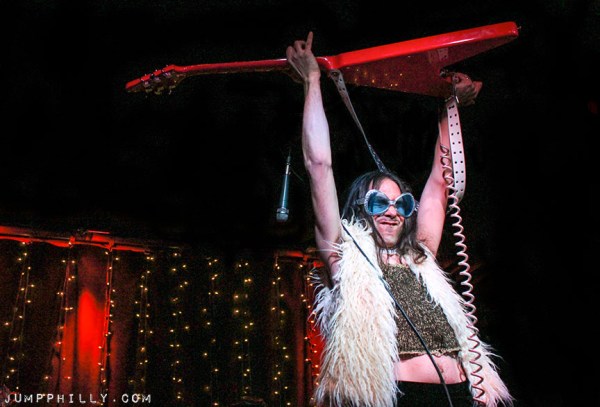
On Friday, throwback 70s glam rockers Creem Circus celebrated the release of their new album “Rock and/or Roll” with a show for fans at Bourbon & Branch.
Donning clothing tighter and more provocative than the women in their audience, the band created a seemingly unified body of gyrating motions and spirited voices.
Lead guitarist and vocalist, Chris Th’Pinto of DiPinto Guitars, oozed energy and just the right amount of edgy promiscuity. Straddling their instruments in sky high platforms and bared midriffs, Th’Pinto egged on the fans, asking, “What do they say when Creem Circus leaves the room?”
One fan responded, “Why am I so sticky?”
The statement rang true, as sweat filled the venue’s air with thick humidity, and bodies danced on to rapid riffs and raucous vocals.


 JUMP: The Philly Music Project