ODESZA @ Union Transfer.
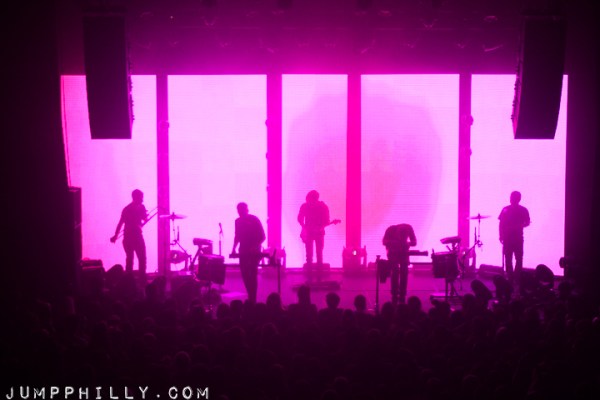 Text and images by Holli Stephens.
ODESZA took over Union Transfer’s stage Wednesday evening, selling out two back-to-back shows at 8pm and 11pm.
Philly producer Louis Futon (Tyler Minford) kicked off the late night show on a loud note. Minford’s sound was a mixture of some of his key influences, like Cashmere Cat, Ta-Ku and Mr. Carmack. That satisfying blend on top of some popular trap-like sounds was both awakening and enticing. The crowd was pretty sparse at this point but nonetheless was feeling the groove. ROZES, also a native, accompanied Minford on his last couple of songs.
The intermission periods between each performance was quite short. As quickly as Louis Futon left the stage, Jai Wolf (Sajeeb Saha) appeared before the smokescreen-coated darkness. The NYC producer piggybacked off Minford’s energy. Union Transfer’s balcony section provided quite a view of the spectacle during a remix of Drake’s “Hotline Bling.” It was one of those one-of-a-kind moments when everyone in the crowd just lost it through dance. Jai Wolf also remixed a Purity Ring song before closing out with his most popular song, “Indian Summer.”


As Wednesday turned into Thursday, the stage crew started getting things set up for ODESZA. A slew of glovers entertained whoever would stop to watch as more young people wearing elephant pants and animal spirit hoodies appeared in the crowd.
ODESZA told the crowd that they had just got back from the desert and how awesome it was to be playing two shows in Philly. The Seattle duo, consisting of Harrison Mills and Clayton Knight, had a mirrored instrument set up of a controller and some drum equipment. A massive 5-panel visualizer rested behind them, as did as back-up trumpet, guitar and trombone players.
The set consisted entirely of crowd favorites, like their remix of Hayden James’ “Something About You” and a remix of ZHU’s “Faded.” The visualizer presented everything from experimental narratives of sepia-toned lovers to crazy colored patterns that danced across the screen.
ODESZA’s encore featured a very bass-heavy song as Godzilla knocked down buildings on the visualzer panels. The crowd was still dancing at 2am as the house lights turned back on.
Max Swan: Beyond The Sexy Sax Guy.
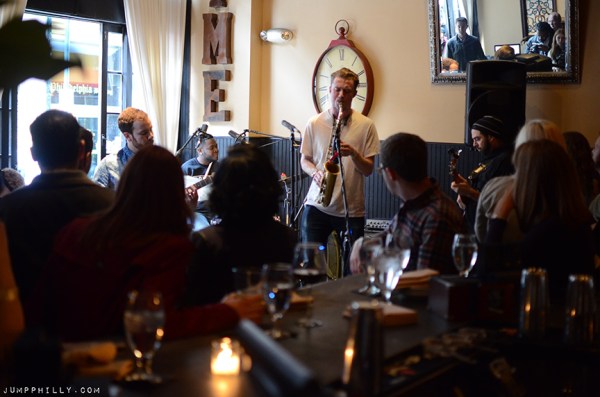 Text by Kyle Bagenstose. Show images by G.W. Miller III. Portraits by Samantha Moss.
It’s a late Thursday night and Max Swan is feeling it in mSOUNd Recording Studios, tucked above Adventurers Indoor Mini Golf in a converted warehouse behind IKEA on Columbus Boulevard.
The 26-year-old Manayunk resident is watching drummer Lionel Forrester through the control room glass. The song they’re working on, like the rest of Swan’s soon-to-be-released album, For Thought of Others, is nearly complete. It’s 99 percent done. What they’re working on is the gravy.
Forrester comes in a little early on one take, and looks to Swan for some direction. Swan asks studio co-owner and stand-in engineer Domenic Prizivalli to press the button that beams his voice through to Forrester.
“Just play man,” Swan says, encouragingly.
Forrester opens up on the next take with extra oomph on the kicks and flourishing fills made up on the spot. One crescendo brings a huge smile to Swan’s face. Swan then raises his hands triumphantly, nodding to Forrester through the glass.
The whole process is an accumulation of the skills Swan has picked up since his graduation from the University of the Arts four years ago. A prodigal saxophone player since the age of 9, Swan has toured with the jazz-funk Dirk Quinn Band and made inroads into the city’s hip-hop scene, doing musical production for artists like Kuf Knotz.
“This album is a time when I feel I’m coming into my own as an artist,” Swan says. “I’m singing, producing, writing, playing instruments.”
Swan’s challenge is in getting the science right. He’s passionate about the saxophone and writing thoroughly composed music, bucking the verse-bridge-chorus-repeat formula most popular music follows in favor of longer pieces with multiple movements. But he realizes neither really fit into what’s popular these days.
“The whole effort of my career so far is bringing the saxophone back to a seriously effective thing that people enjoy,” Swan says. “Not to dispel the ‘sexy sax guy’ idea but because of things like that, it’s a challenge to create a legitimate chunk of music that people can take seriously.”
But Swan has seen encouraging signs. He says assumptions about the saxophone and nine-minute songs usually fade away in front of live audiences. And he’s discovered that vocals – at which Swan proves more than capable – help to make the connection.
“I’m not fixated on making the saxophone a popular thing again,” Swan says. “I’m fixated on making it part of my music. Whether it’s the secret weapon or fixture of the show, it’s going to be there. And I’ve learned that singing really plays a huge part in people’s approval of the material. When they hear lyrics on one tune, they’ll listen to a 15-minute instrumental shred.”
Josh Nussbaum, who is playing guitar for the album’s recording and has known Swan since the two met at UArts about six years ago, says that the challenge of making the music work is what draws him to the effort.
“When I first met Max, I really liked his saxophone playing,” Nussbaum says. “That’s really what made me want to play with him. There weren’t a lot of people taking risks with instruments like saxophone and trumpet. Most jazz school people are into old school bebop.”


That’s not to say Swan can’t play the old ways. In the past year, he’s played at both the Center City Jazz Festival and Welcome America! festival. Swan credits a long line of influential teachers for his prowess on the instrument, including John Thompson of PhillyBloco and Lenny Pickett, the band director of “Saturday Night Live,” whose signature sax opens up each show. Normally unreachable, Swan says he had to use a bit of misdirection to reach Pickett.
“I had been trying to get in touch with him for the longest time. He was the white whale,” Swan says, remembering the time he faked a call to NYU, where Pickett teaches, and received an email address after claiming to have lost it. “I hit him up and he responded, like, right away. I could not believe it.”
Now, Swan drives to New York once a year for private lessons from Pickett, whom he says is a zen master of the sax.
“I go study with him and there’s like eight months worth of personal development I have to do before going back,” Swan says.
Perhaps Pickett sees something in Swan, or at least those like him. In order to keep the saxophone relevant to the mainstream, it’s going to take such artists who can successfully interweave the instrument into music that includes elements of hip-hop, soul and rock. Swan, for one, is looking forward to dropping the album in November and seeing how listeners respond to the accumulation of his skills so far.
“I’m really excited about it,” Swan says. “I definitely have way more personal confidence when asking myself, ‘Did I do my job on it? Did I meet the aspirations I wanted?'”
Driftwood Soldier: Under Construction.
 Text by Dave Miniaci. Images by Mina Lee.
The floorboards creak with each step. Plastic tarp covers certain walls. There are boxes and tools strewn around.
Owen Lyman-Schmidt sits back in his chair, sips iced coffee and chuckles about the state of his West Philly house.
“I liked the idea of doing all the renovations myself,” he says.
The house is coming together nicely for the Driftwood Soldier singer but is still very much a work in progress.
And the same could be said of the band itself.
Born out of the desire to write more music and play as a band rather than solo, Driftwood Soldier was formed when Lyman-Schmidt, originally from D.C., met bassist Bobby Szafranski at a party in Philly. Lyman-Schmidt was traveling and playing solo as Owen and His Checkered Past and Szafranski had been playing in the band Mountjoy.
But each wanted more and that’s when they met. It’s been a process.
“As a band, we’re growing, for sure, in a live setting,” Szafranski says. “I don’t know whether it’s we’re getting more comfortable with each other or just playing songs faster than we intended.”
From the start, the duo did everything themselves. They both believe strongly in the DIY culture.
Their debut album, Scavenger’s Joy, was recorded fairly quickly and the band’s record release party, true to their nature, took place in a warehouse that Szafranski helped renovate with a friend.
“The DIY is for us an aesthetic choice and also about staying in control of your music and keeping the music for people making music,” Lyman-Schmidt says.
The band’s sound – a mix of blues, jazz and alt-country – comes off as a good workingman series of songs, featuring Lyman-Schmidt’s deep, whiskey-soaked voice.
Lyman-Schmidt’s instrument of choice, the mandolin, is of course self-taught.
The band utilizes interesting foot percussion during shows, creating their own take on bass drums by using items including a suitcase and bottle caps.
And with that passion, the band hopes to help the Philly DIY music scene with the old warehouse they helped convert. The 7th and Thompson venue, Bond Villain, was created with the idea that it could bridge the gap for bands to perform to an intimate and interested crowd while still maintaining their artistic sensibilities, something that isn’t always guaranteed at a larger venue.
 Logan Welde owns the space. He recruited Szafranski to help renovate it. They gutted the first floor and built a stage. The first show was a Driftwood Soldier show and it went better than expected.
“I actually was expecting like 20 or 30 people and we had over 100,” says Welde. “It was incredible. It was freezing cold, too. It was February and there is no heat in the building, so people were wearing coats. But everyone was dancing and having fun.”
It was that show that made Welde realize the full potential of the space and continue to book shows as Bond Villain, a space where artists can roam free and keep all the profits.
“They do everything, down to making their own shirts,” Welde says, praising Driftwood Soldier for their part in the DIY scene.
There are spaces that really put love into their sound and have great sound crews to work with the musicians. But acoustics aren’t the only ingredient for a good show at Bond Villain. It isn’t even the bottom dollar. It’s having a fun and memorable show.
“We let the musicians have a good place to play and they can bring their friends and they can make money without having to pay the venue,” Szafranski says.
“It’s all part of giving back to a community of people who make it possible for folks who don’t have a flashy website but are playing good music and can play a show for the first time,” Lyman-Schmidt adds.
He goes on to point out that word-of-mouth publicity is still a valuable commodity in the scene, referring to a point in time when certain venues were known just for being a place to hear good music.
“We’ve encountered that on the road, where it’s this place that people from three counties comes out on a Friday just to see whoever is playing that night,” says Lyman-Schmidt. “And if it’s us, we appreciate the hell out of that.”
While they say they have enough material to record another album, the duo wants to take it slow and continue to refine Driftwood Soldier’s sound.
And for a man who started out on the road, it sounds like Lyman-Schmidt has found his home.
“I love Philly,” Lyman-Schmidt says, motioning to the home-renovation surroundings. “As you can see, I plan on staying for awhile.”
“Unless the roof collapses on us,” jokes Szafranski.
 Text by Sami Rahman. Images by Rick Kauffman.
Cold Fronts turned Johnny Brenda’s into a crowd-surfing party on Friday for the release of their album Forever Whatever.
Nashville band Chrome Pony was the first opener, serving up some swaggering rock and roll. Vocalist Tyler Davis sneered his way through the set with attitude and energy. But it wasn’t until the second opener, Heyrocco, took the stage that things really started to liven up.
Wearing a black T-shirt with a “FUCK YOU” emblazoned across the back, singer Nate Merli thundered his way through the set. It was hard to tell if it was him or powerhouse drummer Tanner Cooper who powered the band’s grungy sound more. After the second song, the singer threw down his guitar and ripped off his shirt as Cooper pounded away behind him.
“I just wish it could have been louder,” Merli said after the show.
Near the end of the set, members of Cold Fronts rushed the stage to bash the cymbals. After a suitably crashing finale, the band finished, and fans began to crowd the stage in anticipation of Cold Fronts.
Taking the stage amid cheers, Cold Fronts opened with “Jackie,” calling out Philly in the first verse. Singer and guitarist Craig Almquist lost his hat and proceeded to whip his hair around while kids with their arms around each other in the front row sung along to every word.
“I just wanna feel the love,” Almquist said, ushering the audience forward in between songs.
The enthusiasm from the band’s hometown crowd was undeniable. It was Cold Fronts’ first Philly show since early September, after which they band went on a 15-stop tour across the Midwest and down South.
As the crowd’s energy peaked, the stage diving began. Cooper, the drummer of Heyrocco, climbed up to the balcony and Almquist took his own turn crowdsurfing.
On that energetic high, the band left the stage, leaving behind a satisfied crowd.
After the show, Almquist smoked a cigarette, his eyes wide with excitement.
“It was probably the most fun show we’ve played in Philadelphia,” he said.
After a long tour, you’d think the singer would be exhausted. But he was still amped up, even after the show.
“The tour was great,” said Almquist. “But I wish we had more shows.”


The Pretty Greens: Greens to The Front.
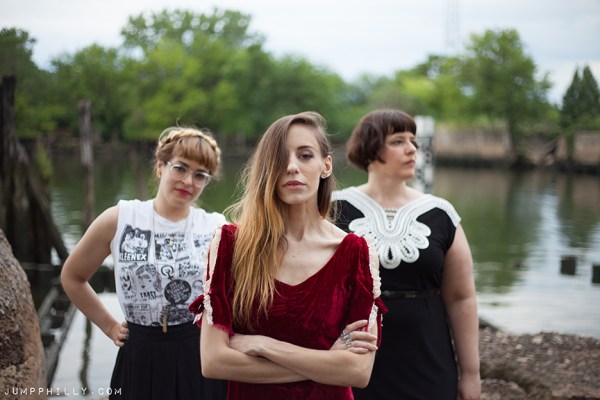 Text by Emily Scott. Images by Rosie Simmons.
Julia Green wears a gold-painted ring that reads “Coffee,” which fits well in the setting of Grindcore House coffee shop in South Philly. She also wears a Wacky Wacko brand graphic T-shirt that pays tribute to women of punk, like Kleenex and Bratmobile.
She and Carly Green, along with guitarist Kool Schmool (all go by stage names), make up The Pretty Greens – a punk trio with a message of equality and social justice.
Carly, who works as an IT technician by day, was a radio DJ for more than 15 years in Ontario, where she grew up. She booked shows in her spare time and became involved in the punk and Riot Grrrl scenes of the ’90s while in her teens.
She moved to Philadelphia in 2005 and met Julia at a non-profit organization where they worked.
Carly lent Julia the book Girls to the Front by Sara Marcus, which fostered her interest in the feminist and social justice scenes.
“I came to the punk/feminist/social justice scenes so much later,” says Julia Green. “I am really happy I found it when I did because I needed it.”
The duo released their first EP, Ghost World, in August 2013, featuring just drum and bass.
Soon after, Carly and Julia met Kool Schmool, whose name derived from a Bratmobile track, when they played as a duo at the Nut Hut Saloon in Fishtown. Kool, a guitar player, joined the band and learned all of their songs in a month.
The Pretty Greens work closely with Pussy Division, a feminist activist group in Philly that raises awareness of political issues geared toward LGBTQ rights and gender equality.
Kool notes that the track “Elevator Eyes,” off their latest EP, Lonely Hearts Club, stems from being tired of dealing with harassment every time she walks out the door.
“This specifically happened,” Kool says. “I just woke up, got my shit together, left and literally opened the door to leave and was harassed on my stoop, the corner and the bus stop.”
Their music is an outlet to raise awareness of topics that otherwise wouldn’t be discussed, she adds.
“You look out into the crowd and see that people are relating and appreciative of that because people aren’t really doing that kind of stuff around here,” Kool says.


The Pretty Greens signed to Raleigh, North Carolina-based Negative Fun Records in early 2015 and released Lonely Hearts Club on cassette through the label in February.
With the band’s vintage sound, the opportunity to put their music on tapes feels much like creating a collectible item.
“There is something sweetly nostalgic about it and the image of someone hitting play that old school way,” Julia says. “It’s a really intimate relationship with our music.”
The trio also has their own zine, “The Pretty Signals,” of which they’ve produced three issues over the last three years.
Kool and Carly complement each other by adding their own interests to the zine. The guitarist contributes fashion aspects, while the drummer interviews local bands.
“The last issue was about what makes you strong and what makes you vulnerable in your community,” Carly says.
The Pretty Greens performed at the March to End Rape Culture in October. Carly Green organized Treat Y’rself Fest, which took place in August at PhilaMOCA, to raise money for the march. The festival included locals like Kississippi and Ghost Gum on the line-up.
“It was mostly about fostering a community and having us work with other groups that we wanted to work with,” Carly says.
The Pretty Greens hope to release a seven-inch and embark on another tour in the near future, while continuing their activism.
“In Philly, I just like that there is lots of opportunity to play different places and do it in a way that you can keep separate parts of yourself,” Julia says.
Spice House Sound: The Gear Whisperer(s).
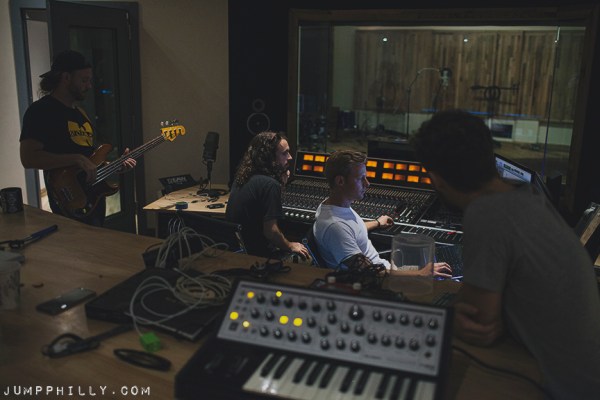 Text by Lissa Alicia. Images by Chris Fascenelli.
Fishtown’s Spice House Sound is quickly becoming a go-to recording studio for rising indie acts from Philly. Much of this is due in part to the genius of managing partner Alex Santilli, who has dedicated much of his life to creating the perfect sound. This sound can be found throughout Spice House Sound thanks to the meticulous design and engineering which Santilli had his hand in from the very beginning.
Spice House Sound was originally located in the basement of a South Philly spice warehouse, the place Santilli got his start by fixing equipment and later engineering recording sessions. Not long after, Santilli became the lead engineer. During the stint in South Philly, Santilli got word that the operation had to vacate the space being rented.
“We got kicked out of our building, essentially,” he says. “The building got sold and we didn’t know it. It was an interesting adventure.”
They were originally told that they would have a month to vacate the premise but Santilli says they ended up having six months of transitory time to find a new space.


After that six months of looking around, Santilli and the Spice House Sound family found the Fishtown space that they now call home. From the very beginning, Santili was deeply involved in the renovation, alongside partners the Walters-Storyk Design Group, of the one-time carriage house into the state-of-the-art recording studio it is now, even down to the architectural design.
“I tried to design an acoustical system based on the mathematical principle phi … it’s an infinite number and it goes on forever,” he says. “It’s in all living things. It’s in acoustics. It’s in everything. It’s in the space between this bone and this bone. It’s mathematical but it’s also kind of mystical and people attach all sorts of interesting things to it. I approached it from an acoustic and mathematical standpoint. I made every measurement that I possibly could based that ratio.”
Santilli is a self-proclaimed gear nerd. People like John Storyk, who partnered with Santilli on the design of the studio, call him the “gear whisperer.” From a young age, Santilli has dedicated much of his time to understanding the dynamics of sound, occupying himself by taking apart audio consoles, tape machines and other sound equipment. These skills have developed so much over the years that Santilli is able to take pieces of old equipment, then retrofit and redesign them with modern high-quality parts to create something new – and better sounding than anything you could buy. The access to old equipment in the studio is complemented by the capability for artists to record full analog, full digital or any hybrid in between.
“The level of commitment to audio – and great audio – is what separates it from everywhere else,” says Dave Pettit, a Spice House Sound producer.
“What we are doing here is breeding the next generation – so another two or three years and who we’re working with are going to start replacing who is out now,” says Santilli. “We will start building our reputation from the ground up just like we did with the studio.”
For the year and change that Spice House Sound has been in operation in Fishtown, Santilli and crew have been working with such up-and-comers as Flyermile and The Binary Sea, and are currently in production with prominent locals including Cape Wrath, Among Criminals and Vita and the Woolf. Santilli says that the laid-back atmosphere that is maintained at the studio makes the artists feel as if they are in a stress-free environment.
“The most important thing is that we have so many happy clients and that we really care,” Santilli says. “It’s fun. People describe studio sessions as tortuous sometimes. People have a bad time, and they are scared by it and don’t want to go back to studios. A lot of those people who are unhappy come here because I’m a friendly, nice guy and they are so surprised that they have a ton of fun while they are recording. It’s a painless process and we get great results way quicker.”
Mr. Sampson and Congo Sanchez @ Silk City.
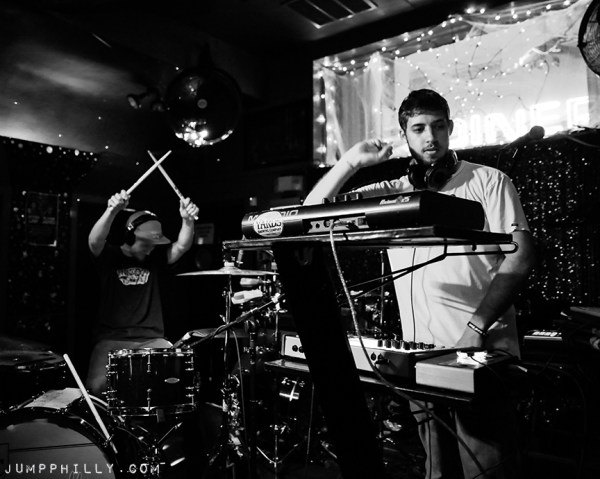 Text and images by Magdalena Papaioannou.
Mr. Sampson and Congo Sanchez rocked Silk City last Wednesday.
Aurize opened the night with some electronic tunes but the real show didn’t start until Mr. Sampson took the stage. The crowd that had been gathered at the bar ran to the dance floor when Mr. Sampson began to play.
Many in attendance were college students from Drexel University, where Mr. Sampson began. Aaron Harel beat the drums as Joe Haederle played soulful samples and funky beats. Together, they created a new groovy sound that crossed funk and EDM.
Mr. Sampson recently opened for Griz and Break Science at The Fillmore.
Congo Sanchez joined Mr. Sampson at the end of their set. Flex, the rapper from Congo Sanchez, was incredibly energetic, jumping on the stage as his partner, Haile, sang beautiful reggae melodies.


The Underachievers @ Voltage Lounge with Bodega Bamz, Kirk Knight, Pouya & the Buffet Boys.
 Text by Lissa Alicia. Images by Evan Kaucher.
On Monday, The Underachievers performed at Voltage Lounge for the Philly leg of The Forevermore Express tour. The line up included rappers who have built their buzz in the streets – Bodega Bamz, Kirk Knight, Pouya & the Buffet Boys – and, of course, The Underachievers.
Bodega Bamz and squad took to the stage first with perhaps the most lively performance of the evening – attendees were thrashing in the mosh pit not even five minutes into the show thanks to songs from Bamz’s recently released Sidewalk Exec. Bodega Bamz broke up the sounds of the fiery snares common to trap, with a Bachata music break. Bamz, who is clearly proud of his Puerto Rican heritage, cleared the stage of the for a few seconds and didn’t come back out to perform his final song, until full-sized Puerto Rican and Dominican flags were waving regally into the crowd.
Next to the stage was Kirk Knight of Pro Era. His youthful, unjaded attitude gave a slightly wholesome air to the show. Knight performed tracks from his recently released album, Late Night Special, making a reflective choice when he rapped “Heaven Is For Real.” After finishing the song, Knight requested a moment of silence for his fallen camp member Capital Steez who committed suicide in 2012. The audience gladly obliged – not a sound could be heard in all of Voltage Lounge.


Pouya and the Buffet Boys were next to the stage with a refreshingly odd performance. Pouya, who slightly resembles Philly Jesus, and Fat Nick with his freeform dreadlocks, delivered their unique style of suburban Miami trap rap to energized fans. Trap is such a unique genre – It has the ability to blend music, that at first thought, would be considered polar opposites. At one point in their snare laden set, the Buffet Boys switched gears and sang along to “Let The Bodies Hit The Floor” by Drowning Pool. The crowd instantly went insane – it is safe to assume that a few bodies hit the floor in the mosh pit that encompassed most of the viewing area.
Pouya performed hit track “Energy” where he boasted, “I got a whip now, I got a whip now, I got a whip now, I got a bitch now, I got a bitch now, I got a bitch now.”
Clearly some pretty spectacular accomplishments.
Although the opening acts left the stage absolutely lit, with very little time in between sets, The Underachievers decided to build anticipation with more than a 15 minute pause before they hopped on stage. The duo performed tracks off of their latest album, Evermore such as “Generation Z” and “Star Signs.” The audience was very forgiving of the wait that they endured – their fans couldn’t have possible showed more love. Unlike the opener, The Underachievers low energy set was possibly due to the fact that the show, which was originally supposed to take place at the TLA was moved to a cozier Voltage Lounge.
Overall the show was a great smorgasbord of relevant up and coming artists who are making their mark. The audience was constantly turnt, and most left a big sweaty mess covered in mosh pit bruises.


 Text and images by Erin Marhefka.
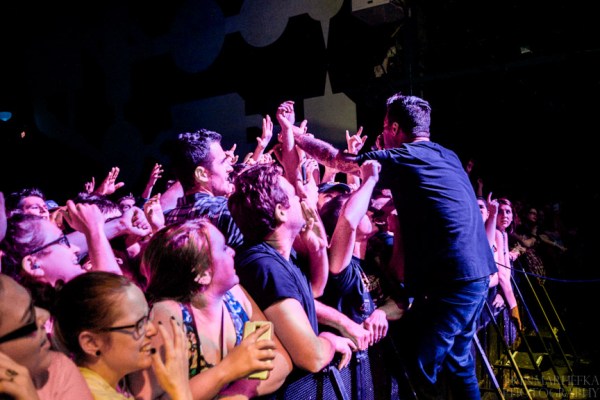
Legends of pop punk Yellowcard and New Found Glory took the sold out Electric Factory’s stage last Friday alongside Tigers Jaw for a night of immense nostalgia. . The show was around the same time of both of the bands one year anniversaries of their newest albums. Yellowcard celebrated Lift A Sail and New Found Glory commemorated Resurrection: Ascension.
Scranton based Tigers Jaw opened up the show with their sweeping, melancholy sound, letting the crowd vibe just a little bit before things got crazy. Comprised of members Brianna Collins and Ben Walsh, the small band took the stage and captivated the crowd with their unusual sound.
With a simple black backdrop with the word YELLOWCARD in illuminated white letters, Yellowcard opened with “Breathing,” off of their 2003 album Ocean Avenue. Frontman Ryan Key repeatedly told the crowd, “It’s very important to lose your voice before you go home tonight.”
Frankly, that wasn’t a problem for the crowd as the entire room erupted, singing along with him on every song. The most unusual aspect of this band would be Sean Mackin, the violinist of the group. His energy is everywhere, as he is constantly moving, constantly engaging the crowd and constantly jumping off things while still playing the violin beautifully. The band played hits such as “Way Away,” “Only One” and, of course, “Ocean Avenue.”
New Found Glory came out to close the show. They opened up with “Understatement,” off of their fourth studio album Sticks and Stones. They roamed the stage, jumping and running around as they jammed. Their silly demeanor showed how much of veterans they are to the scene.
Guitarist Chad Gilbert strummed his guitar with a Converse shoe that was thrown onto the stage. Gilbert also climbed onto Jordan Pundik’s shoulder and began to play from there. Pundik grabbed a shirt that was thrown up to him and put it on as some sort of skirt/diaper combination and left it on far longer than anyone would have thought.
Inspired by the T-shirt, someone threw a bra on stage as well and Pundik also put that on.
Despite the silly atmosphere, Gilbert pointed out a fight going on in the crowd. Needless to say, the band was not pleased and immediately called them out. As the crowd got together for a good old-fashioned “asshole” chant, security escorted the disrupters out. This prompted Pundik to give a little speech about fighting.
“This is supposed to be fun,” he said. “It’s not a fighting environment. Violence is never okay.”
The vibe was fixed after playing a few songs. Tigers Jaw keyboardist Brianna Collins joined them on stage for “Vicious Love,” a duet originally performed with Paramore frontwoman Hayley Williams.
At the close of the show, A young fan by the name of Delaney joined the band for their final song, “My Friends Over You.”


Nero @ The Electric Factory.
 Text by Jennifer Granato. Images by Dana Ricci.
Nero’s appearance on stage Saturday night at the Electric Factory was much like their music – a big build up until something dramatic finally happens. At the start of their set, the group teased the audience for a while with blacked out projections of the band flashing onto their sound booth and loud beats to match, before at last appearing on stage to perform a lengthy and exciting set.
The Grammy Award winning British group is made up of three musicians – producers Dan Stephens and Joe Ray and vocalist Alana Watson.
The trio performed a range of new tracks from their latest album, Between II Worlds, and older, crowd favorite tracks such as their hit song “Promises.” To the audience’s obvious delight, they even included the popular Skrillex remix of the track in their set.
Watson’s voice sounded so clear and striking that it was difficult to believe the voice was real and coming out the tiny blonde girl on stage. She provided vocals to Stephens and Ray for about half the set on and off, singing and dancing around the stage in cool black and white outfits.
The rest of the set was made up of Stephens and Ray twisting and dropping beats. They traveled through several styles of electronic music, ranging from their dubstep roots to drum & bass and house tracks.
Their almost castle-like set had patterns and colors projected onto it all night, from blinding, flashing white lights that silhouetted the group, to projections making the entire structure look like a retro sound system, a wall of speakers and cassette tapes.
Before Nero, London-based producer Redlight entertained the crowd with tropical house beats. The night began with local producer Evan Riley.


 JUMP: The Philly Music Project